A good VoIP phone system for a small business is basically a modern, internet-powered communication setup. It gives you all the professional features you need—like call routing, voicemail sent to your email, and calls on your mobile—while often saving you up to 40% compared to an old-school landline. It's a flexible, budget-friendly upgrade that helps Aussie businesses stay connected and sound professional, whether you're in the office or out and about.
Is Your Old Phone System Holding You Back?
Let’s talk about Dave. He runs a buzzing café on the Central Coast, and his mornings are pure, organised chaos. Between slinging flat whites and managing his team, he’s constantly on the phone with suppliers down in Sydney. The problem? His ancient landline system, a relic from another decade, has a terrible habit of dropping calls right as he’s confirming a crucial delivery. One dropped call means no almond milk, and that means unhappy customers. Dave's phone isn't just an annoyance; it's costing him business and sanity.
Does that hit a bit close to home? So many small business owners from Gosford to Newcastle are stuck wrestling with clunky, expensive, and unreliable phone systems. You're paying a fortune for a service that feels like it’s held together with duct tape and hope. It’s inflexible, chains you to a desk, and doesn't have any of the smart features customers expect these days.
So, What Exactly Is a VoIP Phone System?
Let's clear the air—VoIP isn't some scary, complicated tech reserved for the big end of town.
In simple terms, VoIP (Voice over Internet Protocol) is just a way of making phone calls over your internet connection instead of a traditional copper phone line. Think of it like this: if a regular phone call is like posting a letter, a VoIP call is like sending an email. It just uses the same digital highway your business is already on.
This simple switch from analogue to digital opens up a whole new world. Suddenly, it’s not just about making and receiving calls. It’s about building a communications hub that actually works for your business, not against it.
Why It Matters for Your Business
Switching to a VoIP phone system for your small business is about more than just clearer calls. It's a smart move to set your business up for the future. You get the power to:
- Work from anywhere: Your business number can go with you on your mobile. Take calls whether you're working from home, in your ute on the M1, or on-site with a client.
- Present a professional image: Features like an auto-attendant ("Press 1 for sales…") make your small operation sound like a well-oiled machine.
- Boost security and reliability: Modern VoIP systems are secure and often more reliable than ageing copper lines, especially when you have a solid NBN connection. Speaking of security, it's just as important to protect your physical premises as it is your communications. You can learn more about safeguarding your business in our guide to security and CCTV solutions.
At the end of the day, it’s about ditching the headaches of an outdated system for a smarter, more efficient way to connect with customers and suppliers. Just like Dave, you can stop fighting with your phone and get back to what you do best—running your business.
What Are the Real-World Benefits of Switching to VoIP?
So, we've covered that VoIP is clever tech that sends calls over your internet connection. But let's cut to the chase—what does that actually mean for your business's bottom line and your daily grind? This is where it gets good. Let's break down the real-world advantages that businesses from Newcastle to Sydney are raving about.

Slash Your Eye-Watering Phone Bills
First up, the big one: cost. Traditional phone lines feel like a financial ball and chain, with their constant line rental fees, expensive hardware, and per-minute call rates. It all adds up. In fact, small businesses often see their communication costs drop by up to 40% after moving to a VoIP system.
Think of it like this: a traditional phone system is like having a private road built just for your voice. It's expensive to maintain, and you pay for it whether you use it much or not. A VoIP phone system for a small business, on the other hand, is like carpooling on the NBN highway you're already paying for. By bundling your voice and data together, you get rid of redundant costs and just pay a simple, predictable monthly fee for each person.
Unbeatable Flexibility and Mobility
Remember being chained to your desk, waiting for that important call? VoIP completely smashes that old-school way of working. Your business number is no longer physically tied to a line in the wall. Instead, it lives in the cloud and can follow you absolutely anywhere.
This kind of freedom is a total game-changer for Aussie business owners. Just picture it:
- A tradie on the Central Coast can answer a call from a client in Hornsby on his business number, all while he’s stuck in traffic on the M1.
- A consultant in Newcastle can seamlessly flick a call from her desk phone to her mobile app as she pops out for a coffee, and the customer won't have a clue.
- Your whole team can work from home during a snap lockdown, answering calls exactly as if they were all sitting together in your Sydney office.
This level of flexibility means you never have to miss an opportunity again. Your business stays open and responsive, no matter where you or your team happen to be. It’s pretty much like having your entire office in your pocket.
Punch Above Your Weight with a Professional Image
Let's be honest, perception is everything. When a potential customer calls, you want to sound like a professional, well-oiled machine, even if you’re a two-person team working out of the garage. VoIP is your secret weapon here.
Features that were once only for corporate giants are now affordable and easy for everyone to use. An auto-attendant can greet callers with a polished, "Thanks for calling. Press 1 for sales, press 2 for support." This instantly makes your business sound bigger, more organised, and more professional. Calls get routed to the right person or department straight away, so customers get help quickly without being passed around.
It’s the difference between a customer hearing a muffled "G'day?" and being greeted by a system that inspires confidence. That first impression can be the deciding factor between a lost lead and a loyal customer.
Of course, giving your team the tools to work from anywhere relies on a rock-solid internet connection. If you're noticing signal dropouts in parts of your office or home, you might need to improve your coverage. It's worth exploring whether a WiFi extender or a mesh network is the right fix for your space to keep those VoIP calls crystal clear. It's this combination of powerful features and reliable connectivity that lets your small business compete with the big guys.
Must-Have VoIP Features for Aussie Businesses
So, what exactly is a VoIP system? Think of it less like a simple phone and more like a Swiss Army knife for your business communications. It’s absolutely packed with clever tools that can genuinely streamline how you operate and help you punch well above your weight.

It's no surprise that small business owners across Australia are catching on, and the local VoIP market is booming because of it. The big drivers are the serious cost advantages and flexibility these systems offer, with experts predicting a 7.9% annual growth rate in Australia's VoIP sector. For a small operation, this often means slashing communication costs by up to 40% compared to old-school landlines. You can get the full story on why Australian businesses are making the switch on sipcity.com.au.
But beyond the savings, it’s the features that truly change the game. Let’s dive into the must-haves that businesses from the Central Coast to Newcastle are using to get ahead.
The Auto-Attendant: Your Digital Receptionist
Ever called a big company and heard, "Thanks for calling. Press 1 for sales, press 2 for accounts"? That’s an auto-attendant, and it's no longer just for the corporate giants. This feature is your 24/7 digital receptionist, and it’s a game-changer for making your small business sound incredibly professional.
Instead of a phone ringing out or going to a generic voicemail, the auto-attendant greets every caller with a polished, custom message. It instantly directs them to the right person or department, whether that's "sales" (which could be your mobile) or "support" (your business partner's line). This single feature saves you time, makes your business sound bigger and more organised, and gets your customers to the right person, first time.
Never Miss a Message With Voicemail-to-Email
We’ve all been there—stuck on a train into the city or on a noisy worksite, trying to scribble down a garbled voicemail. It’s a pain. This is where voicemail-to-email comes in to save the day.
With this handy feature, every time someone leaves you a voicemail, the system automatically converts it into an audio file and pings it straight to your inbox. You can listen to it right there from your email, or even better, many systems now provide a text transcription. You can literally read your voicemails.
This means you can check messages discreetly in a meeting, forward a client’s request to a team member with a quick note, and keep a searchable record of every single message. It’s a simple but brilliant tool for staying on top of communications when you’re on the move.
Find Me/Follow Me: Your Go-Anywhere Office Number
For any business owner who isn’t chained to a desk all day, intelligent call routing (often called "Find Me/Follow Me") is an absolute must. This feature ensures you never miss an important call just because you stepped out to grab lunch or visit a client.
It’s pretty clever. You can set up rules to control how and where your calls find you. For example:
- Ring your desk phone first: For the first 15 seconds, the call goes to your office phone.
- Then, ring your mobile: If there's no answer, the call automatically forwards to your mobile.
- Finally, go to voicemail: If you still can’t pick up, the call is sent to your professional voicemail.
This all happens seamlessly in the background, so your caller has no idea they're being bounced around. It gives you the freedom to be anywhere without ever being out of reach. Of course, features like this rely on a solid internet connection. If your calls are dropping at home or in the office, it might be time to look into expert home networking installation services to get your connection sorted.
How Much Does a VoIP System Actually Cost?
Okay, let's get down to brass tacks. All the fancy features in the world don't mean much if the numbers don't add up. So, what’s a VoIP system actually going to set you back in Australia?
The good news is, it's almost certainly less than you think.
One of the best things about switching to VoIP is leaving behind those unpredictable phone bills that can give you a nasty surprise. Most VoIP plans are based on a simple, per-user, per-month subscription. This approach bundles everything – your line rental, calls, and features – into one neat, predictable cost. Budgeting just got a whole lot easier.
Breaking Down the Costs
When you're looking at a new VoIP setup, your costs will generally fall into two main buckets: the initial outlay and the ongoing monthly fees.
-
Upfront Costs: This is where you'll notice a massive difference from old-school phone systems. Often, the only upfront cost is for the physical desk phones, and that’s if you even need them. Many businesses get started using softphones (which are just apps for your computer and mobile), bringing that initial setup cost down to nearly $0.
-
Monthly Subscription: This is your main ongoing expense. Providers typically charge a flat fee for each person on the system, every month. For a small Aussie business, you can expect this to be somewhere between $20 and $45 per user. This fee usually includes unlimited local and national calls, which is a huge bonus.
This straightforward pricing is a big reason why so many Australian SMBs are jumping on board. In fact, a recent report highlighted that the number of small businesses planning to adopt VoIP shot up to 25% in a single year, a huge leap from the previous 17%. Business owners are clearly seeing the financial sense it makes.
Traditional Phone Bill vs VoIP Monthly Costs
Let's look at a quick, real-world example. Imagine a small accounting firm in Newcastle with five staff members. Here’s a rough comparison of what their monthly phone expenses might look like before and after making the switch.
| Expense Item | Typical Monthly Landline Bill (AUD) | Typical Monthly VoIP Bill (AUD) |
|---|---|---|
| Line Rental (5 lines) | $200 | $0 (Included in plan) |
| Local/National Calls | $150 | $0 (Included in plan) |
| Mobile Calls | $100 | Often included or low cost |
| Feature Add-ons | $50 | $0 (Most are standard) |
| Total Monthly Cost | $500 | ~$150 (e.g., 5 users @ $30) |
| Potential Monthly Savings | $350 |
As you can see, the savings aren't trivial. That's an extra $350 a month that our accounting firm can put back into the business – whether that’s for marketing, new software, or even just a well-deserved team lunch.
The predictability of a VoIP bill just makes financial planning so much simpler. No more guesswork.
The image below gives a great snapshot of the features small businesses are really using, like call forwarding and having voicemails sent straight to their email.
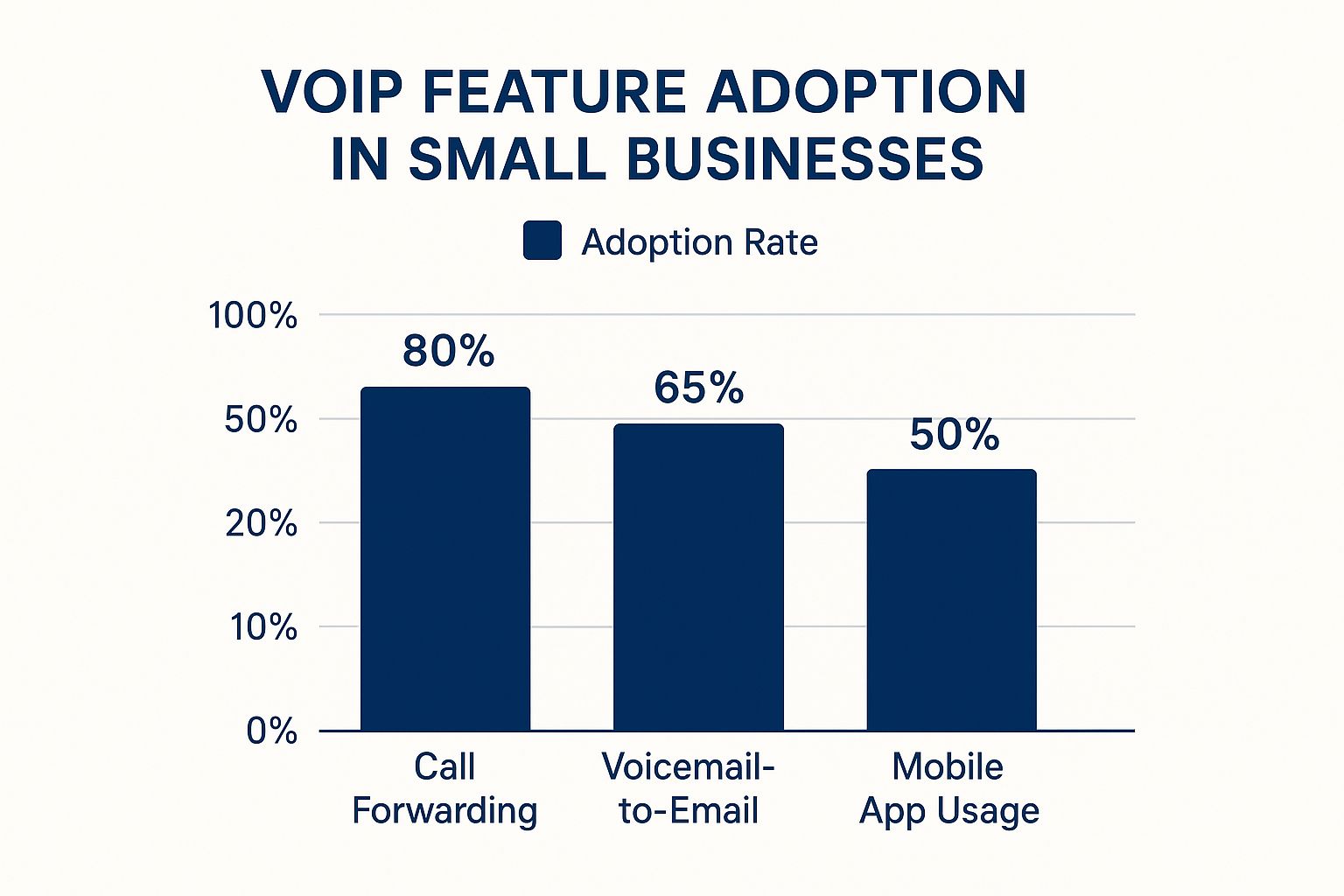
It’s clear that business owners are focusing on features that give them more flexibility and make their day-to-day operations run smoother.
Of course, the quality of your VoIP system is only as good as the internet connection it runs on. A stable, reliable network is absolutely essential for crystal-clear calls. If you’re moving into a new office or find your current connection is a bit flaky, it’s a good idea to sort out your network foundation first. A professional data cabling installation will ensure your infrastructure is ready to deliver a flawless VoIP experience from day one.
Choosing the Right VoIP Provider for Your Business
Picking a VoIP provider can feel a bit like choosing a new ute. They all look the part on the brochure—shiny, powerful, and promising to get the job done. But you know the difference between one that’s built for tough Aussie conditions and one that’ll conk out halfway up a hill. The same goes for your business communications.
It’s tempting to just go for the cheapest option you find online, but that can lead to a world of pain. Just ask Mark, a sparky from Newcastle. He thought he’d scored a bargain with a super-cheap overseas provider. The price was great, but when his calls started dropping during peak times, he discovered their “24/7 support” was based in a completely different time zone and had no idea what the NBN was. He’d spend mornings trying to sort out connection issues instead of being out on jobs.
This is a common trap. When it comes to your business's lifeline—its phone system—you need a partner who gets it. You need someone who understands what "NBN woes" really means and can provide real support when you need it.
What to Look for on Your Checklist
To avoid Mark’s headache, you need a solid checklist. Don't just look at the price tag; dig a bit deeper to see what you're really getting. Your VoIP phone system for small business should be a long-term asset, not a short-term problem.
Here are the non-negotiables to look for:
- Aussie-Based Support: Is their support team located here in Australia? When things go wrong, you want to speak to someone in your time zone who understands the local network infrastructure, not someone reading from a script thousands of kilometres away.
- Clear, All-Inclusive Pricing: Get a detailed quote that breaks down every cost. Are there hidden fees for things like call recording, extra phone numbers, or setup? A good provider is upfront about what’s included in their monthly per-user fee.
- Scalability for Growth: Your business might be small now, but you're planning for growth. Ask them how easy it is to add or remove users. A great system should grow with you, allowing you to add a new team member to the phone system in minutes.
Security and Reliability Are Not Optional Extras
In a world of constant digital threats, the security of your communications is paramount. A VoIP system is connected to the internet, which means it needs to be properly secured, just like your computer network or Wi-Fi.
A provider that doesn’t talk about security isn’t taking your business seriously. Ask them about their encryption standards, fraud detection measures, and data protection policies. Your business and client conversations are sensitive—make sure they’re kept that way.
Reliability is just as crucial. Ask potential providers about their uptime guarantee. A 99.999% uptime guarantee is the industry standard, which translates to only a few minutes of potential downtime per year. For more tips on keeping your digital front door locked, check out our guide on how to secure your WiFi network.
Reading Reviews and the Fine Print
Finally, do your homework. Don't just rely on the testimonials on the provider’s website. Look for independent reviews from other Australian small businesses. What are people saying about their call quality, customer service, and reliability?
This isn’t a new trend; Aussie businesses have been weighing up these factors for years. In fact, data from way back in 2009 showed a steady rise in VoIP use among small businesses, with satisfaction rates hitting 82%. This historical data shows that when businesses find the right provider, they are overwhelmingly happy with the switch. You can read more about these early VoIP adoption trends in Australia.
Choosing the right partner from the start saves you from the stress and lost income that Mark the sparky had to deal with. Find a provider with solid Aussie support, transparent pricing, and a focus on security, and you’ll have a communications system that works for you, not against you.
Answering Your Top VoIP Questions
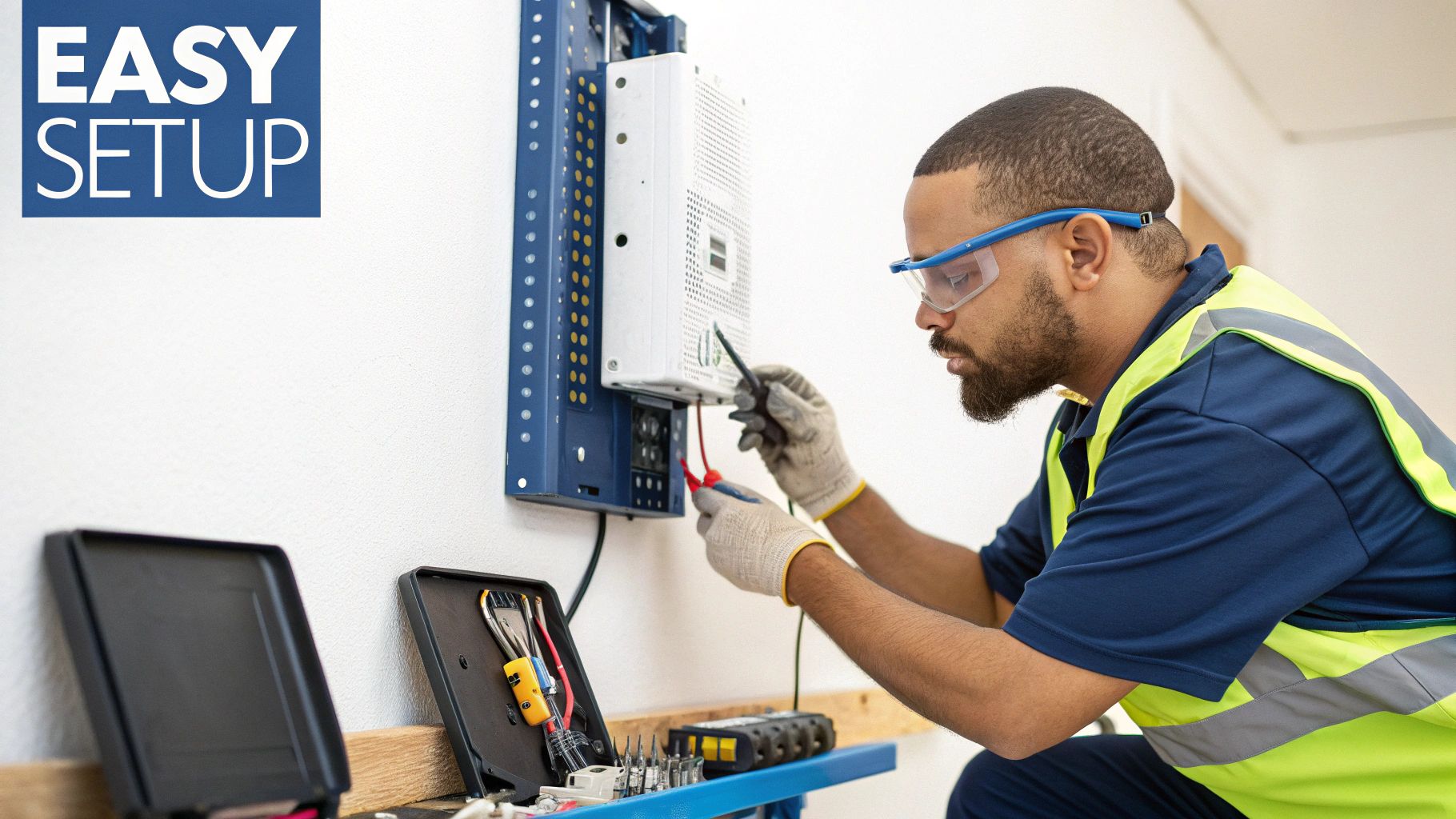
We get it. Moving to a new bit of tech, even one that promises to make life easier, always comes with a few questions. It's smart to have all the facts before you jump in.
Over the years, we've heard just about everything from business owners across the Central Coast, Sydney, and Newcastle. So, let's cut to the chase and give you the straight-up answers to the most common queries we get.
What Happens If My Internet Goes Down?
This is probably the number one worry we hear, and it's a completely fair one. If your phones are powered by the internet, what happens if the NBN has a wobbly? Think of it like a power outage – you just need a good backup plan.
The good news is that modern voip phone systems for small business are designed for exactly this scenario. Any quality provider will have automatic failover features built right in.
This means if your office internet drops out, the system will instantly start redirecting calls to pre-selected mobile numbers. You and your team can keep answering calls on your mobiles without missing a beat, and your customers will be none the wiser. The show goes on.
Can I Keep My Existing Business Phone Number?
Yes, one hundred percent. The thought of changing that number – the one plastered on your van, your website, and every business card you've ever printed – is enough to give anyone a headache. Luckily, you don't have to.
The process is called "porting," and it’s a standard, everyday part of switching to VoIP. Your new provider takes care of the whole thing, moving your existing number from your old carrier to the new system. It's a smooth transition that keeps all that brand recognition you've worked so hard for.
It’s just like keeping your mobile number when you switch from Telstra to Optus. The number belongs to you, and it follows you wherever you go. The tech changes, but your connection to your customers stays exactly the same.
Is VoIP Secure?
This is another big one. With all the talk of online security threats, it’s only natural to ask how safe an internet-based phone service really is. The truth is, modern VoIP systems are exceptionally secure – often much more so than old-school analogue lines, which could be tapped with relative ease.
Reputable VoIP providers build their systems with heavy-duty security measures to keep your calls and data safe. You'll want to look for providers that offer things like:
- End-to-end encryption: This essentially scrambles your call data, making it completely unreadable to anyone trying to listen in.
- Secure networks: Providers actively monitor their networks 24/7 for any suspicious activity or potential threats.
- Fraud detection: These are smart systems that can pick up on unusual calling patterns that might signal someone is trying to hijack your account.
When you team up with a provider that prioritises security, you can rest easy knowing your business conversations are kept private.
Will the Call Quality Be Any Good?
We all remember the early days of internet calls – choppy, full of echoes, and constantly dropping out. It's easy to wonder if VoIP calls still sound like you’re talking from the bottom of a well.
The short answer is a definite no. Thanks to the NBN and massive leaps in the technology itself, VoIP call quality is now crystal-clear. It often delivers what’s known as HD (High Definition) voice, which is actually superior to a traditional landline.
The real key to excellent call quality is a solid internet connection. As long as you have a decent business NBN plan, your calls will be sharp, clear, and reliable. It’s not a gamble anymore; it's simply a better way to communicate.
Ready to stop wondering and start enjoying the benefits of a modern phone system? The team at Advanced Comtech is here to help. We provide straightforward advice and expert installation for businesses on the Central Coast, in Sydney, and Newcastle. Let's get you connected today.