A professional television wall mounting service isn't just about chucking your new TV on the wall. It’s about making sure it's secure, safe, and perfectly positioned for the best viewing experience, all without you having to lift a finger or risk a DIY disaster.
Why Pro TV Mounting Is a Game Changer
So, that beautiful new telly is still sitting in its box. You’ve got this vision of it hanging perfectly on the wall, the clean, modern centrepiece of your living room. But the idea of drilling into your walls, crossing your fingers that you hit a stud and not a water pipe… well, it’s a bit daunting, isn't it?
Let’s talk about Dave from Davistown. Dave's a keen DIYer and thought mounting his new 65-incher would be a walk in the park. A few hours, several wonky holes, and one near-miss with the TV later, he was staring at a very expensive screen propped on the floor and some sad-looking plaster. Dave’s story is a classic—and a solid reason why underestimating this job is a bad idea.
This is exactly why calling in a professional for your television wall mounting service isn't a luxury; it's a dead-set smart move for anyone on the Central Coast, or in Sydney or Newcastle.
More Than Just Drilling Holes
Getting a pro in is about so much more than just avoiding a mess. It’s about getting the job done with precision and giving you total peace of mind. A seasoned installer knows the tricks of the trade.
They’ll know exactly how to:
- Find the Perfect Spot: An expert can help you figure out the optimal height and angle, making sure your movie nights are free from neck strain and that annoying glare from the window.
- Securely Anchor Your Investment: Whether you’ve got gyprock, brick, or something trickier, they have the right tools and fixings to guarantee that TV isn’t going anywhere.
- Achieve a Flawless Finish: Cable management is an art form. Pros are brilliant at hiding those messy HDMI and power cords, giving you that clean, 'floating TV' look everyone wants.
This infographic really shows how a professional install can transform your living space from cluttered to clean.
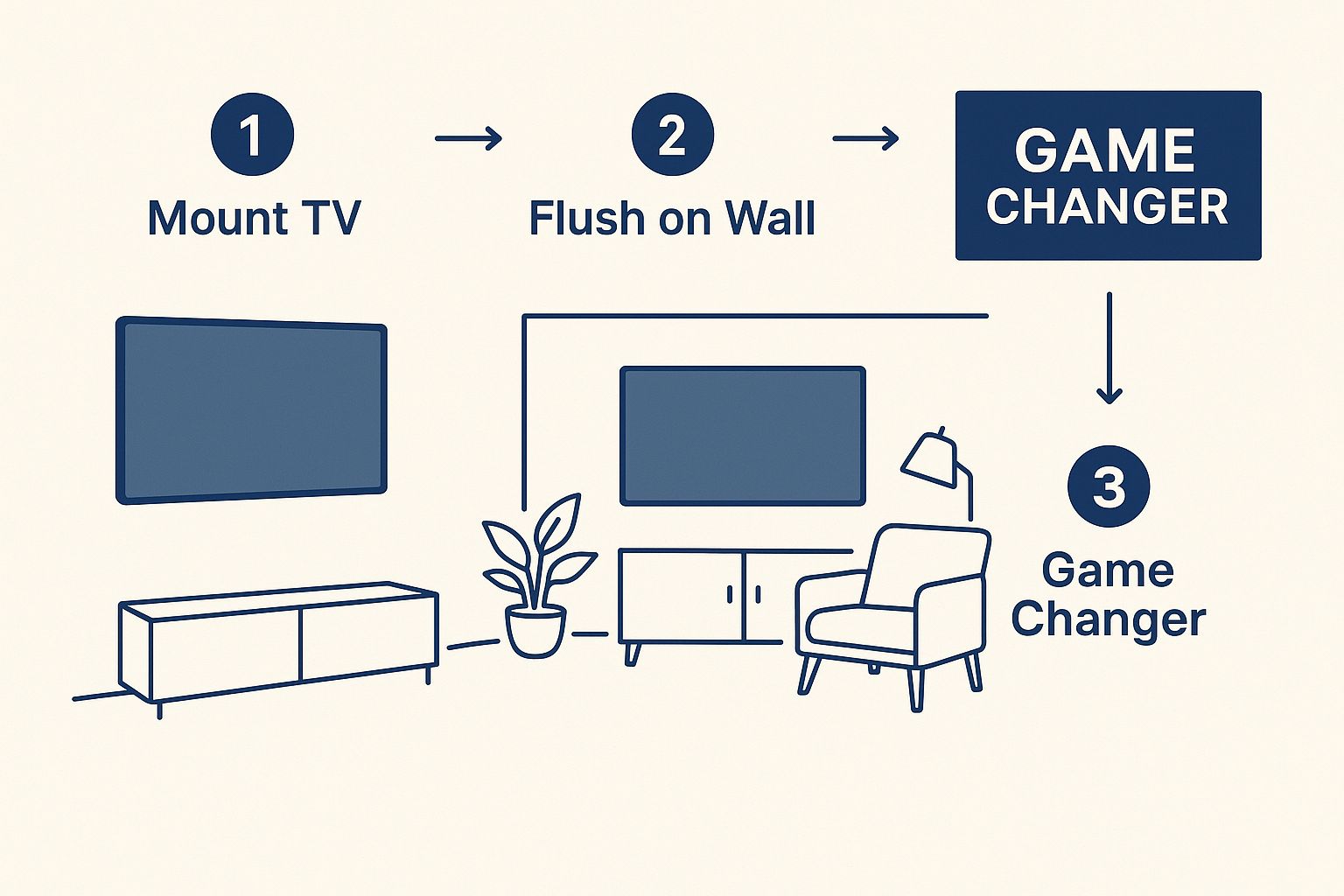
You can see the clear shift from a messy, potentially unsafe setup to the secure, sleek result that only a pro service can deliver.
Safety and Expertise You Can Trust
At the end of the day, safety is the biggest win. A properly mounted TV is far more secure than one sitting on a stand, especially if you have kids or curious pets running around the house. It completely eliminates the risk of it being knocked over, which is a massive relief for any family.
The real value of a professional service is knowing your expensive new TV is securely fastened by someone who does this day in and day out. It's about protecting your property, your family, and your investment.
To ensure your setup is handled by genuine pros, it helps to know how to find a trusted residential electrician who can manage all the electrical services in your home. Their expertise often goes beyond just power points to include the safe installation of home entertainment systems.
Plus, a truly clean installation often involves hiding data cables in the wall, a specialised skill. You can learn more about what a professional data cable installer does to create that seamless, fully connected look for your home.
Getting the Right Gear for Your Setup
Before you even think about drilling a hole, we need to talk about the gear. Picking the right equipment for your TV wall mount isn't just about grabbing the first sturdy-looking bracket you see at Bunnings. It's a bit of a matching game – you’ve got to pair the gear to your room, your TV, and the way you actually use it. Nail this part, and you're already halfway to a flawless finish.
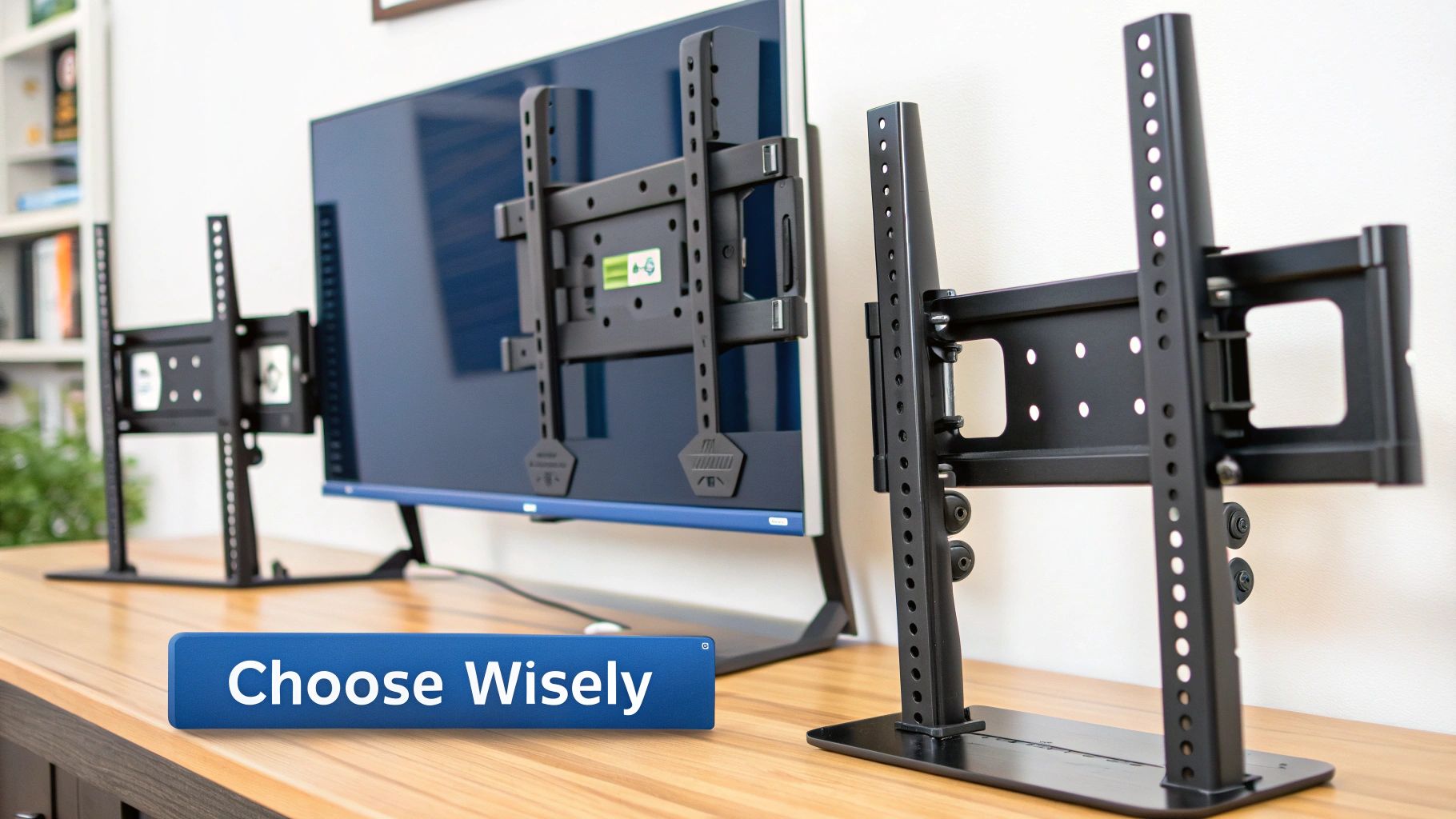
It all kicks off with the wall bracket. Honestly, these are the unsung heroes of any great entertainment setup. They generally come in three main flavours, and each one has its own special trick.
Understanding Your Bracket Options
Not sure which bracket is for you? It really comes down to where your TV is going and how you'll be watching it. Here's a quick rundown of the main types to help you figure out what's best for your space.
Choosing Your TV Wall Mount Bracket
| Bracket Type | Best For | Pros | Cons |
|---|---|---|---|
| Fixed Mount | Dedicated viewing rooms where the couch is directly opposite the TV. | Sits flush for a sleek, low-profile look. Very sturdy and cost-effective. | No adjustability at all. What you see is what you get. |
| Tilting Mount | TVs mounted higher up (like over a fireplace) or rooms with window glare. | Allows for vertical tilt to reduce glare and improve viewing angles from above or below. | Can't swivel side-to-side. Sits slightly further from the wall than a fixed mount. |
| Full-Motion Mount | Open-plan living, awkward corners, or rooms with multiple viewing spots. | Maximum flexibility – tilt, swivel, extend. Pull the TV out and angle it anywhere. | Sits furthest from the wall. Can be more complex to install and more expensive. |
As you can see, the right choice really depends on the unique challenges of your room.
I remember a job we did for a family in Newcastle who were fighting a losing battle with the afternoon sun. Every day around 3 pm, a massive glare would blast their screen, making the kids' shows impossible to watch. A simple tilting bracket was all it took. A quick downward nudge and the sun was defeated. Sanity was restored in the household!
What’s Your Wall Made Of?
Okay, so you’ve got a bracket in mind. The next massive question is: what's the wall actually made of? Is it gyprock? Double brick? Something else? This is where professional experience really makes a difference.
A pro can spot the studs in a gyprock wall like a magpie spots something shiny – it's just second nature. We use a stud finder to pinpoint the solid timber beams behind the plasterboard, making sure your 75-inch pride and joy has a rock-solid anchor point.
For brick or concrete, it's a completely different ball game. That requires specialised masonry anchors and a heavy-duty drill. Since most modern Aussie homes are built with plasterboard, knowing the best fixings for plasterboard walls is non-negotiable for a safe installation. Trust me, using the wrong anchor is one of the fastest ways to a DIY disaster.
Your wall's structure is the foundation of the entire installation. A pro doesn't guess; they assess the material and use the precise hardware required to hold thousands of dollars of electronics safely in place.
The Great Cable Disappearing Act
Now for the final piece of the puzzle: that ugly mess of cables. Getting that super clean, wireless look isn't magic; it’s just smart planning. There are a couple of ways we can make those cords vanish.
- In-Wall Cable Concealment: This is the top-tier solution. Your installer will run the HDMI, power, and any other cables right inside the wall cavity. We then connect them to discreet wall plates behind your TV and your entertainment unit. It’s the secret sauce for that true "floating TV" look.
- On-Wall Cable Trunking: If you're after a more budget-friendly option, we can use trunking. It’s a slim plastic channel that sticks to the wall, hiding the cables inside. We can even paint it to match your wall colour so it blends right in.
This kind of careful planning isn't just about making things look pretty. It’s about properly integrating your TV into a smarter, more connected home. It's worth looking into modern audio visual smart home systems to see what's possible for a truly seamless setup.
As TVs get smarter and bigger, the demand for professional installation keeps growing. The Aussie smart TV market was valued at a whopping $2.9 billion AUD recently and is only set to get bigger, which means more people will be looking for a pro to get their viewing experience just right.
What a Professional TV Installation Actually Looks Like
Alright, let's pull back the curtain and see what happens when the pros roll up to your door. This isn't just about drilling a few holes. To give you a real sense of it, let's follow a Sydney-based installer—we'll call him Mick—on a typical job. Seeing the process through his eyes shows you exactly why a professional service is worlds away from a weekend DIY job that could end in tears.
Mick’s day kicks off with a simple chat at the front door. The client's just bought a shiny new 75-inch TV and wants it to 'float' perfectly above their entertainment unit. This first conversation is gold. It’s not just about finding wall studs; it’s about figuring out how the family actually lives in and uses the space.
The All-Important Room Assessment
First things first, Mick asks the homeowner to sit down in their favourite spot on the couch. This isn't just him being friendly—he’s gauging the perfect viewing height from their perspective. The golden rule here is to get the centre of the screen pretty much level with your eyeline when you're sitting back and relaxed.
Mounting a TV too high is a classic rookie mistake. It's what we in the trade call the 'chiropractor's special' because it’s a one-way ticket to a sore neck.
He’ll also clock any glare coming from the windows, consider the main walkways through the room, and note where the power points are. He’s basically building a mental blueprint of the job before a single tool even comes out of the bag.
Tools of the Trade in Action
Once they've agreed on the sweet spot, the real precision work begins. This is where you see the difference. Mick pulls out a high-quality electronic stud finder, which gives a confident beep as it pinpoints the solid timber supports behind the gyprock. There's no guesswork or tentatively tapping the wall and hoping for the best.
Out comes the laser level next. A crisp red line shoots across the wall, giving him a perfectly straight guide for drilling the bracket holes. Everything is measured meticulously to make sure it’s dead centre and perfectly balanced.
A professional doesn't just drill holes; they use specialised gear to guarantee absolute precision and structural integrity. You simply can't put a price on the peace of mind that comes from knowing you’ve hit a stud right in the middle.
With the pilot holes drilled, he breaks out the heavy-duty lag bolts—specifically designed to hold some serious weight—and secures the bracket to the wall studs. You can feel how solid it is; that thing isn't going anywhere.
Lifting, Locking, and Hiding the Mess
Now for the main event: getting the TV on the wall. Lifting a big screen is always a two-person job, and it’s done with care. Mick and his apprentice gently hoist the TV, hooking it onto the wall plate until they hear a satisfying click as the safety locks engage. A firm but gentle wiggle confirms it's locked in tight.
With the TV mounted, it's time for the final, and most important, step for a clean look: cable management. The client wants a seamless finish, so Mick is running the cables inside the wall. This involves cutting small, discreet openings in the plasterboard—one behind the TV and another down near the power outlet—and then 'fishing' the HDMI and power cords through the wall cavity. This takes a delicate touch and a good understanding of wall structures to avoid hitting any existing electrical wiring or plumbing. If you're after that kind of fully integrated setup, you might find our guide on professional data cabling installation useful.
The final connections are made, all the devices are tested, and the TV powers on, floating flawlessly on the wall without a single cable in sight. It's this clean, minimalist aesthetic that's driving demand. It’s no surprise that the Asia Pacific region, including Australia, makes up a massive up to 46% of the global TV wall mount market. Our love for smart homes and clutter-free design is a huge part of that trend.
Before packing up, Mick cleans every last bit of dust, wipes down the screen, and gives the homeowner a quick rundown of how everything works. That’s the full professional experience—expertise, precision, and leaving the place even tidier than when he arrived.
So, What Does a Pro TV Wall Mount Actually Cost?
Alright, let's get down to the brass tacks. It's the big question on everyone's mind when they start picturing that sleek, floating TV look: what’s this really going to set me back? You don’t want to be blindsided by a bill that’s more shocking than the twist in a season finale.
So, let's have an honest chat about the costs for a professional television wall mounting service, particularly around the Sydney, Central Coast, and Newcastle areas.
The simple truth is, there’s no single, flat-rate price. The final cost is a bit like ordering a coffee – a simple long black is one price, but a triple-shot, half-strength, soy decaf latte with extra froth is going to be a different story. The final figure really comes down to a few key things specific to your setup.
The Main Price Factors
Think of your TV mounting job as a project with a few moving parts, and each one can nudge the price up or down. A straightforward job putting a 55-inch telly on a standard gyprock wall will always be on the lower end of the scale. But if you're wrangling an 85-inch beast onto a solid brick fireplace? Well, that’s a whole different ball game.
Here’s what really shapes the final quote:
- TV Size and Weight: A bigger, heavier TV needs a more robust bracket and often a bit more muscle to lift and secure it safely. This naturally influences the cost.
- Your Wall Type: Is it simple gyprock with timber studs? Or are we dealing with double brick, concrete, or even stone? Masonry walls require specialised tools and anchors, which adds a layer of complexity and time.
- The Bracket You Choose: A basic fixed bracket is the most budget-friendly option. A tilting mount is a small step up, while a full-motion, articulating bracket that can pull out and swivel will, of course, cost more.
- Cable Concealment: This is a big one. Do you want those pesky cables to completely vanish inside the wall for that ultra-clean finish? That's the premium option, but it takes far more time and skill than just using simple on-wall trunking to tidy them up.
The biggest variables are almost always the wall type and how hidden you want the cables. A simple mount might take an hour, but a complex job on a brick wall with in-wall cabling could easily take half a day.
So, What's the Ballpark Figure?
Let's talk numbers. You'll see a fair bit of variation out there, but you can generally expect a standard professional installation to fall within a pretty reasonable range. Some data suggests that the average cost of mounting a TV in Australia can be anywhere from $99 to $299 AUD, depending on all those factors we just ran through.
For a more detailed local breakdown, check out our guide on the cost to mount a TV on the wall, where we dive deeper into the specifics for our Central Coast and Sydney clients.
What Are You Actually Paying For?
When you hire a pro, you’re not just paying for a couple of holes in the wall. You're investing in a perfect result, total safety, and a massive dose of peace of mind.
You're really paying for:
- Expertise: Someone who knows exactly where to drill to hit a solid stud, not a water pipe or electrical wiring. That experience is priceless.
- The Right Tools: From high-end stud finders and laser levels to heavy-duty masonry drills that can handle anything.
- Safety and Security: The guarantee that your expensive TV is securely anchored and won't end up on the floor in the middle of the night.
- A Flawless Finish: Perfect alignment, the optimal viewing height, and clean cable management that makes the whole setup look schmick.
Ultimately, the cost reflects the value of getting the job done right the first time. It's about avoiding costly mistakes, saving yourself a weekend of stress, and creating a setup you’ll love for years.
Common Mounting Mistakes to Avoid
Right, let's talk about the hard-won wisdom that comes from fixing DIY jobs gone wrong. Over the years, we've seen it all, from TVs hanging on by a prayer to walls that look like they've been attacked by a woodpecker. This is where we share the gold—the common blunders people make when they go it alone or hire a dodgy operator who doesn't know their lag bolts from their elbows.
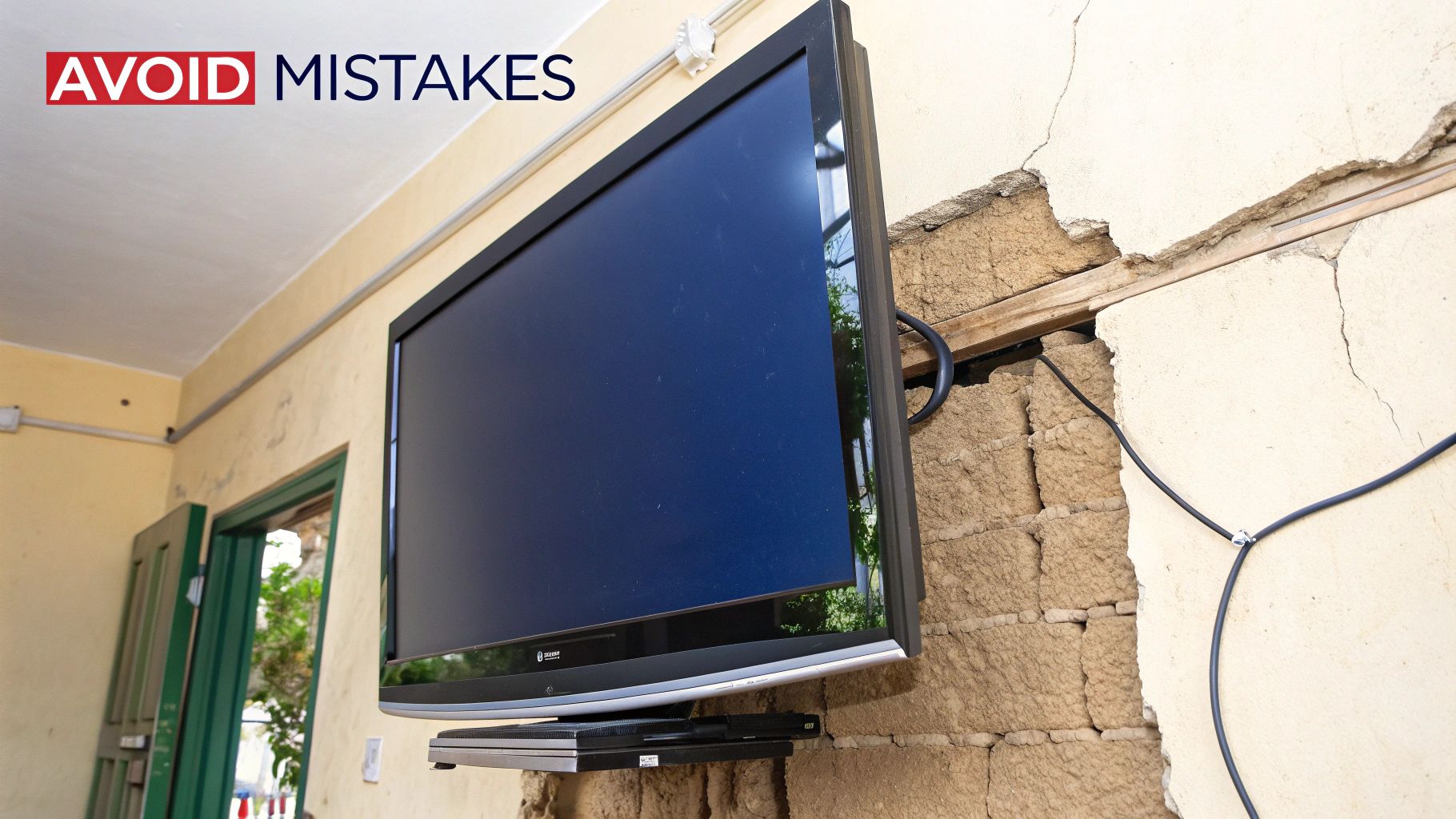
Think of this as your friendly warning, a highlight reel of what not to do. Avoiding these classic errors is the secret to a perfect, stress-free installation.
The Chiropractor’s Special: Mounting Too High
This is, without a doubt, the most common mistake we see. Someone gets excited and mounts their TV way up the wall, often above a fireplace, because it looks good. The problem? It’s a one-way ticket to a sore neck.
Your TV should be at eye level when you're seated. It’s that simple. Watching a two-hour film while craning your neck upwards is uncomfortable and can lead to genuine strain over time.
Pro Tip: Before you even think about drilling, sit on your main couch and just stare at the wall. Your natural, comfortable eye line is the sweet spot. A great little trick is to get someone to hold the TV (or even just a cardboard cutout of its size) against the wall while you check the height from your favourite seat.
Using the Wrong Anchors for the Wall
This one is a recipe for disaster. Grabbing a random pack of wall plugs from the hardware store and hoping for the best is a massive gamble with your expensive new telly. Gyprock, brick, and concrete all need completely different types of anchors.
Using a standard gyprock anchor in a brick wall will be useless. Even worse, using one in plasterboard without hitting a stud means your TV's entire weight is supported by a thin sheet of plaster. It’s not a matter of if it will fall, but when.
- Gyprock Walls: You absolutely must locate the solid timber or metal studs behind the plasterboard. The mount must be secured directly into these studs with heavy-duty lag bolts. No exceptions.
- Brick or Concrete Walls: These demand specialised masonry anchors (like Dynabolts) that expand inside the solid wall, creating an unbreakable grip.
Forgetting About Glare and Reflections
Picture this: you’ve just mounted your TV, it’s perfectly level, and you’re ready for movie night. Then, the arvo sun hits, and your screen turns into a giant, unusable mirror. Or at night, the reflection from the kitchen lights creates a distracting glare right over the main character's face.
It's crucial to consider all the light sources in your room before you decide on a final position. This includes windows, downlights, and lamps.
A professional television wall mounting service will always assess the room's lighting. Sometimes, shifting the TV just 30cm to the left or right, or opting for a tilting bracket, can completely solve a reflection problem.
The Dreaded Swiss Cheese Wall
This happens when someone can’t find the studs and decides to just drill more holes until they hit something solid. The result is a wall that looks like Swiss cheese and is structurally compromised. Not a good look, and definitely not safe.
A good-quality electronic stud finder is an installer's best mate for a reason. It pinpoints the exact centre of the studs, so you can drill with confidence the first time, every time. It saves your wall, your time, and your sanity.
A clean installation is not just about aesthetics; it's about structural integrity. For more complex jobs that involve running network points, you might be interested in our guide on installing data cable to understand what goes into achieving that clean, professional finish.
Your TV Mounting Questions Answered
We get asked these questions all the time, so we’ve put the answers in one handy spot. From wall types to cable mysteries, this is your go-to guide for everything you’ve wanted to know about getting a professional television wall mounting service. Think of it as a friendly chat before you make the call.
We’ve tackled everything from pricing to the common mistakes people make, but there are always a few extra queries that pop up. So, let’s dive into the nitty-gritty and clear up any lingering doubts you might have.
Can You Mount a TV on Any Type of Wall?
The short answer is a resounding yes, pretty much! Whether your home on the Central Coast is modern gyprock, a classic Newcastle double brick, or even a feature wall made of concrete, an experienced installer has the right tools and know-how for the job. It all comes down to using the correct fasteners.
For gyprock, the secret sauce is finding the solid timber or metal studs behind the plasterboard. This gives us a rock-solid anchor point. For tough customers like brick and concrete, we bring out the specialised masonry anchors to create an unbreakable grip.
A professional installer doesn’t just see a wall; they see a structure. They’ll assess the material and come prepared with the exact hardware needed to ensure your TV is completely secure, no matter what it’s made of.
The only time it gets a bit tricky is with some older, heritage-listed homes, but even then, there’s almost always a creative and safe solution we can work out.
What Is the Best Height to Mount a TV?
This is the golden rule of TV mounting: the centre of the screen should be at eye level when you're sitting comfortably on your sofa. It’s so simple, yet it's the one thing people most often get wrong when they try to do it themselves.
A classic mistake is whacking it way too high, especially over a fireplace. While it might seem like a good use of space, you’ll be craning your neck like you’re in the front row of the cinema. A good installer will literally sit on your couch to find that perfect, comfortable viewing height before a single hole is drilled.
For bedrooms, the rules change slightly. Since you’re usually watching while lying down, it's often better to mount the TV a bit higher and use a tilting bracket to angle it downwards. It’s all about creating the most comfortable and enjoyable experience for how you use the room.
How Do You Hide All the Messy Cables?
Ah, the secret to achieving that magical "floating TV" look! Nobody wants a beautiful, sleek screen on the wall with a tangled mess of cables dangling down like black spaghetti. This is where a professional service really shines.
Here are the main ways we make the mess disappear:
- In-Wall Cable Concealment: This is the top-shelf solution for a completely seamless finish. We carefully run the cables through the wall cavity, connecting them to discreet wall plates. It’s the ultimate in clean, minimalist design.
- On-Wall Cable Trunking: A more budget-friendly option is to use cable covers or trunking. This is a slim plastic channel that sticks to the wall and neatly hides the cables inside. The best part? It can be painted the same colour as your wall to help it blend in seamlessly.
A pro can chat with you about the best method for your specific wall type and budget.
Is It Safe to Mount a Large, Heavy TV?
Absolutely, but only if it’s done correctly. In fact, safety is the number one reason to call in a professional. A properly mounted TV is often much safer than one sitting on an entertainment unit, especially if you have kids or energetic pets running around. It completely eliminates the risk of the TV being knocked or pulled over.
Professionals use high-quality, weight-rated brackets and know exactly how to secure them to your wall's structural supports. When a pro mounts your TV, you can rest easy knowing that your expensive investment isn't going anywhere. It’s peace of mind, pure and simple.
Ready to get that perfect, professional finish for your home entertainment setup? Let the experts at Advanced Comtech handle the heavy lifting and technical details. Get in touch with us today for a stress-free, flawless installation!