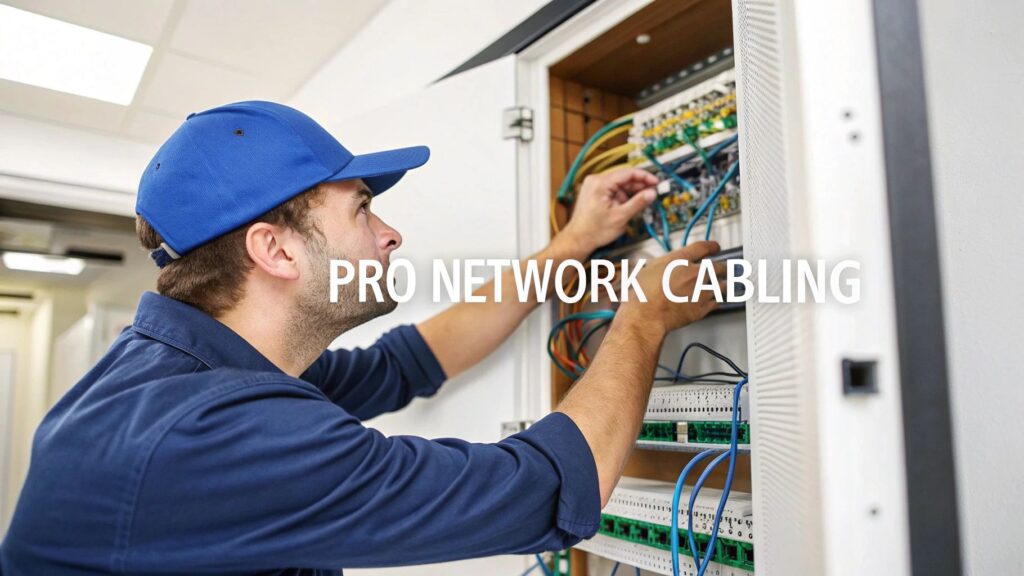
Let's be real—fighting for a stable internet connection can feel like a losing battle. If you're after a rock-solid online experience, searching for professional network cable installation near me is your first move. It’s the difference between dodgy Wi-Fi and a powerful, hardwired setup that just works, letting you finally ditch the lag and get the speeds you’re paying for.
Tired of Dodgy Wi-Fi? Here's Why Pro Cabling Is the Answer
You know the drill. You’re settling in for the finale of that show everyone’s been talking about on Netflix. Right at the massive cliffhanger… the dreaded buffering wheel of death appears. Or maybe you're halfway through explaining a critical point to your boss on a Zoom call, and your face freezes in a deeply unflattering expression.
We’ve all been there. And let's be honest, yelling at the router doesn't actually fix anything. This daily struggle with digital frustration is exactly why so many people are looking for a permanent solution. While fiddling with settings might offer a temporary fix, nothing beats the raw speed and reliability of a hardwired connection.
The Big Shift to Stable Connections
It's no surprise that professional cabling is becoming more common across Australia. The NBN rollout, paired with the huge jump in people working and studying from home, has turned a reliable connection from a "nice-to-have" into an absolute must.
This isn't just a feeling; industry data shows steady growth in the Aussie Ethernet cable market, all thanks to our growing hunger for high-performance networks. You can read more about these market trends to get the full story.
A professional network cable installation isn't a tech luxury anymore. It's essential infrastructure for any modern home or business. Think of it like your plumbing—you don't really notice it when it's working perfectly, but it's a complete disaster when it's not.
For most people, the first thought is to try and patch up a weak signal. While there are some useful tricks you can try, and you can learn how to boost your Wi-Fi signal in our guide, it's never going to match the sheer power of a physical cable. It’s about swapping those daily tech headaches for a genuinely seamless online experience, whether you're gaming on the Central Coast or running your business from Newcastle.
Understanding Cat6, Cat6a, and Fibre Cables
So, you've started searching for "network cable installation near me," and now you're swimming in a sea of jargon. Installers are throwing around terms like Cat6, Cat6a, and fibre optic, and it’s easy to feel like you've stumbled into a completely different language.
Don't stress. It’s actually a lot simpler than it sounds.
Think of it like choosing a garden hose. The old, kinked-up hose you've had for years (like an outdated Cat5 cable) might be fine for a light sprinkle. But if you want to blast grime off the driveway, you need something with some serious pressure—that’s your modern, high-speed data cable. The right one just depends on what you need it to do.
Picking the Right "Hose" for Your Data
Let’s break down the main options you'll come across. Each type is a step up in performance, a bit like going from a standard sedan to a high-performance sports car.
-
Cat6 Cable: This is the reliable workhorse for most Aussie homes and small businesses today. It's more than capable of handling fast NBN plans, 4K streaming, and online gaming without breaking a sweat. For a typical family in Gosford or a small office, Cat6 is often the perfect sweet spot between performance and price.
-
Cat6a Cable: Think of Cat6a (the 'a' stands for augmented) as Cat6 on steroids. It offers double the bandwidth and much better protection against interference, which makes it ideal for data-heavy environments. If you're running a home office with massive file transfers or have multiple people streaming and gaming at once, Cat6a gives you that extra headroom for the future.
-
Fibre Optic Cable: This one is the undisputed champion. Instead of sending electrical signals through copper wires, fibre uses pulses of light travelling through impossibly thin glass strands. It’s ridiculously fast, incredibly reliable over huge distances, and completely immune to electrical interference. For a growing business in Newcastle needing a bulletproof network backbone or a tech-savvy homeowner who wants the absolute best, fibre is the ultimate future-proofing investment.
To make things a bit clearer, here’s a quick rundown of how these common cables stack up.
Quick Guide to Network Cable Types
A simple comparison of the most common network cables to help you choose the right one for your home or business.
| Cable Type | Best For | Typical Speed | Aussie Price Guide (per metre) |
|---|---|---|---|
| Cat6 | Standard homes, small offices, NBN, 4K streaming | Up to 10 Gbps over 55m | $1.50 – $3.00 |
| Cat6a | Future-proofing, high-demand homes, offices with heavy data use | Up to 10 Gbps over 100m | $2.50 – $5.00 |
| Fibre Optic | Businesses, data centres, long-distance runs, maximum performance | 10 Gbps to 100+ Gbps | $4.00 – $10.00+ |
This table gives you a ballpark idea, but remember that total installation cost involves labour, connectors, and other hardware, not just the cable itself.
So, Which One Do You Actually Need?
Honestly, it all comes down to your current needs and what you think you'll be doing in a few years. A family just streaming movies and browsing the web will be perfectly happy with a well-installed Cat6 setup.
However, if your home is packed with smart devices, 4K TVs, and a few serious gamers, investing in Cat6a ensures your network won't become a bottleneck down the track. If you want to get into the nitty-gritty, check out our detailed guide on installing data cable for more insights.
The goal isn't just to get connected; it's to build a network that handles everything you throw at it today and everything you'll want to do tomorrow. A quick chat with a professional installer can help match the right cable to your exact needs, making sure you don't overpay for performance you don't actually require.
The Real Cost of Network Cabling in Australia
Alright, let's get down to brass tacks. What’s a professional network cable installation actually going to set you back? It's the number one question on everyone's mind, and the honest answer is: it really depends. The price isn't just about a roll of cable; it's about the unique story of your specific installation.
To give you an idea, let's look at two totally different jobs.
First up, you have Sarah, who lives in a modern home on the Central Coast. She just needs a single data point run from her router to a new home office. The walls are standard plasterboard, getting into the roof cavity is a breeze, and the whole thing is done and dusted in a couple of hours. Simple, clean, and relatively inexpensive.
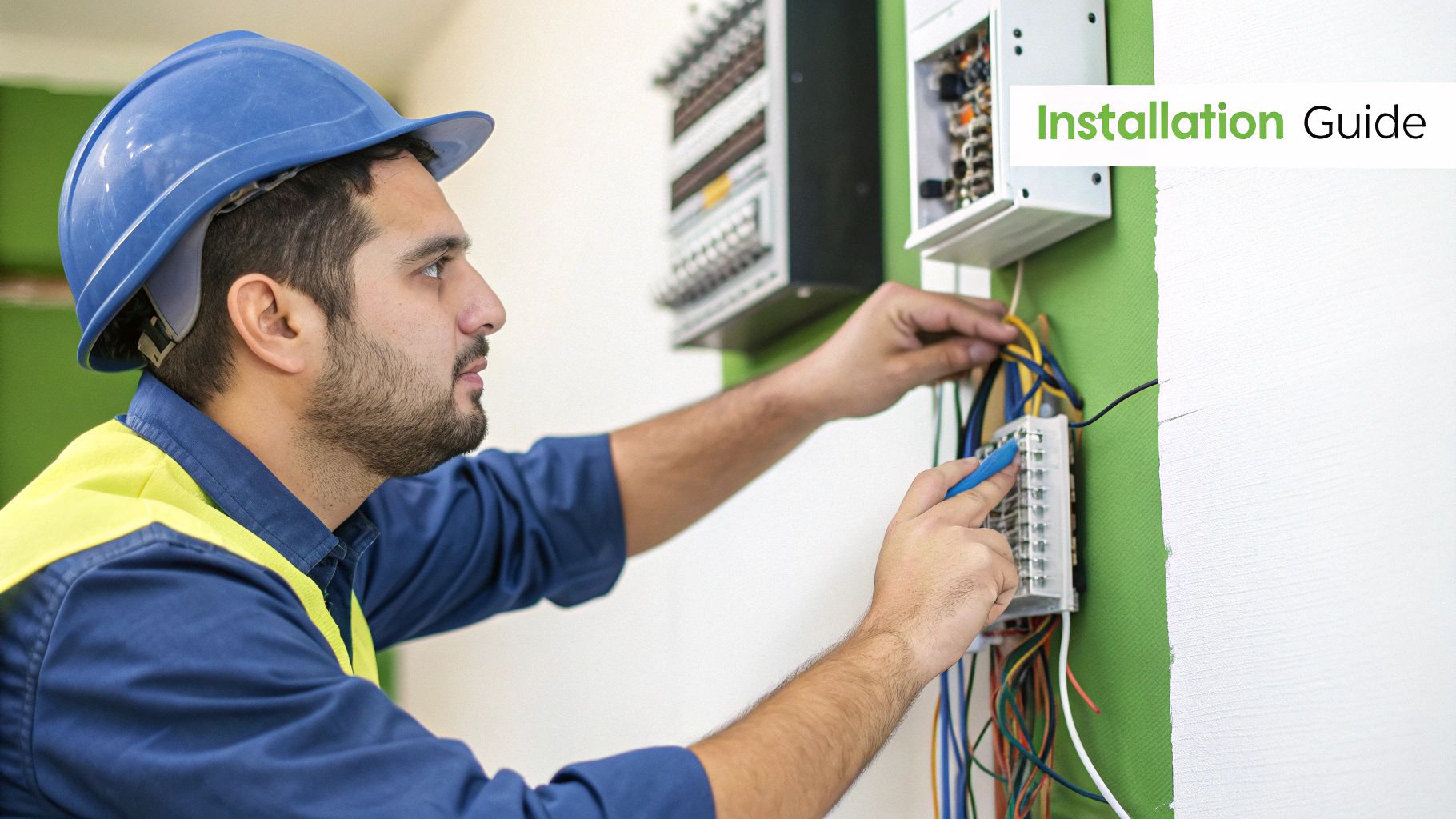
Then there’s Ben. He runs a small accounting firm out of a historic Sydney terrace. He needs ten new data points installed across two floors, battling double-brick walls and tricky heritage features. This job is a complex puzzle of navigating tight spaces and drilling through dense materials, taking a full day and specialised gear. Ben's final bill is naturally going to be higher than Sarah's, even if they used the exact same type of cable.
Key Factors That Shape Your Quote
When you get a quote for a network cable installation near me, the final figure is a blend of several key ingredients. Getting your head around these will help you understand why one price might be so different from another.
- Property Type and Complexity: Just like with Sarah and Ben, a modern home with plasterboard is far easier to work in than a double-brick or concrete building. The more complex the building's bones, the more labour is involved.
- Number of Data Points: This one's pretty straightforward—the more outlets you need installed, the more time and materials are required for the job.
- Cable Type: As we've covered, Cat6, Cat6a, and fibre optic cables all sit at different price points. Your choice here directly impacts the material cost on the invoice.
- Accessibility: How easy is it for the installer to get into the ceiling or under the floor? Or are they going to be navigating a maze of obstacles? Easy access always means a faster, more affordable job.
The raw cost of the cable is only one piece of the puzzle. As of 2025, you might be looking at $1.50–$3.00 per metre for standard Cat6 cable, but this doesn't include labour, connectors, wall plates, or the crucial testing needed to make sure the connection is solid. To get a better handle on this, you can explore more about current Australian network cable price trends for the full picture.
What a Professional Installation Actually Looks Like
So, you’ve decided to stop yelling at the Wi-Fi router and get it done properly. Smart move. But what actually happens when you book a professional network cable installation? It’s a world away from a DIY job with a drill and a roll of cable; it’s a precise, planned-out process designed to give you a flawless connection without turning your place into a construction zone.
Let’s walk through the process with a fictional homeowner, Dave, who lives on the Central Coast and is absolutely fed up with his internet dropping out every time someone uses the microwave.
The Initial Chat and On-Site Consultation
Dave’s journey starts with a simple phone call. He explains his woes—the patchy Wi-Fi in his back office and a smart TV that seems to spend more time buffering than playing. The installer on the other end listens, asks a few key questions, and then schedules the most important part: the on-site visit. This isn’t just a sales pitch; it’s a strategic planning session.
The technician walks through Dave’s house, mapping out the best and most discreet routes for the new cables. They’re a bit like a detective, spotting potential challenges like double-brick walls or tricky ceiling access points. They’ll discuss exactly where Dave wants the new data points, making sure the final wall plates will be neat, tidy, and right where he needs them. By the end of it, Dave gets a clear, itemised quote and knows exactly what to expect. No surprises.
Installation Day: The Nitty-Gritty
On the day, the real work begins. The installer doesn’t just start drilling holes at random. First, they lay down drop sheets to keep everything clean, and then they get to work with a clear plan.
The process is methodical and clean:
- Careful Drilling: Small, precise holes are drilled only where the wall plates will go. The goal is always minimal impact and maximum neatness.
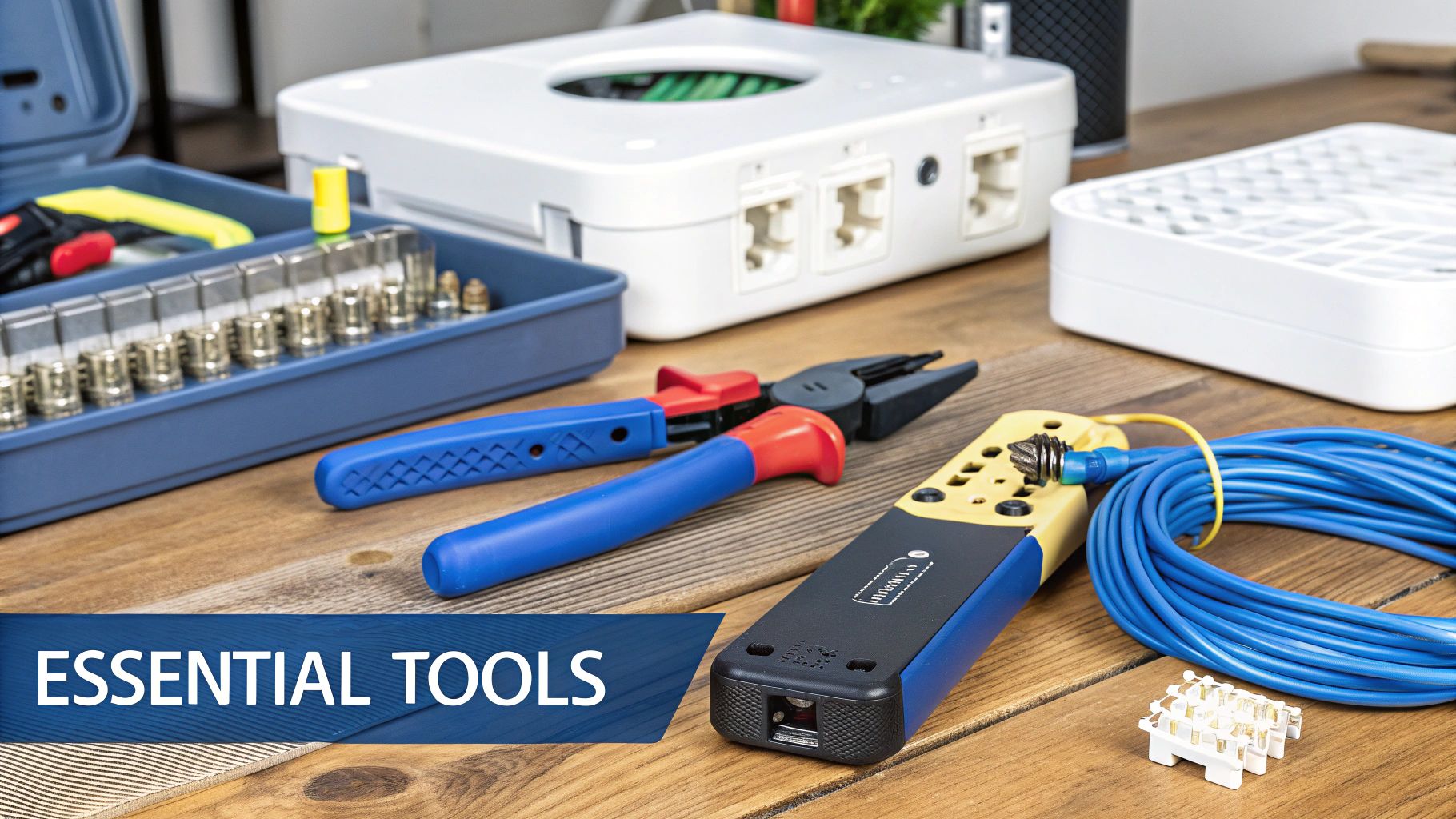
- Running the Lines: Now for the tricky part. The installer uses specialised tools, like flexible rods, to feed the Cat6a cables through wall cavities and ceiling spaces. It’s a bit of an art form, navigating unseen obstacles to get the cable from A to B without a single wire showing.
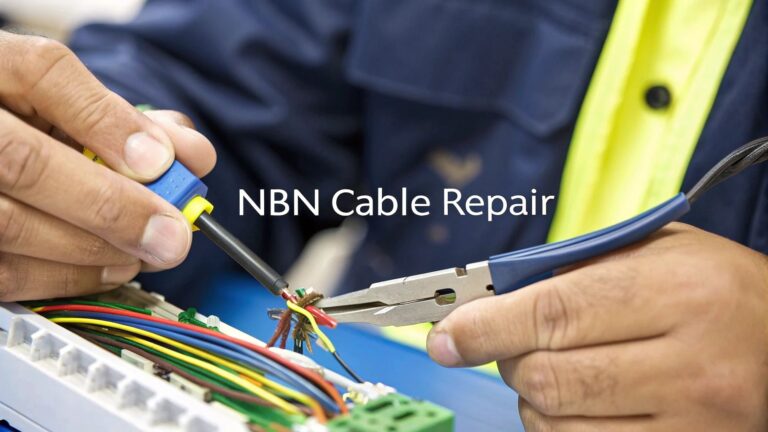
- Termination and Wall Plates: Once the cables are run, each end is expertly ‘terminated’ with a connector. This isn’t just plugging something in; it requires a specialised tool to ensure every tiny copper wire makes a perfect connection for optimal speed. A clean, professional wall plate is then fitted, looking just like any other power point.
Safety is a huge priority during any professional install, and there’s a strict process to protect your equipment, your property, and the technician.
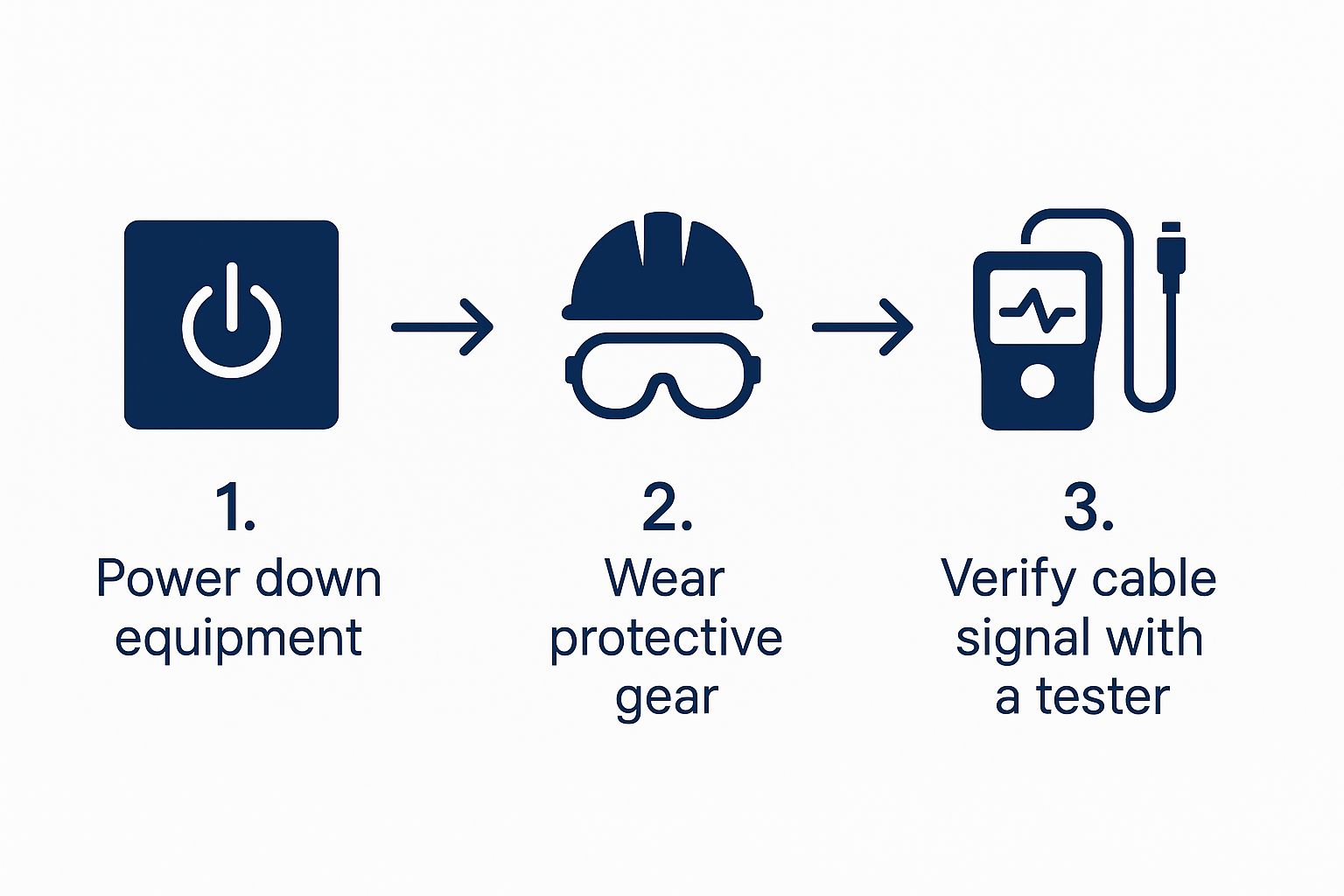
This simple, three-step safety flow ensures that every installation is carried out properly, without any risk to your home's electrical systems.
The Most Important Final Step: Testing
The job isn’t done when the tools are packed away. The final, and arguably most important, step is testing every single connection. The installer plugs a specialised network tester into each new data point.
This bit of kit doesn’t just check for a connection. It sends signals down the line to verify the speed, check for any signal loss, and confirm there are absolutely no wiring faults. It’s the ultimate quality assurance check.
This final step guarantees that every new port delivers the rock-solid, high-speed performance you’re paying for. For Dave, this means his home office now gets lightning-fast internet, and his smart TV streams in perfect 4K without a single hiccup. He’s left with a clean, professional setup that not only works perfectly but has also added genuine value to his home.
You can learn more about this whole process in our complete guide to data cabling installation.
How to Spot a Top-Notch Installer from a Dodgy One
Finding a great tradie can feel like a bit of a lottery, but you really can't afford to gamble when it comes to your home or business network. A dodgy installation can cause more headaches than the flaky Wi-Fi you were trying to fix in the first place. The good news? There are clear green flags to look for and bright red ones to run from.
Let’s talk about a mate, Mark from Newcastle. He needed a few data points installed and just went with the cheapest bloke he found on Gumtree. Big mistake. The guy offered a vague “cash price,” showed up late, and left a complete mess of tangled cables and wonky wall plates. To top it off, the connection was constantly dropping out. It ended up costing Mark double to get a real professional in to fix the whole disaster.
The Good Guys Checklist
A top-notch installer operates on a completely different level. They're proud of their work, and they have no problem proving it. Here’s exactly what you should be looking for:
- Proper Licensing: In Australia, anyone touching data cabling must have an ACMA ‘Open Cabler’ registration. Seriously, don't be shy—ask to see their card. It’s your only guarantee they know the standards and regulations to do the job safely and correctly.
- Proof of Insurance: Even with the best tradies, things can occasionally go wrong. A professional will always have public liability insurance to cover any accidental damage to your property. If they can't show you a current certificate, show them the door.
- Detailed, Itemised Quotes: A pro will give you a written quote that breaks everything down clearly. You should see the cost of labour, the type and amount of cable, and the price for every component like wall plates and connectors. That kind of transparency is a massive green flag.
Red Flags to Watch Out For
On the flip side, some warning signs should have you backing away slowly. Be wary of a vague verbal quote or anyone pushing hard for a “cash-only” deal—it often means they’re cutting corners somewhere else, and you'll have no recourse if things go pear-shaped.
Reading online reviews is a great idea, but do it with a critical eye. A small number of glowing-but-generic reviews can sometimes be faked. Look for detailed feedback that actually describes the job and the installer’s professionalism.
It’s worth noting the cabling industry has seen some big shifts recently. After the main NBN rollout, the installation market changed quite a bit, with larger companies taking over a lot of the work. This has definitely reshaped the scene for local installers, making it even more important to find someone you can trust. If you're curious, you can get more detail on the state of the Australian fibre optic installation industry to see what's happening.
Ultimately, choosing a qualified data cable installer isn't just about finding the lowest price. For a deeper dive, check out our guide on what to look for in a professional data cable installer. Think of it as an investment in getting the job done right, the first time.
Unlocking Your NBN's Full Potential at Home
Getting that NBN box installed on the side of your house is a fantastic first step, but it's really only half the job. The real magic happens when you deliver that incredible speed from the street right to the devices you actually use, day in and day out.
Think of it like this: the NBN is the high-speed motorway bringing traffic to your neighbourhood. Professional network cabling is your own private, multi-lane driveway that gets that speed directly into your garage. No bottlenecks, no delays.
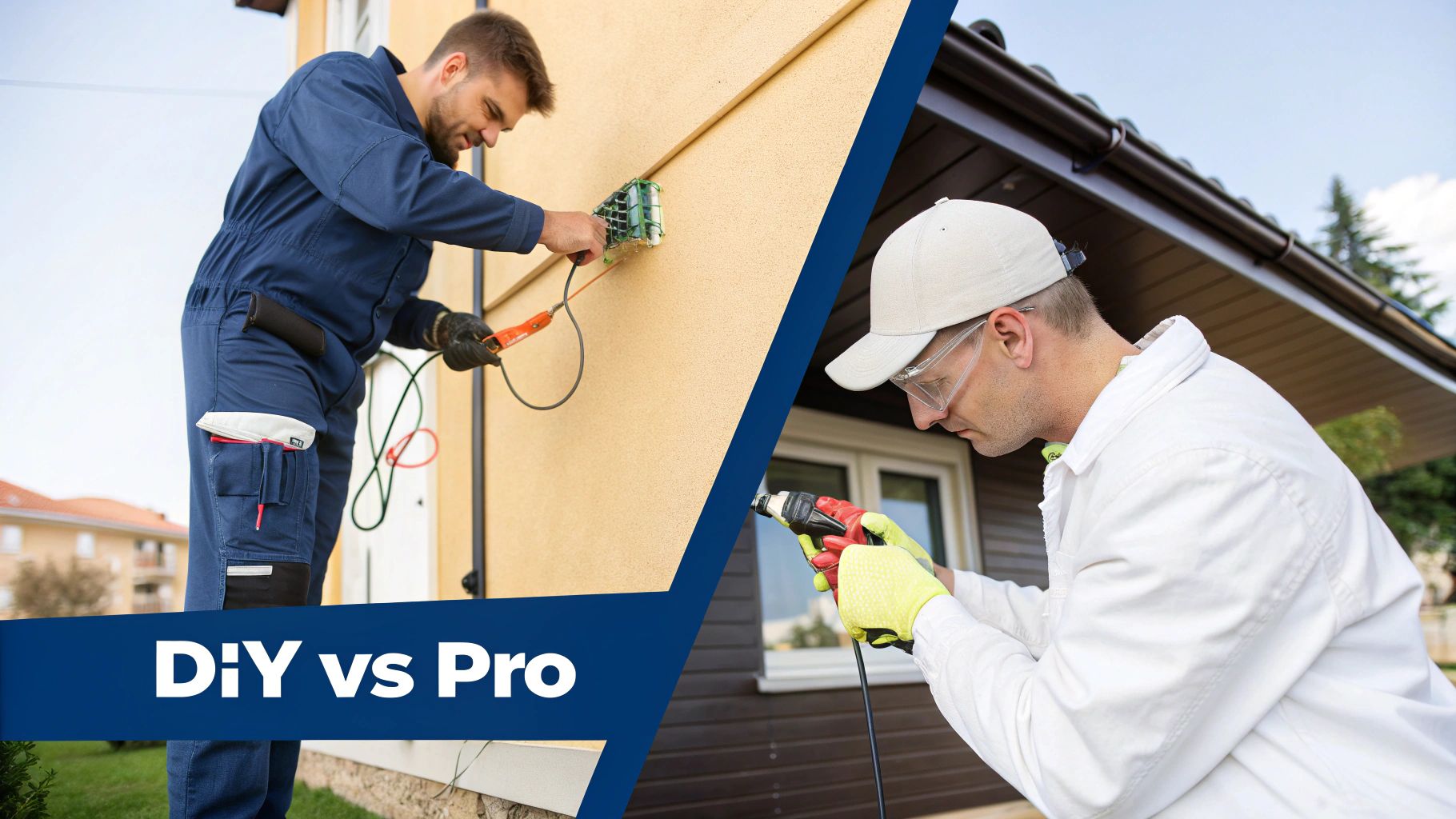
This is why looking up "network cable installation near me" isn't just about solving a tech issue; it's about upgrading your lifestyle. It's about creating a home where all your technology just works, seamlessly.
Real-World Scenarios Where Cabling Is a Game-Changer
A hardwired connection isn't just for tech geeks anymore; it's the best fix for some of the most common frustrations around the house. If you're working from a home office on the Central Coast, it means finally saying goodbye to embarrassing video call dropouts. Your connection will be rock-solid.
For the rest of the family, it’s all about smooth, uninterrupted entertainment.
- Lag-Free Gaming: Give the kids a dedicated, wired connection to their console. They'll get a gaming experience with zero lag, which helps keep the peace in the house!
- Perfect 4K Streaming: Make sure your smart TV has all the bandwidth it needs to stream movies and shows in stunning 4K, without ever seeing that dreaded buffering wheel again.
- Connecting the Whole Property: Need reliable internet in the granny flat out the back or the workshop down the garden? A professionally installed cable is the only way to guarantee you're getting full-speed coverage out there.
A professional installation is more than just a convenience; it’s an investment in your property. A home with a robust, structured cabling system is far more attractive to future buyers who expect seamless, reliable connectivity as standard.
Ultimately, a wired network gives you the strong foundation you need for a truly connected home. It consistently outperforms most off-the-shelf consumer solutions, which you can see when you compare a wired connection against Wi-Fi extender vs mesh systems. It's about building a digital backbone for your modern Aussie home that's ready for anything you throw at it.
Your Network Cabling Questions Answered
We get a lot of questions about getting a home or office professionally cabled up, so we've put together some quick, straightforward answers. Here’s what people from the Central Coast to Sydney are asking when they’re looking for a solid fix for their internet woes.
Is It Worth Getting My House Wired with Ethernet?
Absolutely, mate. While Wi-Fi is super convenient for scrolling on your phone, it's also a magnet for interference, dead spots, and slowdowns from things like your microwave or your neighbour's network.
A hardwired Ethernet connection is the only way to get the full-throttle speed, rock-solid stability, and security you’re actually paying your NBN provider for. It's a genuine game-changer for a serious home office, lag-free gaming, or flawless 4K streaming.
How Long Does a Typical Home Installation Take?
For an average-sized Aussie home needing around 3-5 data points, a professional job usually takes between 4 to 8 hours.
The exact timeframe really depends on your home’s construction. Navigating a double-brick wall in an older Newcastle home is a bit trickier and takes more time than working with a modern plasterboard build.
Think of it this way: a few hours of professional work can save you years of daily internet frustration. It's a small investment for a massive upgrade in digital peace and quiet.
Can You Install a Data Point Anywhere I Want?
Pretty much! A skilled cabler is a bit of a magician when it comes to finding discreet routes. We can run cables through wall cavities, ceilings, and under floors to place a data point exactly where you need it.
The goal is always to make it look like it was part of the original build—neat, tidy, and perfectly placed without ugly cables running along the skirting boards.
Ready to finally ditch the dodgy connection and get the internet you deserve? The team at Advanced Comtech has been helping homeowners and businesses across the Central Coast, Sydney, and Newcastle get reliably connected for years. Get in touch for a free, no-obligation quote today!