So, you’re forking out for a premium NBN plan, but your internet connection is less reliable than a Sydney train in a downpour. Sound familiar? For countless homes and businesses across the Central Coast, Sydney, and Newcastle, the real issue isn't the service provider—it’s the messy, outdated tangle of wires lurking inside the walls. That old cabling is the bottleneck throttling your speed and turning movie night into a buffering marathon.
Why Your NBN Connection Still Feels Like Dial-Up
It’s a story we hear almost every day. Someone signs up for a blazing-fast 100 Mbps plan, but when they run a speed test, they’re lucky to hit 30. It's easy to blame the NBN, but the truth is, the physical data cabling in your property is the real foundation for your connection.
Think of it this way: you can't drive a high-performance sports car down a potholed dirt road and expect a smooth ride. Your NBN plan is the sports car, but your internal wiring is that dodgy, neglected road.
The Real-World Impact of Bad Cabling
We recently worked with a small business owner in Erina who was at her wit's end. Her client video calls were constantly dropping out, turning important meetings into a pixelated disaster. She’d tried everything—upgrading her plan, buying a brand-new modem, even rearranging her office to chase a better Wi-Fi signal.
It turns out the culprit was a dodgy DIY wiring job done years ago using old telephone-grade cable. It simply wasn't designed to handle the demands of modern high-speed data. This one hidden problem was choking her entire business.
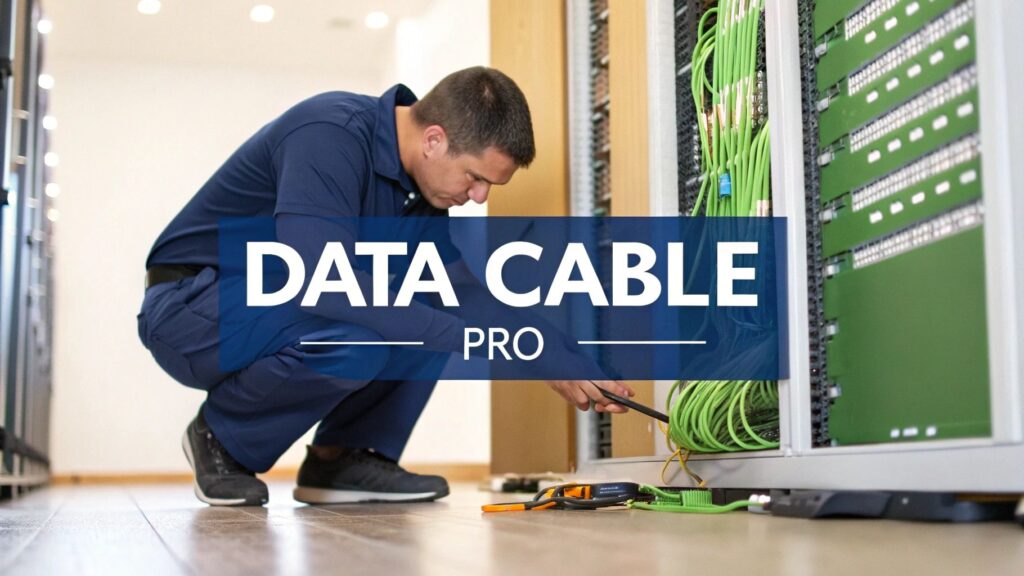
A professional data cable installer does more than just pull wires through a wall. They're essentially building the super-highway that lets your internet plan deliver the speeds you actually pay for.
This kind of situation is incredibly common. At the end of the day, your connection is only as good as its weakest link. For many people, that weak link is hiding right behind the plasterboard.
Before you spend another hour on hold with your internet provider, it might be time to look at the one thing they can't control: the cabling inside your property. A professional data cable installer can quickly diagnose and sort out these hidden issues, finally letting you tap into the internet performance you were promised.
Getting to Grips with Data Cabling Jargon
Ever had a tradie on-site at your Central Coast office, rattling off terms like ‘CAT6a’, ‘RJ45 ports’, and ‘structured cabling’ while you just nod along, hoping it all makes sense? You're not alone. It’s a language all its own, but understanding the essentials is a lot easier than you might think.
Think of it like choosing the right plumbing for your house. You wouldn't use a tiny pipe for a main water line, right? Data cabling is the same. Cat5e is your standard, reliable option—perfect for basic home internet and a few devices. Then you have Cat6, which is more like a multi-lane freeway. It's built to handle much heavier data traffic, making it the go-to for a modern office or a tech-heavy home.
So, Which Cable Is Right for You?
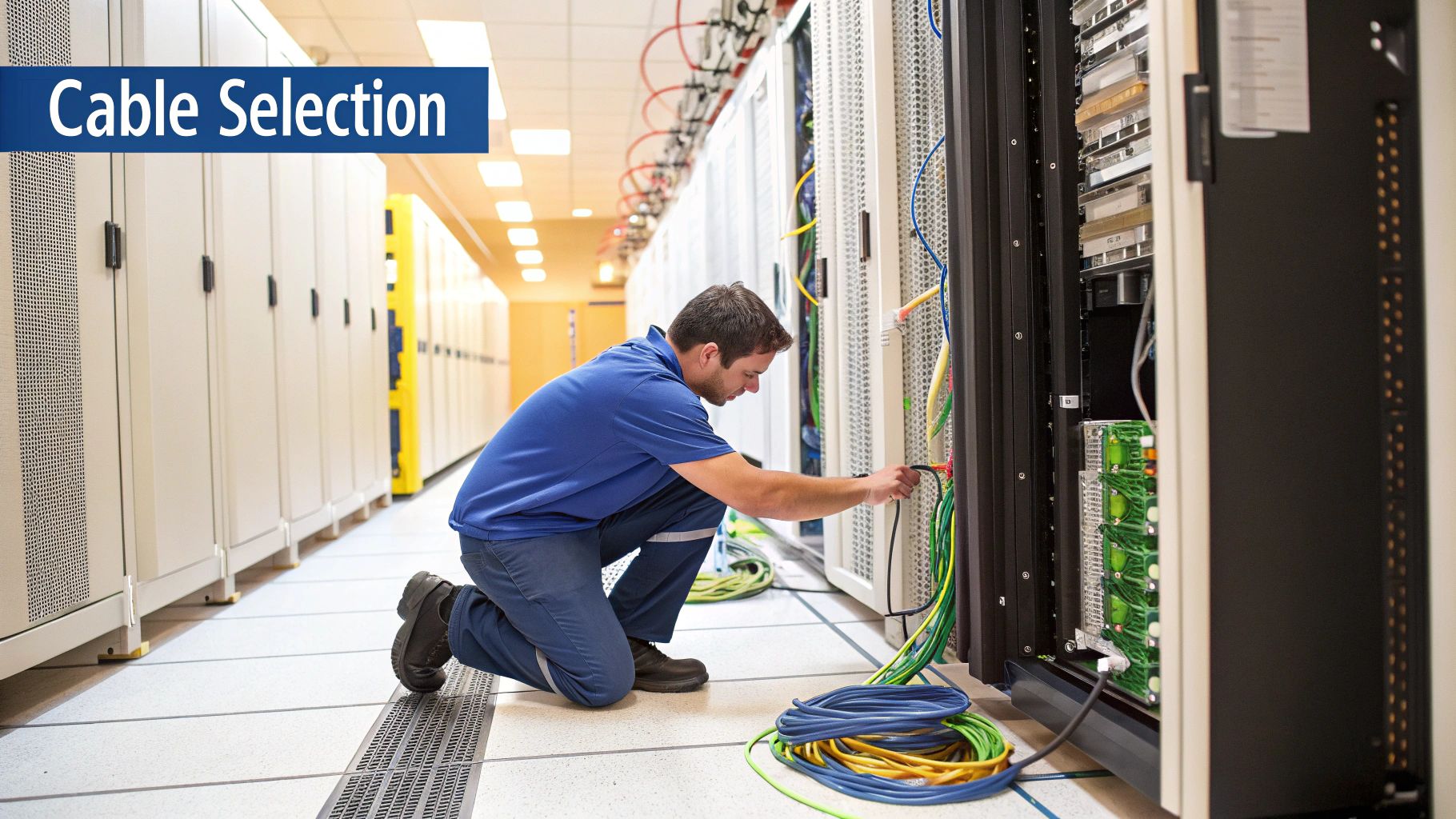
Choosing the right cable really just comes down to matching the tech to what you actually do. A small beach house in Terrigal with a couple of laptops and a smart TV will get by just fine with a Cat6 setup. But a growing Gosford business running multiple servers, high-def CCTV, and VoIP phones needs the bigger capacity of Cat6a or even fibre optics to avoid frustrating digital traffic jams.
This is where the idea of 'future-proofing' really comes into play. A good data cable installer doesn’t just solve today’s Wi-Fi blackspot; they set you up for whatever tech comes next. Spending a little extra on a better cable now can save you a fortune on a complete re-wire in five years. You can learn more by checking out our complete guide on data cabling.
A professional installer plans for the tech you don't even own yet. That’s the difference between a quick fix and a smart, long-term investment in your property's digital backbone.
Choosing Your Cable What's Right For You?
To make it even simpler, here's a quick rundown of the common cable types you'll encounter. It’s a good starting point for figuring out what best suits your home or business on the Central Coast.
| Cable Type | Best For | Good to Know |
|---|---|---|
| Cat5e | Basic home internet, email, and standard-definition streaming. | An older standard, but still capable for simple needs. It's the minimum you should consider. |
| Cat6 | Busy homes with multiple devices, 4K streaming, online gaming, and small offices. | The current sweet spot for price and performance. Offers a big step up in speed and reliability over Cat5e. |
| Cat6a | Larger offices, data-heavy tasks, video editing, and future-proofing. | Thicker and less flexible, so it can be trickier to install. It’s built for high-performance and 10Gbps speeds. |
| Fibre | Connecting buildings, server rooms, and situations needing maximum speed. | The ultimate in speed and reliability, but the cost and installation are on another level. |
Ultimately, the goal is to install a system that you can forget about because it just works. Picking the right cable from the get-go is the most important step.
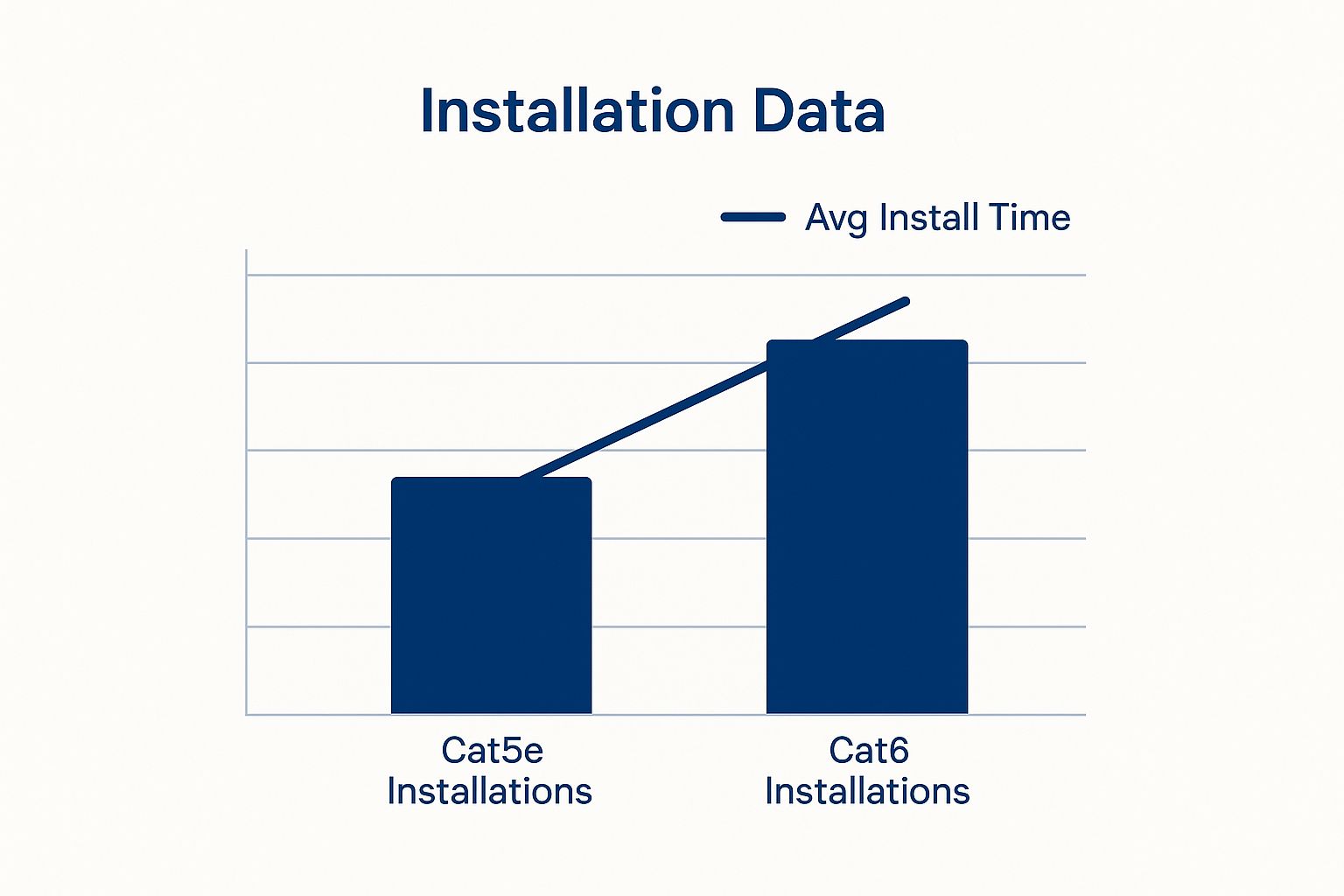
The data shows that while Cat6 installations might take a little more time due to more precise termination, its popularity is on the rise as people prioritise network performance. This reflects a broader trend, with Australia’s cable management market hitting a valuation of $798 million AUD. This sector is only set to grow, especially with the rise of smart systems that can monitor cable performance in real-time.
How to Spot a Pro from a Cowboy
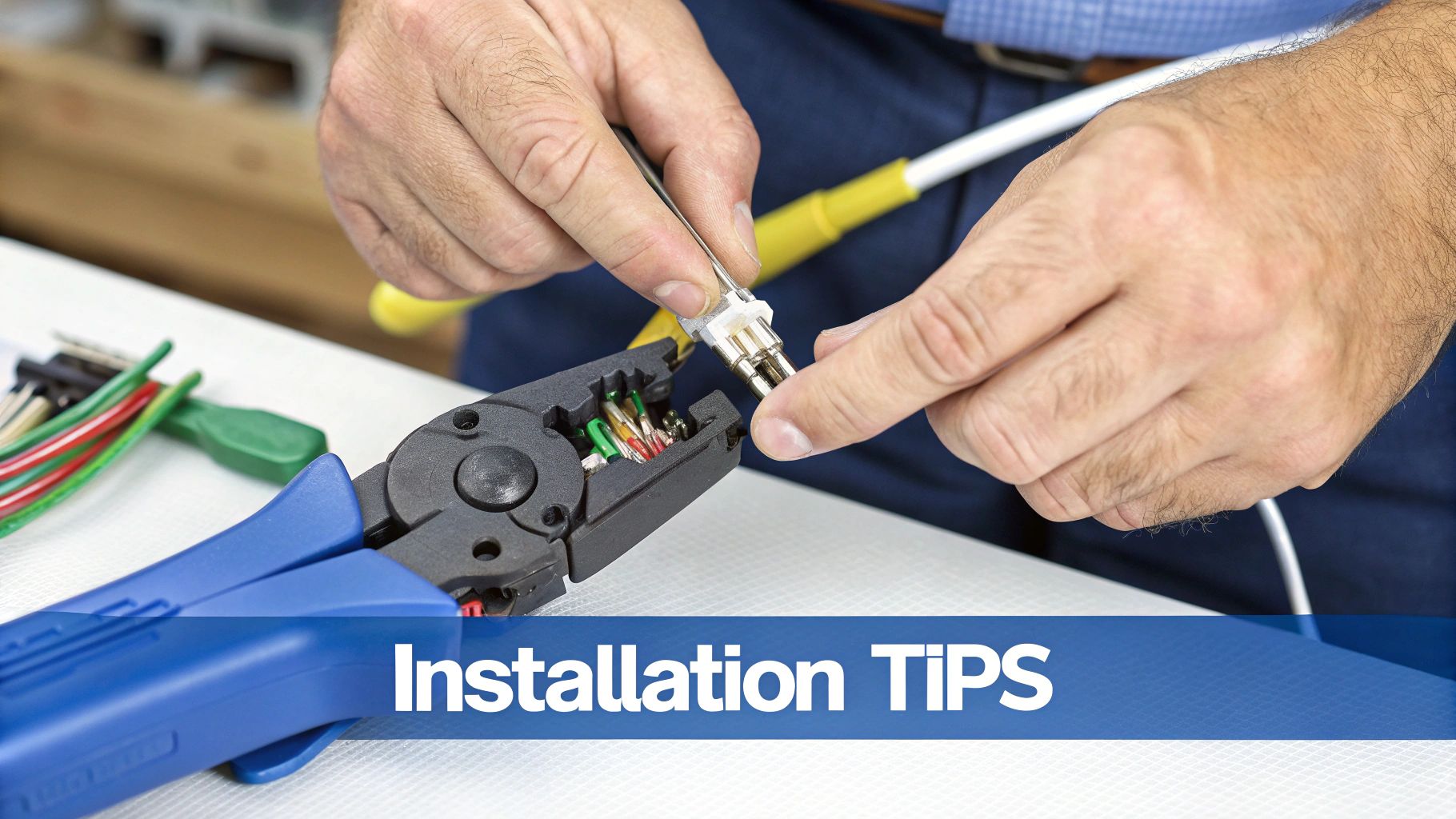
Finding a solid data cable installer on the Central Coast shouldn't feel like you're rolling the dice. But let's be honest, we've all heard the horror stories. The good news? Sorting the genuine professionals from the cowboys is actually pretty straightforward once you know what to look for.
First things first, there’s one absolute deal-breaker. Before you even get into quotes, ask this one simple question: "Are you an ACMA Registered Cabler?"
If they umm and ahh, dodge the question, or give you a vague "yeah mate, something like that," just walk away. Seriously.
In Australia, it's a legal requirement for anyone touching telecommunications cabling that connects to the public network to be registered with the Australian Communications and Media Authority (ACMA). A pro will have their 'Open' Cabler Registration card and will be happy to show you. It’s not just a nice-to-have; it's your proof they’ve had the proper training to do the job safely and to Aussie standards.
Reading Between the Lines of a Quote
Okay, so you've confirmed they're legit. The next test is their quote. A cheap, one-line quote scrawled on a scrap of paper is a massive red flag. A proper quote from a reputable installer will be detailed, transparent, and won't leave you guessing.
Here’s what you should see clearly laid out:
- Labour Costs: A clear breakdown of the hourly rate or a fixed price for the job.
- Materials: Specifics on the cable type (e.g., Cat6, Cat6a), wall plates, patch panels, and any other gear.
- Testing and Certification: A line item showing they will properly test every connection to make sure it performs as it should.
- Warranty: Clear info on the guarantee they offer for both their workmanship and the parts.
The cheapest quote is almost never the best value. It usually means corners are being cut—think dodgy materials, rushed work, or zero post-install testing. You'll end up paying for it later in troubleshooting headaches.
Arm Yourself with the Right Questions
Finally, a few smart questions can tell you everything you need to know. Don't be shy—a real expert will respect an informed client.
Try asking, "How do you test and certify your connections once they're installed?" A pro will mention using a network cable tester or even a Fluke certifier. A cowboy might just say they'll plug in a laptop to see if the light blinks.
Also, ask, "What warranty do you offer on your workmanship?" A confident installer will always stand by their work. Taking a moment to understand what a full professional data cabling installation involves can also arm you with more insight. A little homework now ensures you hire someone who will get the job done right the first time.
The Real Cost of Data Cabling in NSW
https://www.youtube.com/embed/y3DmOPrmBio
Alright, let's talk about the dollars and cents. Asking "how much does data cabling cost?" is a bit like asking "how long is a piece of string?". The final bill really hinges on a few key things, but I can give you a realistic idea of what to expect for projects around the Central Coast and Sydney.
A professional data cable installer doesn’t just pull a number out of thin air. They’re sizing up the job. For example, running a few new data points in a modern Woy Woy apartment with easy roof access is a world away from retrofitting a double-brick heritage home in Newcastle. One is straightforward; the other requires a lot more problem-solving.
What Shapes the Final Quote
The biggest driver of your final cost is, without a doubt, the complexity of the job.
- Building Structure: Older buildings with solid walls, tricky access points, and multiple storeys simply demand more time and expertise.
- Cable Quality: The type and quality of the cable you choose also plays a big part. It’s always tempting to save a few quid on cheaper cable, but trust me, it’s a false economy that will bite you later with poor performance.
As a rough guide, you could be looking at anywhere from $150 to $300+ per data point installed. For a small office setup needing a handful of points and a basic patch panel, you might budget somewhere between $1,000 and $3,000. These are just ballpark figures, of course.
The real cost isn't just what's on the invoice. It's the price you pay down the line in lost productivity, endless IT support calls, and the sheer frustration of a network that just won’t cooperate. Think of a professional installation as an investment against those future headaches.
This work is all part of a much bigger picture. The skills of a local data cable installer are directly tied to Australia’s booming data centre market, where construction costs in Sydney are hitting $10 to $11 AUD per watt. Whether it's a massive data centre or your home network, both rely on the same fundamental principles of quality cabling. You can find more insights on Australia's data centre growth on arizton.com.
Ultimately, paying for a professional job is about buying peace of mind. It’s the difference between a rock-solid, fast connection and constantly battling Wi-Fi blackspots—a common frustration we dig into in our post on Wi-Fi extenders versus mesh networks.
What a Professional Installation Actually Looks Like
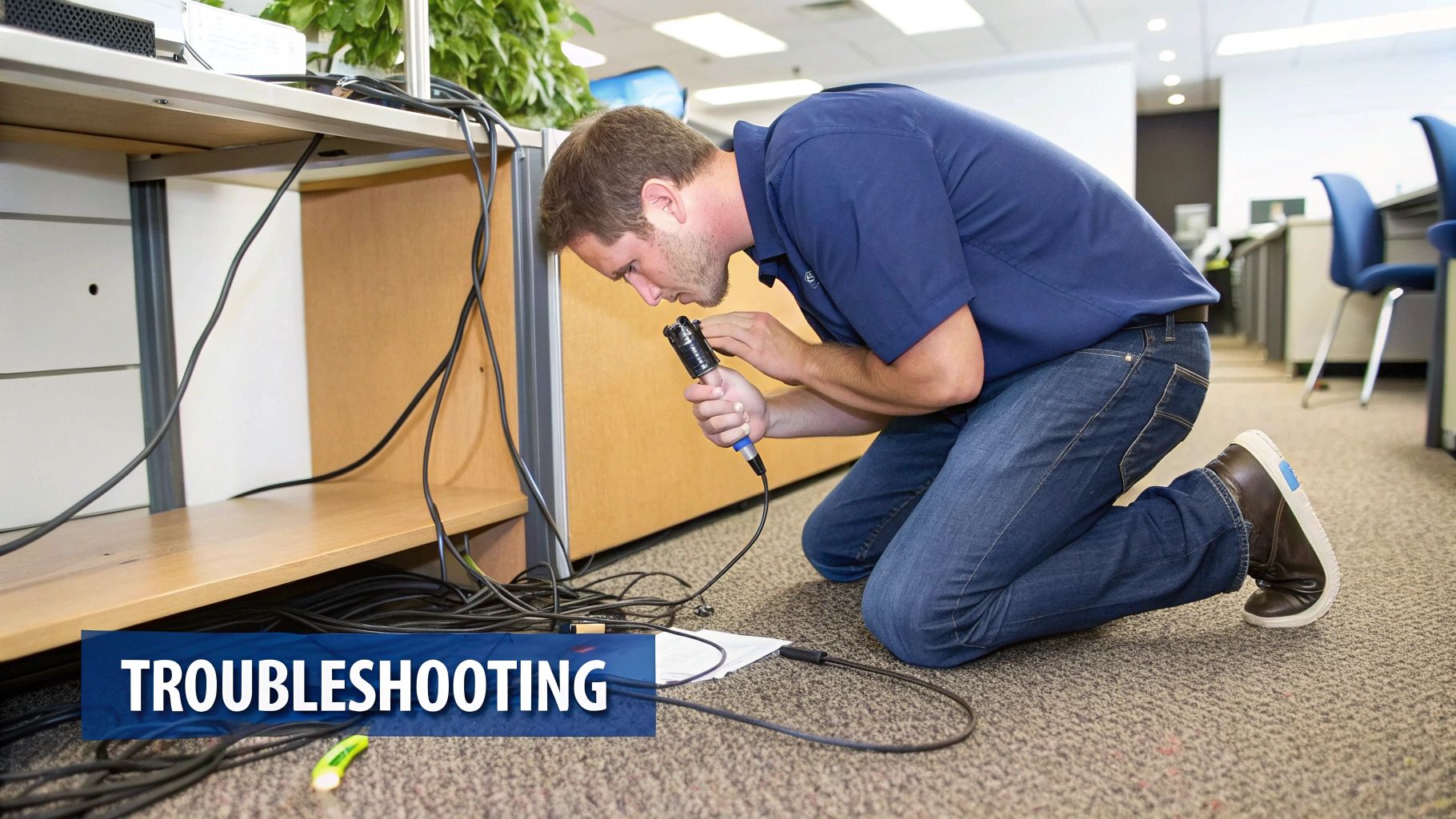
This is where the rubber really hits the road. You can talk theory all day, but seeing a professional data cabler transform a tangled mess into a streamlined network is something else entirely. It’s the difference between chaos and control.
Think about a typical small business here on the Central Coast—maybe a bustling café in Terrigal or a small office in Gosford. We've all seen it: that dreaded "spaghetti junction" of cables lurking under the front counter or in the back office. The internet drops out, the EFTPOS machine gets sluggish, and no one has a clue which cable goes where. It's a disaster waiting to happen.
This is where a real pro steps in. The first thing they'll do isn't rip out the old wires. They'll start by listening and then creating a solid plan. They'll walk the site, figuring out the smartest, cleanest pathways for new cables—often through wall cavities or ceiling spaces to keep everything out of sight. It's not just about aesthetics; it's about protecting the cabling from damage and making life easier for any future maintenance or upgrades.
From Chaos to Order
Once a plan is agreed upon, the installation begins. A qualified installer will run quality cabling, like Cat6 or Cat6a, from a central point to every single spot that needs a connection. Each cable is terminated with precision—no loose, dodgy connections that will fail in six months. They'll also cut every cable to the exact length needed, which immediately eliminates the slack that creates those messy bird's nests under desks.
The heart of any professional job is the patch panel and communications cabinet. This is where all the new cable runs meet. Instead of a jumble of wires plugged directly into a router, each cable is properly terminated onto the panel and clearly labelled. It instantly turns a confusing mess into a logical, organised system that anyone can understand.
A great installation isn't just about making things work today. It's about creating a reliable digital foundation that you won't have to think about again for years to come.
The All-Important Final Test
The job’s not done just because everything is plugged in. The final, and arguably most critical, step is testing. A professional will use specialised equipment, like a network certifier, to test every single cable run from end to end.
This isn't a simple "does the light blink?" check. This test confirms the cable can handle the data speeds it's rated for, ensuring you get the performance you paid for. This certification is your guarantee that the job was done right.
This meticulous process is what separates the pros from the amateurs, whether it's for a busy commercial site or a high-performance home networking installation. The industry has certainly evolved since the major NBN rollout, and with our ever-increasing demand for data, the need for skilled technicians has never been higher.
Still Got Questions About Data Cabling?
It's only natural to have a few more questions rattling around before you commit. We get it. Let’s tackle some of the most common things we hear from folks on the Central Coast when they’re thinking about getting a data cable installer in.
Can't I Just Do This Myself?
Look, the DIY spirit is strong, and we respect that. But when it comes to data cabling, this isn't the time to have a crack at it yourself. In Australia, it's a licensed trade for a very good reason.
You legally must hold an ACMA registration to touch any cable that connects to the broader telecommunications network—that includes your NBN connection.
Hiring a pro means your network is not only compliant and safe but also actually performs the way it's supposed to. A dodgy DIY job often leads to frustratingly slow speeds, constant dropouts, and can even land you with a hefty fine. A professional installation is also a massive part of your digital security. You can read more on how to secure your Wi-Fi network in our dedicated guide.
How Long Is This Going to Take?
That's the million-dollar question, and the honest answer is: it really depends.
Popping a single new data point into a modern home with easy access might only take an hour or two. But if we're talking about wiring up a small office with a dozen points, setting up a patch panel, and navigating double-brick walls, you could be looking at a full day's work, or even longer.
A sign of a true professional is transparency. They should always give you a clear and realistic time estimate in their quote after they've had a proper look at your property.
Is This Going to Wreck My House?
Absolutely not. A professional installer takes real pride in their workmanship, and that includes leaving your place spotless.
Their expertise isn't just in making the network run perfectly; it's also about running cables discreetly through wall cavities and ceilings to minimise any visual impact. They'll always clean up any mess, leaving your home or office just as tidy as they found it.
Ready to get your network sorted once and for all? The team at Advanced Comtech has the local expertise to deliver a clean, reliable, and high-performance data cabling solution for your Central Coast home or business. Get in touch with us today!