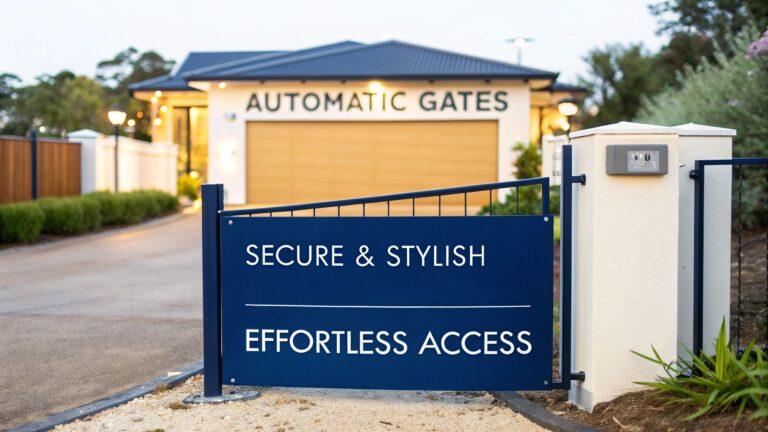
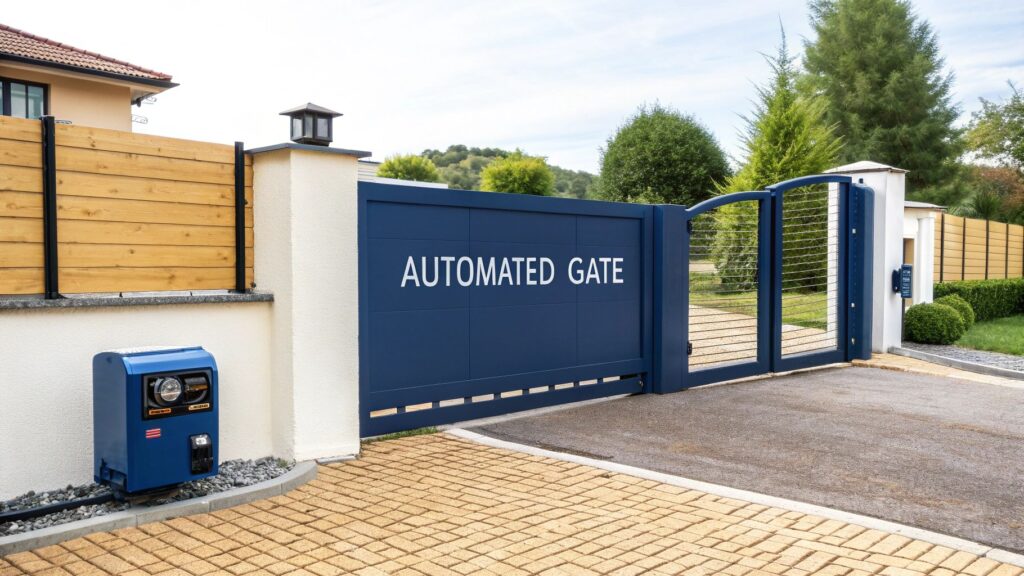
Tired of making that mad dash from your car to the gate in a downpour? Imagine this: it’s bucketing down, you’ve just battled the M1 traffic from Sydney, and the last thing you want to do is get soaked wrestling with a heavy, manual gate. A gate automation system is the answer, letting you open and close your driveway gate with nothing more than the push of a button.
Think of it as adding a bit of remote-controlled magic to your home's entrance. These systems cleverly combine an electric motor, a control unit, and safety sensors to give you a massive boost in both convenience and security.
What Exactly Is a Gate Automation System?
At its heart, a gate automation system simply gives your manual gate a brain and some muscle.
The electric motor provides the brawn to do the heavy lifting, while a smart control panel acts as the brain, taking commands from your remote control or smartphone and putting them into action.
For anyone living on the Central Coast, or in Sydney and Newcastle, it’s all about that simple, satisfying click of a button from the dry comfort of your car. It’s a small luxury that makes a huge difference, especially when a southerly buster decides to roll in right as you get home.
So, what are the real perks?
- All-Weather Convenience: No more getting drenched in the rain or battling the wind.
- A Real Security Boost: You control exactly who comes in. An automated gate is a serious deterrent to unwanted visitors, only opening for authorised remotes or keypads.
- Instant Kerb Appeal: A sleek, modern automated gate doesn't just look great; it can genuinely increase your property's value.
A Quick Look at the Core Components
Choosing the right system really comes down to your gate's style and weight. You wouldn't use the same motor for a light swing gate as you would for a heavy sliding one. It'd be like trying to tow a caravan with a hatchback—not a pretty sight.
For example, a sliding gate typically needs a linear actuator that pulls it along a track, while a swing gate often uses an articulated arm that mimics how you'd open it by hand.
Safety is also a massive part of the equation. Modern systems come with features like photoelectric sensors – little invisible beams that stop the gate in its tracks if a pet, child, or car gets in the way. It’s a non-negotiable feature.
Here in NSW, we have to think about the local climate, too. Every installation needs to be tough enough to handle everything from the salt-laced sea breeze on the Central Coast to humid Sydney summers.
Pro Tip: Always look for a motor with a high IP rating. This number tells you how well it’s sealed against dust and water, which is crucial for surviving our coastal weather and keeping maintenance costs down.
For many homeowners, the ability to control their gate from a smartphone app is the ultimate game-changer. It adds another layer of convenience and peace of mind, especially when you’re away from home.
Here are a few other popular features to consider:
- Smartphone Integration: Get real-time alerts, check access history logs, and open the gate for a delivery driver from anywhere.
- Backup Power: A solar panel or battery backup means your gate will still work perfectly, even during a blackout.
- Visitor Keypads: Easily set up temporary codes for tradies or guests without having to hand out extra remotes.
Ready to say goodbye to the soggy sprint and add a touch of class to your home? Getting a handle on these basics is the first step toward picking the perfect gate automation system for your Central Coast, Sydney, or Newcastle property.
How Gate Automation Systems Actually Work
Ever wondered what’s really happening when you press that button and your gate glides open like a scene from a fancy movie? It might seem like magic, but gate automation systems are really just a clever team of components working together in perfect harmony. Think of it as a remote-controlled butler for your driveway, minus the snooty attitude.
At its core, an electric motor provides the muscle, doing all the heavy lifting. This is paired with a control panel, which acts as the brain of the whole operation. When you send a signal—whether from a classic remote, a wall-mounted keypad, or even an app on your phone—the brain gets the message and tells the muscle to get to work.
The Brains and The Brawn
The whole process is surprisingly straightforward. Your command travels wirelessly to the control box, which then sends an electrical current to the motor, also known as an 'actuator'. This motor is physically connected to your gate, so as it runs, it pushes or pulls the gate open or closed. It's a simple idea, but the execution is what makes it so reliable for homes all the way from the Central Coast to Newcastle.
But what stops the gate from closing on your car, the dog, or a stray wheelie bin? This is where the system gets really smart.
Safety sensors are the system's eyes and ears. They create an invisible light beam across your gateway. If anything breaks that beam while the gate is closing, the control panel instantly orders the motor to stop and reverse, preventing any unfortunate crunches.
More Than Just a Motor
Today’s gate automation systems are complete entry solutions that bring both security and serious convenience. They're a far cry from just being a simple motor on a timer.
This diagram shows how a typical swing gate operator works, with a mechanical arm connecting the gate to the pillar to create that smooth swinging motion.
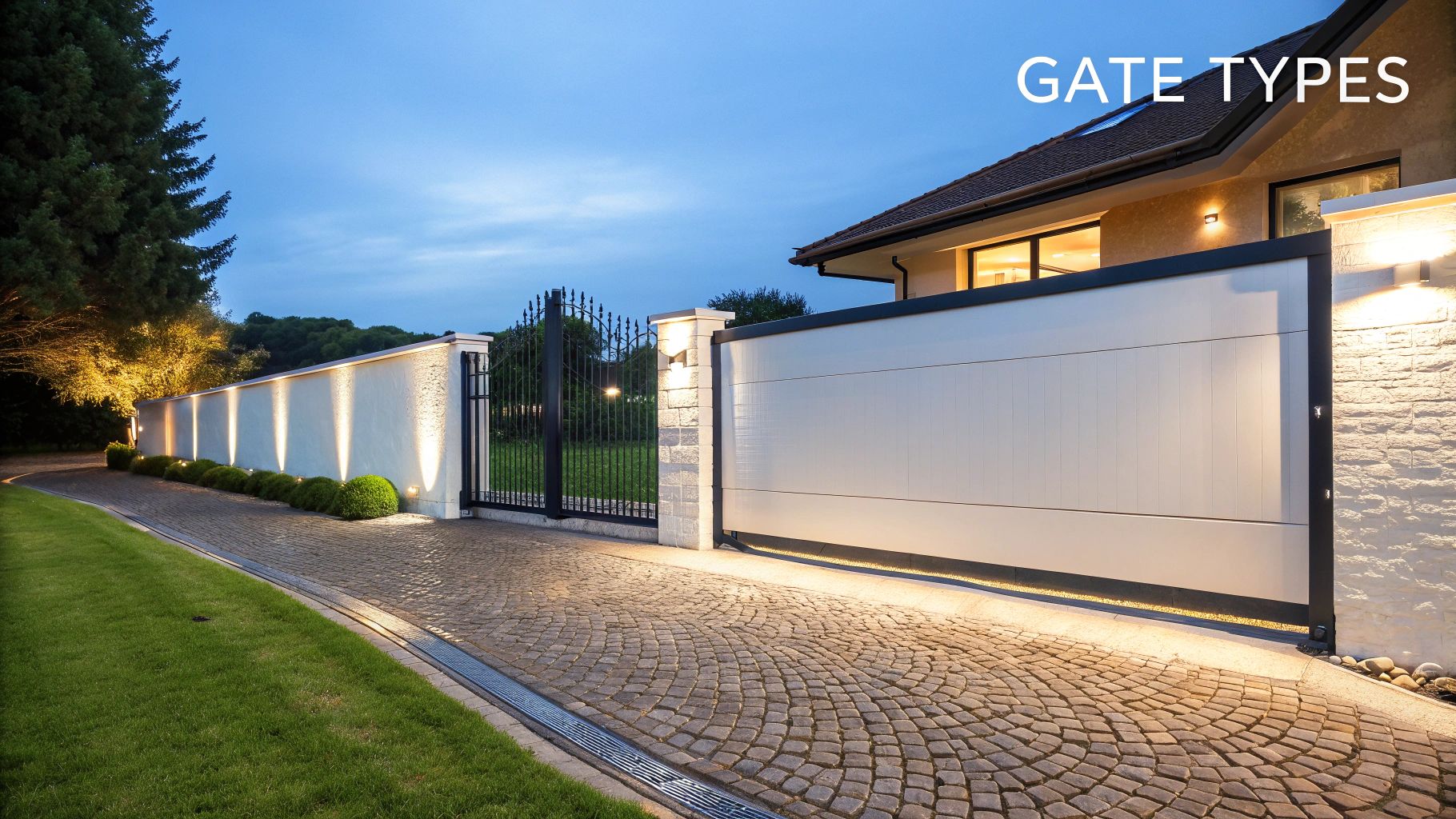
This kind of setup is what translates your remote's signal into physical force, giving you the power needed to smoothly swing even the heaviest gates.
These integrated systems are becoming more and more popular across Australia, fitting into a much bigger picture of modern home infrastructure. The global gate automation market was recently valued at around $28 billion AUD, a figure largely driven by a growing demand for better security and the ability to monitor our properties remotely. You can read more about the global trends in gate automation on 360iResearch.com.
These systems can also tie into your broader home security setup. For instance, integrating your automated gate with cameras gives you a full picture of who is coming and going. You can find more info on this in our guide to CCTV and home security. It's this powerful combination of mechanical brawn, smart controls, and essential safety features that transforms a simple gate into a cornerstone of modern home management.
Breaking Down the Key Components
Every automated gate system, whether it’s a sleek slider in a Sydney suburb or a classic swing gate on the Central Coast, is a bit like a well-drilled footy team. Each part has a specific job, and they all need to work together flawlessly to get the job done. If one piece is off its game, the whole system can fall apart.
So, let's pull back the curtain and meet the key players that make the magic happen. Getting your head around what each component does is crucial for choosing a system that can handle everything from salty coastal air to scorching summer heatwaves.
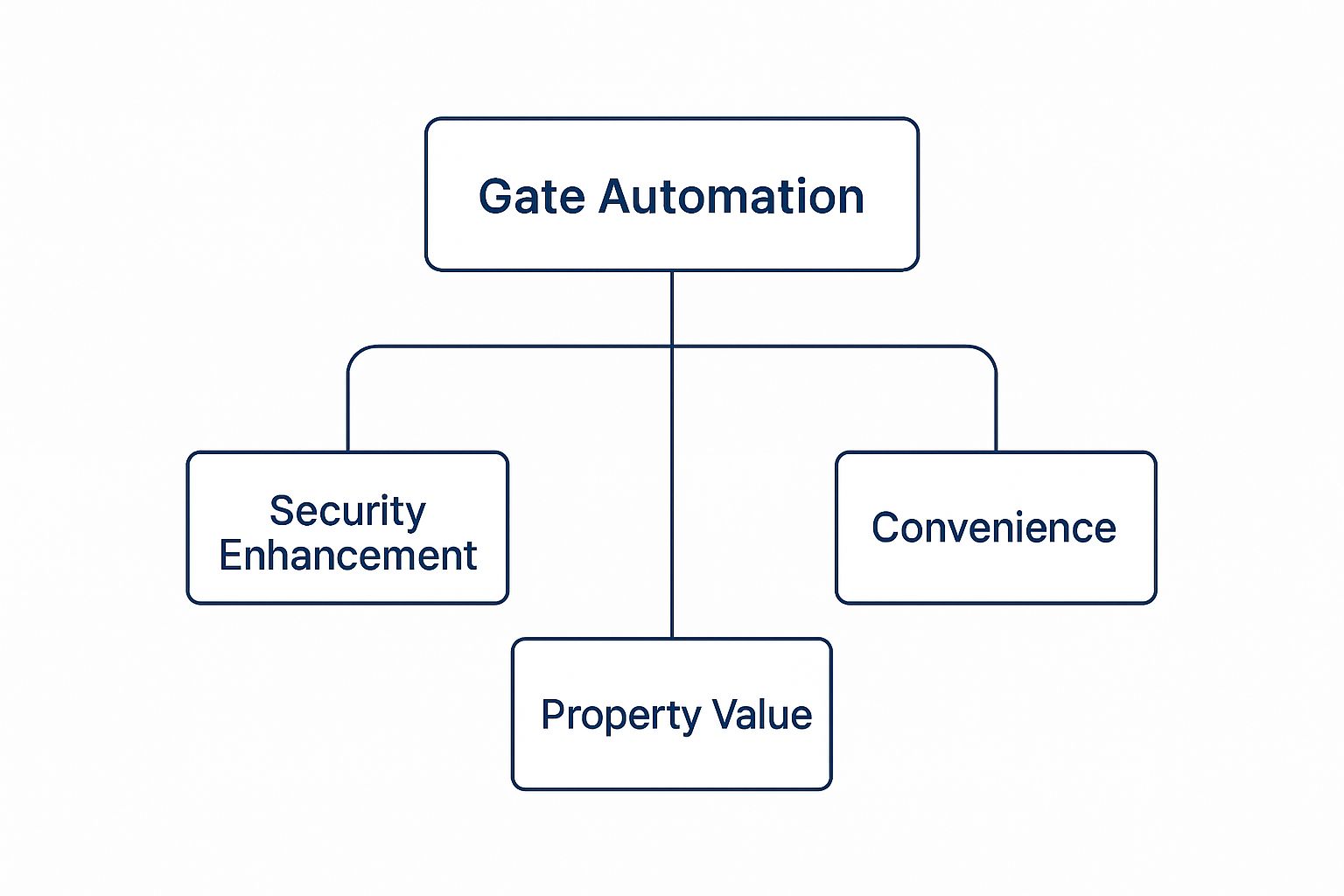
As you can see, the value of gate automation goes far beyond just opening and closing. It branches out into real, tangible improvements in security, daily convenience, and your property's overall appeal.
Let’s take a closer look at the essential parts that make up a gate automation system and what each one actually does.
Gate Automation System Components and Functions
A look at the essential parts of a gate automation system and what they do.
| Component | Function |
|---|---|
| Motor (Actuator) | The powerhouse of the system. It physically moves the gate, converting electrical energy into the mechanical force needed to open and close it. |
| Control Unit | The "brain" of the operation. This circuit board receives signals from access devices and tells the motor what to do, managing speed and safety features. |
| Photocells (Safety Beams) | A critical safety feature. They project an infrared beam across the gateway; if the beam is broken, the gate stops and reverses to prevent accidents. |
| Access Control Device | The user interface. This is how you tell the gate to open, and it can be a remote control, keypad, smartphone app, or intercom system. |
Each of these elements must work in perfect sync for a reliable and safe setup. Now, let's dive into each one in a bit more detail.
The Motor: The Heart of the Operation
The star player of any gate automation system is undoubtedly the motor, sometimes called an actuator. This is the powerhouse, the engine that does all the heavy lifting. It’s what physically moves your gate, converting electrical energy into the force needed to glide open a heavy sliding gate or swing open a pair of elegant driveway gates.
Choosing the right motor isn't just about raw power; it's about matching it to your gate's weight, length, and how often you'll be using it. A motor that’s too weak will struggle and burn out, while one that’s overkill is just a waste of money. It's the Goldilocks principle of gate automation—you need one that’s just right.
The Control Unit: The Brains Behind the Brawn
If the motor is the muscle, the control unit (or control board) is the central command centre. This clever box of electronics is the brain of the entire operation. It receives instructions from your remote or keypad, tells the motor when to start and stop, and manages all the safety features.
It’s where all the settings are configured, like how fast the gate moves or how long it stays open before automatically closing. A high-quality control unit offers more flexibility and reliability, ensuring your gate behaves exactly as you want it to, every single time.
Safety First: Photocells and Sensors
You wouldn't want your gate to close on your car, your pet, or a child. That's where photocells, also known as safety beams, come in. These are the unsung heroes of gate automation.
They work by sending an invisible infrared beam across the gateway. If anything breaks that beam while the gate is closing, the control unit instantly stops the motor and tells it to reverse. It’s a simple but incredibly effective safety feature that is an absolute must-have for any residential gate system.
Modern gate automation is part of a massive global movement. The Australian market is a piece of a worldwide segment valued at around $3.8 billion AUD, which is expected to grow as demand for solar-powered and battery-backed systems increases. You can read more about the automatic gate market on Business Research Insights.
Access Control: How You Get In
Finally, you need a way to actually tell your gate to open. This is handled by your access control device, and there's a whole range of options to suit different needs and budgets:
- Remote Controls: The classic, reliable choice. Keep one in the car, one on your keys, and you’re good to go.
- Keypads: Perfect for visitors or kids who don’t have a remote. Just punch in a code, and you're in.
- Smartphone Apps: The modern solution that lets you open your gate from anywhere. Great for letting in a delivery driver when you're not home.
- Intercoms: Allows you to speak to visitors before granting them access, adding another layer of security.
Each of these components plays a vital role. When they’re all chosen and installed correctly, they create a reliable, safe, and incredibly convenient system for your Newcastle, Sydney, or Central Coast home.
The Real Benefits of an Automated Gate
Let's be honest, the biggest win with an automated gate system is the sheer convenience. Picture this: you’re pulling into your Central Coast driveway after a long day, and the heavens open up with that classic NSW downpour. Instead of making a mad dash to heave open a manual gate, you simply press a button and glide right in. Dry and smug. That feeling alone is priceless.
But the perks go way beyond just staying out of the rain. An automated gate is a serious upgrade to your home’s security, its value, and your overall peace of mind. It’s about taking full control over the very first line of defence for your property.
A Serious Boost to Your Security
A manual gate that’s often left unlocked—or worse, wide open—is pretty much an open invitation for trouble. An automated gate, on the other hand, is a powerful deterrent. It makes it significantly harder for opportunistic thieves or unwanted visitors to just wander onto your property. Suddenly, you're not such an easy target.
This controlled access is a complete game-changer. You decide exactly who comes and goes, whether it’s with a remote, a keypad code, or an intercom system. This isn't just about keeping people out; it’s about creating a secure bubble for your family, pets, and possessions. It’s a key piece in a robust home defence plan, and you can see how it fits into the bigger picture by exploring modern smart home security systems.
An automated gate is one of the most effective ways to establish a clear, controlled perimeter for your home. It’s not just a barrier; it's a statement that your property is secure and monitored.
Adding Value and Kerb Appeal
You can't underestimate the power of a great first impression. A well-installed, stylish automated gate adds a premium touch that potential buyers absolutely notice. It tells them a property is modern, secure, and well-maintained, which can seriously boost its street appeal and, ultimately, its market value.
Just think about it from a buyer’s perspective in a competitive Sydney or Newcastle market. A home that already has an automated gate has a head start in both convenience and security. It’s a feature that adds a touch of class while being incredibly practical.
- Financial Perk: A quality automated gate can add thousands to your property's resale value, often providing a return on investment that goes beyond the initial cost.
- Aesthetic Upgrade: From sleek minimalist designs to classic wrought iron, the right gate can perfectly complement your home’s architecture.
- Insurance Benefits: Some insurance providers might even offer lower premiums for homes with enhanced security like automated gates, as they reduce the risk of theft and vandalism.
At the end of the day, a gate automation system is far more than a simple convenience. It’s a smart investment in your security, your property's value, and your daily comfort. It's about making your home a safer, more pleasant place to be, one smooth, effortless entry at a time.
Choosing The Right System For Your Home
Alright, so you’re done with the soggy sprint to your gate. Now comes the fun part—picking the perfect gate automation system for your place. It’s not quite like grabbing a snag at Bunnings, but it’s also not rocket science.
Matching The Motor To Your Gate
Think of the motor as the engine under your gate’s bonnet. You wouldn’t drop a hatchback motor into a ute; the same goes for your gate. Is yours a slider gliding along a track, or a swing gate that pivots open like a door? Each style demands its own kind of muscle.
A sliding gate motor uses a cog wheel that hooks into a rack on the gate, pulling it smoothly back and forth. Swing gates usually rely on an articulated arm or hydraulic ram to push and pull. Nail this first choice, and you’re off to a solid start.
Once you know the style, check the specs. You’ll see ratings for maximum weight and length—pick a motor rated for at least 20–30% more than your gate’s actual heft. That buffer keeps things humming, even on a gusty Central Coast afternoon.
Don’t skimp on price when it comes to the motor. A bit of extra grunt up front means fewer headaches down the track.
Built For The Aussie Climate
From Bondi to Bar Beach, our weather runs the gamut from scorching sun to salt-laden storms. That’s where the IP rating becomes your best friend. It’s a two-digit score that tells you how well a motor’s casing stands up to dust and water.
For coastal setups, aim high. A robust IP rating means those electronics stay dry, rust-free and working, no matter how heavy the downpour or how fierce the sea spray.
Gate Type Comparison
Here’s a quick rundown of the most popular gate styles and where they shine.
| Gate Type | Ideal Use Case | Cost Range (AUD) |
|---|---|---|
| Sliding Gate | Long driveways, uneven ground | $2,000 – $4,500 |
| Swing Gate | Traditional entryways, decorative homes | $1,500 – $3,500 |
| Cantilever Gate | Heavy gates, rough terrain | $3,000 – $6,000 |
| Bi-Folding Gate | Tight spaces, modern designs | $2,500 – $5,000 |
This table helps you weigh up style, space and budget before you buy. Each gate brings its own perks—pick the one that suits your drive and your décor.
Power, Price, And Peace Of Mind
Now let’s talk wallet and extras. A basic DIY kit can start around $800, while a pro installation with all the bells and whistles might set you back $5,000 or more.
What do those extras look like?
- Solar Power or Battery Backup: Keeps your gate rolling during a blackout.
- Smart Integration: Hook up to your security system for one-touch control.
- Premium Safety Features: Advanced sensors and auto-reverse for extra protection.
Choosing the right system comes down to balancing your needs, your driveway and your budget. Get it right, and you’ll enjoy years of hassle-free, secure access.
For more on tying your gate into a wider security setup, check out https://advancedcomtech.com.au/blog/best-security-cameras-for-home/.
2. Installation and Maintenance: Getting It Right
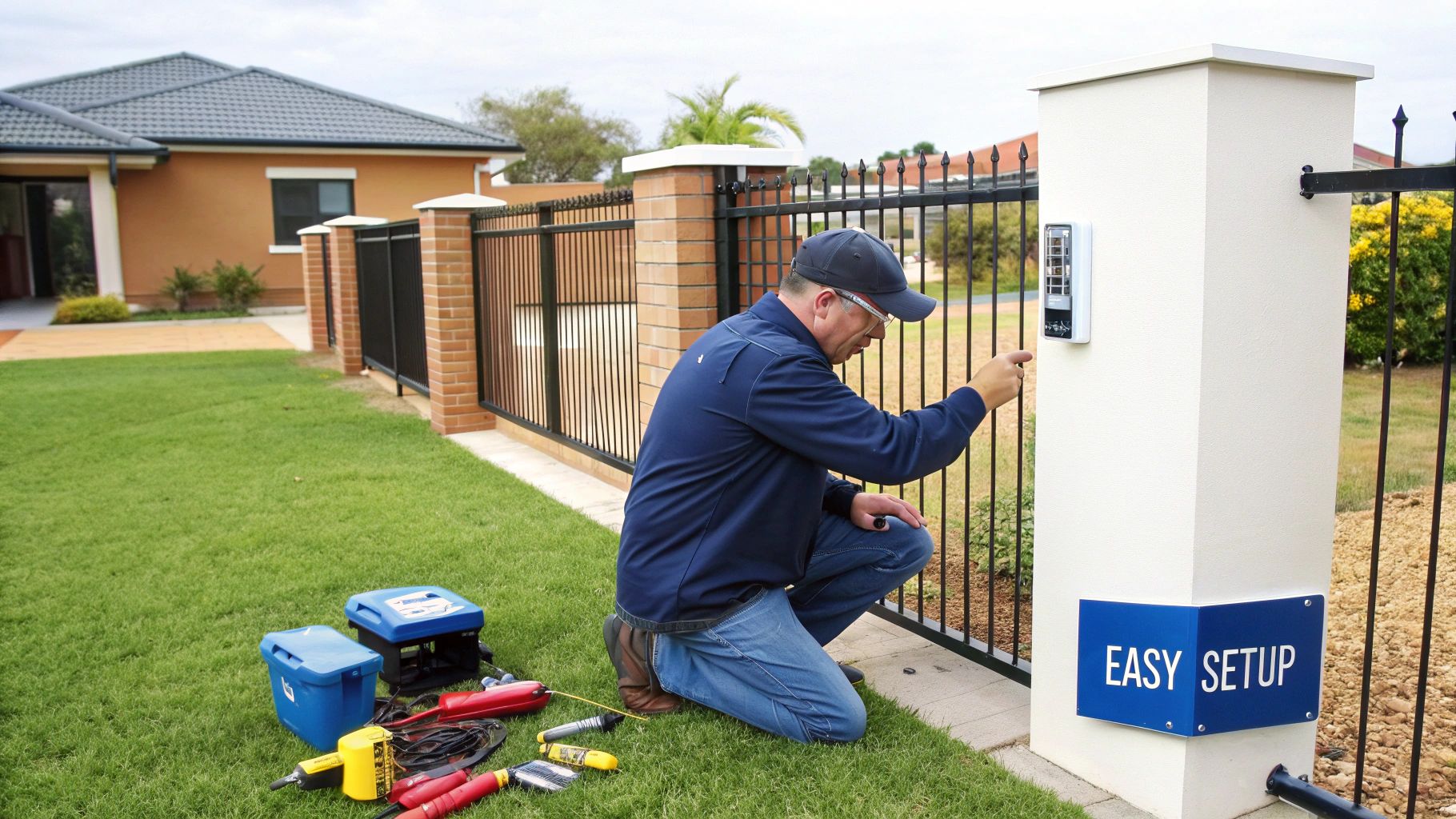
So, you’ve settled on the perfect gate automation system. Fantastic! Now comes the crucial next step: the installation. This is where you hit that classic Aussie crossroads—do you roll up your sleeves and give it a go yourself, or do you call in the professionals?
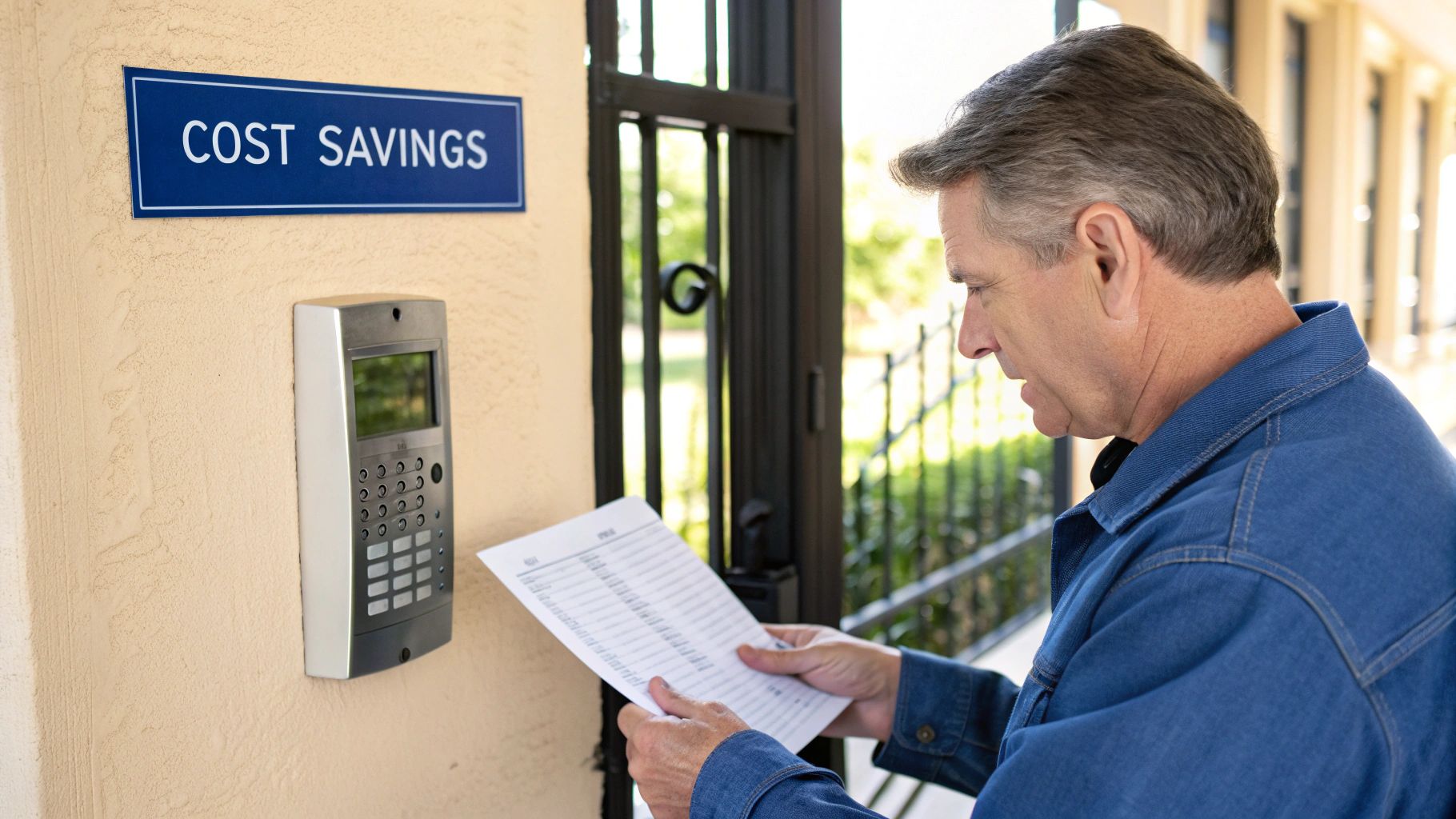
DIY vs. Professional Installation
Let’s be real, the DIY route can look mighty tempting. You save a bit of cash, and there's a certain satisfaction that comes from tackling a project yourself. If you’re a pro with a power drill and reading wiring diagrams is your idea of a good time, it could be a rewarding weekend job.
But here’s the thing: a lot can go sideways between unboxing the parts and that first smooth, automated swing.
A professional installer isn't just a pair of hands; they bring years of experience. They know how to ensure the wiring is not just functional but completely safe and up to code. They'll get the tracks perfectly level—something that's absolutely vital for a smooth slide—and calibrate every single safety feature. Get any of this wrong, and you could end up with a gate that groans, sticks, or worse, becomes a serious safety risk.
A professional installation is less about convenience and more about long-term peace of mind. When you know it's done right, you can trust your gate to work safely and reliably for years, saving you from frustrating and expensive repairs later on.
It’s a bit like servicing your own car. You could do it, but you trust a mechanic to spot the things you'd miss. It's the same principle here. An expert ensures your investment is sound and your family is safe, which is a key part of securing your property, much like installing wireless home alarm systems.
Keeping Your Gate in Top Nick
Once your gate is gliding open and closed like a dream, a bit of regular attention will keep it that way for the long haul. The Aussie climate, from the salty air on the coast to humid summers, can be tough on mechanical gear, but a simple maintenance routine works wonders.
Think of it as a quick health check. A few minutes every couple of months can stop small issues from snowballing into big, costly headaches.
Here’s a simple checklist to keep you on track:
- Keep It Clean: Make a habit of clearing leaves, dirt, and any other gunk from the gate tracks and around the motor. Obstructions are the most common cause of a jammed gate.
- Lubricate Moving Parts: Every few months, give the hinges, wheels, and chains a quick spray with silicone lubricant. This keeps rust at bay and everything moving freely, especially if you're near the coast.
- Test Your Safety Sensors: This one’s a biggie. Once a month, just wave a broom handle in front of the safety beams while the gate is closing. It should stop on a dime and reverse. If it doesn’t, you need to call a pro immediately.
- Check the Battery Backup: If your system has a battery for power cuts, test it every six months. Simply kill the mains power to the gate and check that it still opens and closes without a problem.
Following these simple steps will ensure your automated gate remains a reliable convenience, not a source of frustration. After all, a well-maintained gate is a happy gate.
Gate Automation Questions Answered
Still have a few questions rattling around? You’re not the only one. Investing in a gate automation system is a big decision, and it’s smart to get all the facts straight first. Let's tackle some of the most common queries we hear from homeowners around the Central Coast and Sydney.
Can My Existing Gate Be Automated?
Nine times out of ten, the answer is a resounding yes! As long as your current manual gate is in good structural shape, it's usually a perfect candidate for an upgrade.
What do we mean by "good shape"? It needs to swing or slide smoothly without catching, the posts must be solid, and the gate itself can't be warped. If it ticks those boxes, we can almost certainly fit it with a motor, giving you all the modern benefits without the cost of a brand-new gate.
What Happens When The Power Goes Out?
Ah, the classic question, especially during those wild NSW storms. Don't worry, you won't be trapped inside or stuck on the street.
Most modern systems come with a manual override key. This lets you easily disconnect the motor and open the gate by hand, just like you used to. For even more convenience, many people choose a battery backup or a solar power option, which keeps your gate running perfectly even when the rest of the street is dark.
It’s a common misconception that an automated gate is useless without mains power. With a simple battery backup, you'll still have full functionality and security, no matter the weather.
Are Automated Gates Really Safe for Kids and Pets?
Absolutely, as long as they’re installed correctly with the right safety features. Photocells, often called safety beams, are a non-negotiable part of any professional installation.
These sensors create an invisible line across your driveway. If a child, pet, or even your car crosses that beam while the gate is closing, it will instantly stop and reverse. It’s this crucial feature that gives you total peace of mind. For an even bigger security boost, you can integrate your gate system into a broader surveillance network. You can learn more about creating a complete house CCTV system.
Ready to upgrade your home's security and convenience? The team at Advanced Comtech has the expertise to design and install the perfect gate automation system for your property.