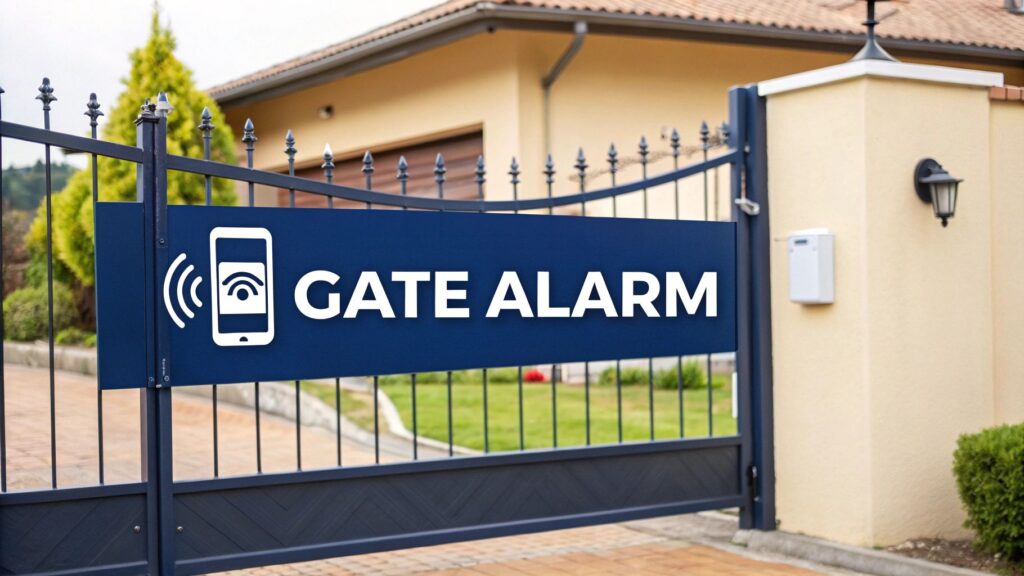
Think of a gate alarm system as a digital watchdog for your driveway. It’s a clever bit of tech that gives you an instant heads-up the moment your gate is opened or some dodgy character tries to tamper with it. This system acts as your first line of defence, letting you know about a potential intruder long before they even get close to your front door.
So, What Exactly Is a Gate Alarm System?
Let's be real, the term 'gate alarm system' can sound a bit technical, maybe even a little over the top. But just imagine this for a second: you're grabbing a flat white down at Darby Street in Newcastle, or maybe just kicking back with a beer on the deck at home in Gosford. All of a sudden, your phone buzzes. It's not a text from a mate; it's a real-time notification that someone has just opened your gate.
That immediate awareness is what it's all about. It turns your gate from a simple physical barrier into an active, intelligent part of your security setup. You're essentially creating a smart perimeter that provides a crucial early warning.
How the Core Components Work Together
A gate alarm system is like a simple but highly effective team. Each player has a specific job, and they all work in sync to keep your property safe.
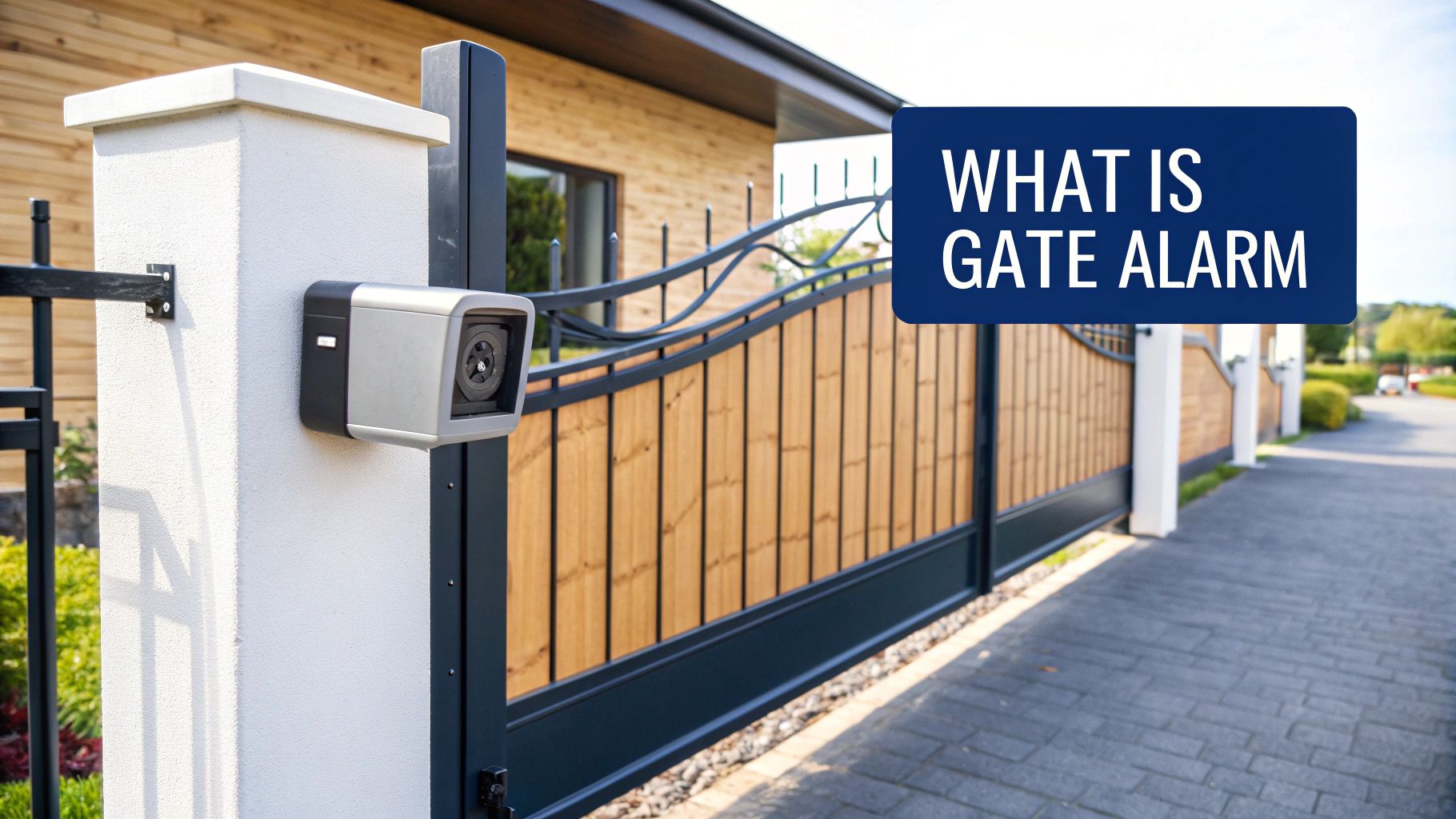
- The Sensors (The Lookouts): These are the eyes and ears of the whole operation. They're usually small, discreet devices attached to your gate and fence post. The second the gate moves, they detect it and fire off a signal.
- The Control Panel (The Brains): This is the central hub where the signal from the sensors lands. It processes the information instantly and decides what to do next – like sounding an alarm or pinging a notification straight to your phone.
- The Siren or Alert System (The Loudmouth): This is the part that lets everyone know something's up. It could be a piercing siren designed to scare off an intruder, a simple chime inside your house, or that handy push notification sent directly to your smartphone.
Why That First Alert Is a Game-Changer
The true value of a gate alarm isn't just about making a racket. It's about giving you precious time to react. You know there's a potential issue the second it happens at your boundary, not when someone is already peering through your living room window.
This proactive approach completely changes the home security game, and it fits perfectly with broader setups like modern wireless home alarm systems.
A gate alarm provides that critical first layer of defence. By detecting unauthorised entry at the property line, it buys you precious time to assess the situation, contact authorities, or activate other security measures.
It’s no surprise that this focus on perimeter security is catching on. The Australian security market, which covers these kinds of intrusion detection systems, was valued at a whopping AUD 4.08 billion in 2024. It’s expected to more than double, reaching AUD 8.33 billion by 2034. You can get the full picture on this trend in this detailed market research report.
2. Choosing the Right Type of Gate Alarm
Not all gate alarms are created equal. Some are like a noisy magpie, squawking the second there's any movement, while others are more like a clever cattle dog, quietly observing and reporting back. Picking the right type of gate alarm system really comes down to understanding your property, your lifestyle, and what you actually need the alarm to do.
Let's break down the most common types you'll find out there. Think of it as a line-up of different specialists, each with their own unique skill for protecting your boundary.
Magnetic Contact Sensors
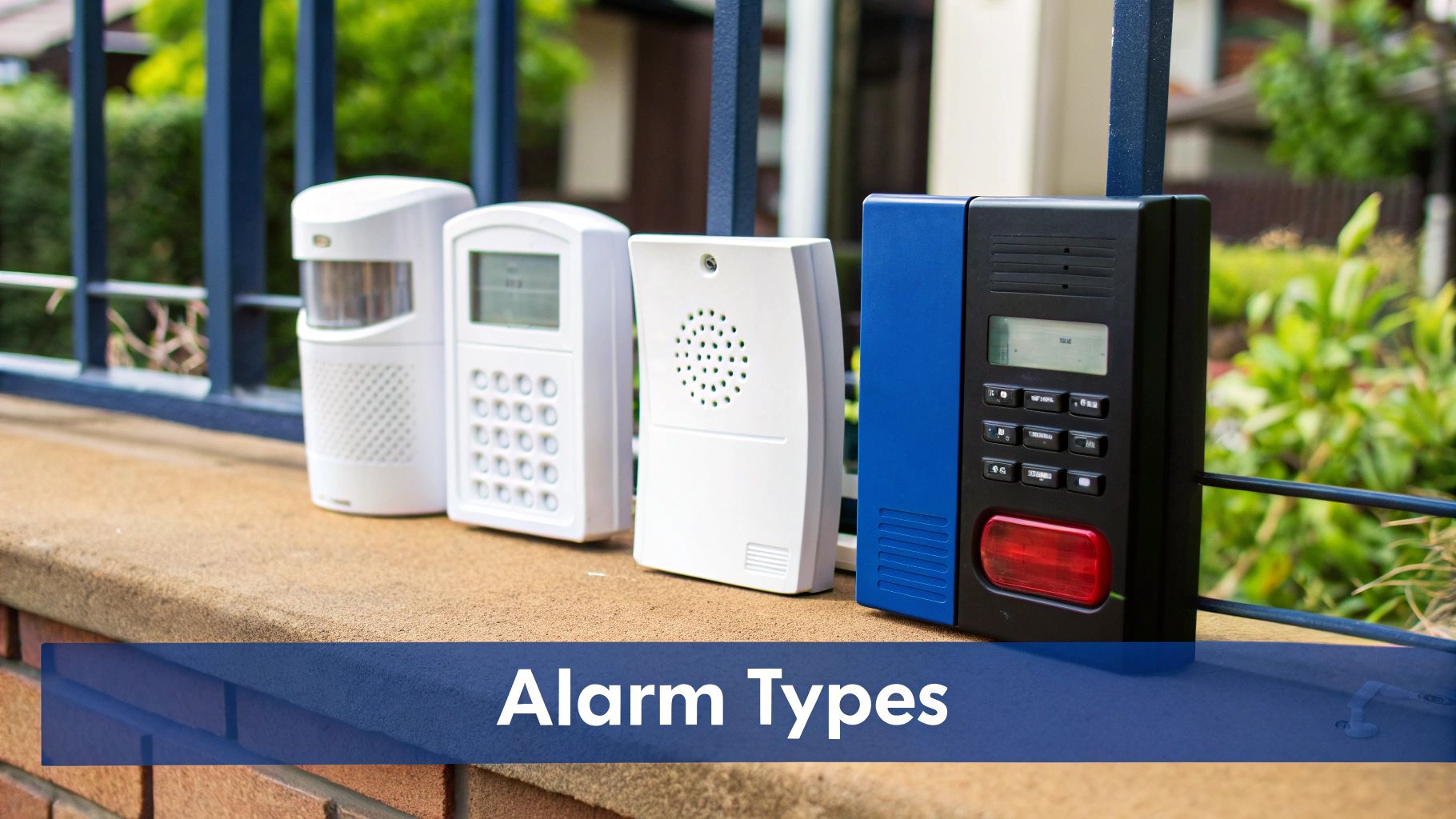
First up, we have magnetic contact sensors. These are the straightforward, no-nonsense members of the crew. It's a simple two-piece system: one part goes on the gate, and the other on the gate post. When the gate is shut, they create a complete circuit.
The moment the gate opens and the two parts separate, that circuit is broken, and bam—an alert is triggered. It's perfect for knowing one simple thing: is the gate open or closed? There are no maybes.
This image shows how different alarm types contribute to the core benefits of a complete gate alarm system.
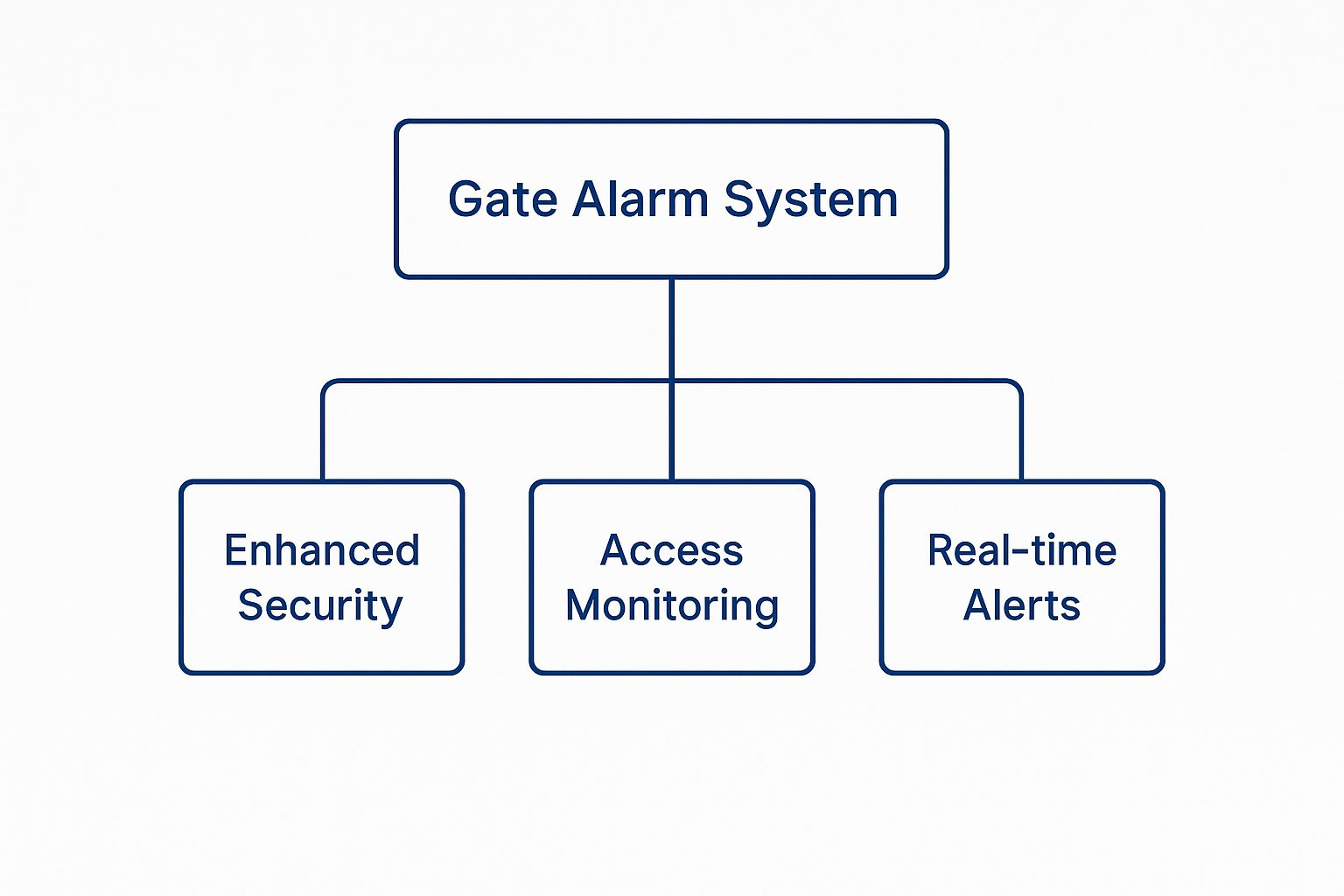
As you can see, each element builds on the last to create a much stronger, more informed security setup for your property.
Infrared Beams and Motion Detectors
Ready to get a bit more high-tech? Infrared (IR) beams essentially create an invisible tripwire across your driveway. You have a transmitter on one side and a receiver on the other. If anything—a person, a car, a particularly large kangaroo—breaks that beam, the alarm goes off. They're brilliant for covering wider entrances.
Motion detectors, on the other hand, are like the wide-angle lens of gate security. They use technology like passive infrared (PIR) to detect body heat and movement within a specific area. Modern ones are pretty clever and can often be adjusted to ignore pets, so your Jack Russell doesn't cause a false alarm every five minutes.
The key difference is precision. An IR beam tells you something crossed an exact line, while a motion sensor tells you something is moving around in a general zone.
Vibration and Pressure Sensors
Finally, we have the really smart ones. Vibration sensors are designed to detect physical force. Is someone trying to climb over your gate, kick it in, or cut the lock? These sensors will feel the tell-tale vibrations and sound the alarm before the gate is even breached. They’re an excellent choice for high-security situations.
Take a look at this table for a quick comparison of the main sensor technologies.
Gate Alarm Technology Comparison
A quick look at the pros and cons of common gate alarm sensor types to help you choose the right one for your property.
| Sensor Type | Best For | Pros | Cons |
|---|---|---|---|
| Magnetic Contact | Knowing if a gate is simply open or closed. Great for pools or side gates. | Reliable, simple, and very few false alarms. | Doesn't detect intrusion attempts before the gate opens. |
| Infrared (IR) Beam | Covering wide driveways or entry points with a clear line of sight. | Precise detection along a specific line; great for perimeter security. | Can be triggered by falling leaves or debris; requires clear line of sight. |
| Motion Detector | Monitoring a general area near the gate for any movement. | Covers a broad zone; can be adjusted for sensitivity and pet immunity. | More prone to false alarms from non-threatening movement if not set up properly. |
| Vibration Sensor | High-security areas where preventing a breach is critical. | Detects forced entry attempts before the gate is opened. | Can be overly sensitive to accidental bumps (e.g., a car tapping the gate). |
Ultimately, choosing the right sensor often means combining it with robust gate hardware. For a deeper dive, you can explore the ins and outs of modern gate automation systems to see how alarms and operators work together. Whether it's a suburban home in Gosford or a large property in the Hunter Valley, the right combination is out there.
The Rise of Smart Integrated Gate Security
Remember the days of jumping out of the car in the pouring rain to wrestle with a heavy, manual gate? Thankfully, that's ancient history. We've come a long way from a simple lock and key, entering an era where your gate is a connected, intelligent part of your home security.
This is the ‘smart’ revolution in gate security, and it’s all about putting convenience and total control right in the palm of your hand.
Picture this: you're in a meeting in the Sydney CBD when your phone buzzes. It's not another email; it's a live video call from your front gate. You see a courier with a package, have a quick chat with them directly through your phone, and tap a button to open the gate just enough for them to leave the parcel safely inside.
This kind of remote control isn't sci-fi anymore; it's the standard for any modern gate alarm system. The whole point is to make security so seamless that it just melts into your daily routine.
Your Gate Is Now Part of the Team
The real magic happens when your gate alarm stops being a lone wolf and starts talking to the rest of your home’s security and automation setup. This is where individual devices transform into a coordinated security ecosystem.
Think of it like this: your gate alarm is no longer a solo artist. It’s the lead singer of a band, and when it hits a high note (like detecting unexpected motion), the rest of the band kicks in right on cue.
Here are the key players in the band:
- Smartphone App Control: This one’s non-negotiable. You need to be able to arm, disarm, open, close, and check your gate’s status from anywhere, whether you're in Chatswood or Chittaway Bay.
- Video Intercoms: Seeing and speaking to visitors in real-time is a game-changer. It’s the perfect way to verify exactly who is at your property before you even think about granting access.
- Security Cameras and Lighting: When the gate alarm is triggered, your cameras should automatically start recording that specific area, and your driveway lights can flood the scene, leaving nowhere to hide.
This push towards connected solutions is reshaping the entire industry. Homeowners increasingly want smart features like remote monitoring, which is driving strong growth in Australia’s home security sector.
Voice Control and Full Home Automation
The final piece of the puzzle is tying it all together with your smart home hub. Linking your gate alarm to systems like Google Home or Amazon Alexa adds another layer of effortless, hands-free control.
Imagine pulling into your driveway after a long day. You just say, "Hey Google, open the gate." By the time you reach it, it's already swinging open for you. Simple as that.
This isn’t just about making life easier; it’s about creating a truly responsive and intelligent home environment. To see how this fits into the bigger picture, check out our guide on the core components of smart home security systems. It’s all about making your technology work for you, not the other way around.
Benefits Beyond Just Keeping Unwanted Guests Out
We often think of a gate alarm as a simple noisemaker—something to startle a would-be burglar and send them running. And while they’re fantastic at doing just that, their real value is much broader. Think of it less as a simple alarm and more as a smart upgrade that adds layers of convenience and safety to your daily routine, often in ways you hadn't even considered.
The most obvious job, of course, is security. A visible alarm system is a huge deterrent. Most opportunistic thieves are just looking for the easiest target, and a property with clear security measures is a big red flag for them. That first line of defence at your boundary is often all it takes to make them move on.
But let's look beyond the classic break-in scenario.
More Than Just a Burglar Alarm
For families, a gate alarm is an incredible safety tool. Picture this: you live on a busy Central Coast road. The moment your front gate opens, you get an instant notification on your phone. You'll know immediately if a curious toddler or the family dog has decided to wander off towards the street. It’s a digital guardian that offers genuine peace of mind.
For a business, the practical perks are just as compelling. Imagine a small industrial unit in a Newcastle business park. A gate alarm system helps you do more than just prevent theft; it helps you manage the entire site. You can track who comes and goes, monitor after-hours deliveries, and make sure staff haven't accidentally left the main gate wide open. It’s as much about operational control as it is about security.
A gate alarm system transforms your property's entrance from a simple barrier into an intelligent, monitored access point that provides security, safety, and operational oversight.
The Financial Perks of a Safer Property
Here’s a benefit that’s easy to miss: the positive effect it can have on your insurance premiums. Many Australian insurance companies offer discounts for homes and businesses with professionally installed and monitored security systems. The specifics vary, but having perimeter security shows you’re actively reducing your risk.
When you combine a gate alarm system with other security measures, you create a powerful, multi-layered defence that insurers really like to see. A great starting point is understanding how a complete house CCTV system can work alongside your gate alarm. Together, they create a robust network that not only deters criminals but could also put some money back in your pocket. It’s well worth having a chat with your insurance provider to see what sort of discount you might qualify for.
DIY Installation or Calling in the Pros
Alright, so you’re convinced a gate alarm is a smart move. The next big question is: who’s going to install it? Are you picturing yourself on a sunny Saturday, tools in hand, or would you rather have a local expert get it all sorted for you? It's the classic DIY vs. pro debate, and honestly, there are good arguments for both.
Let's face it, the appeal of a DIY job is strong. You can save a bit of money, pick up a new skill, and get that brilliant sense of satisfaction when everything clicks into place. If you're looking at a simple magnetic sensor for a small side gate, it's often a pretty straightforward weekend project for anyone comfortable with a drill and basic wiring.
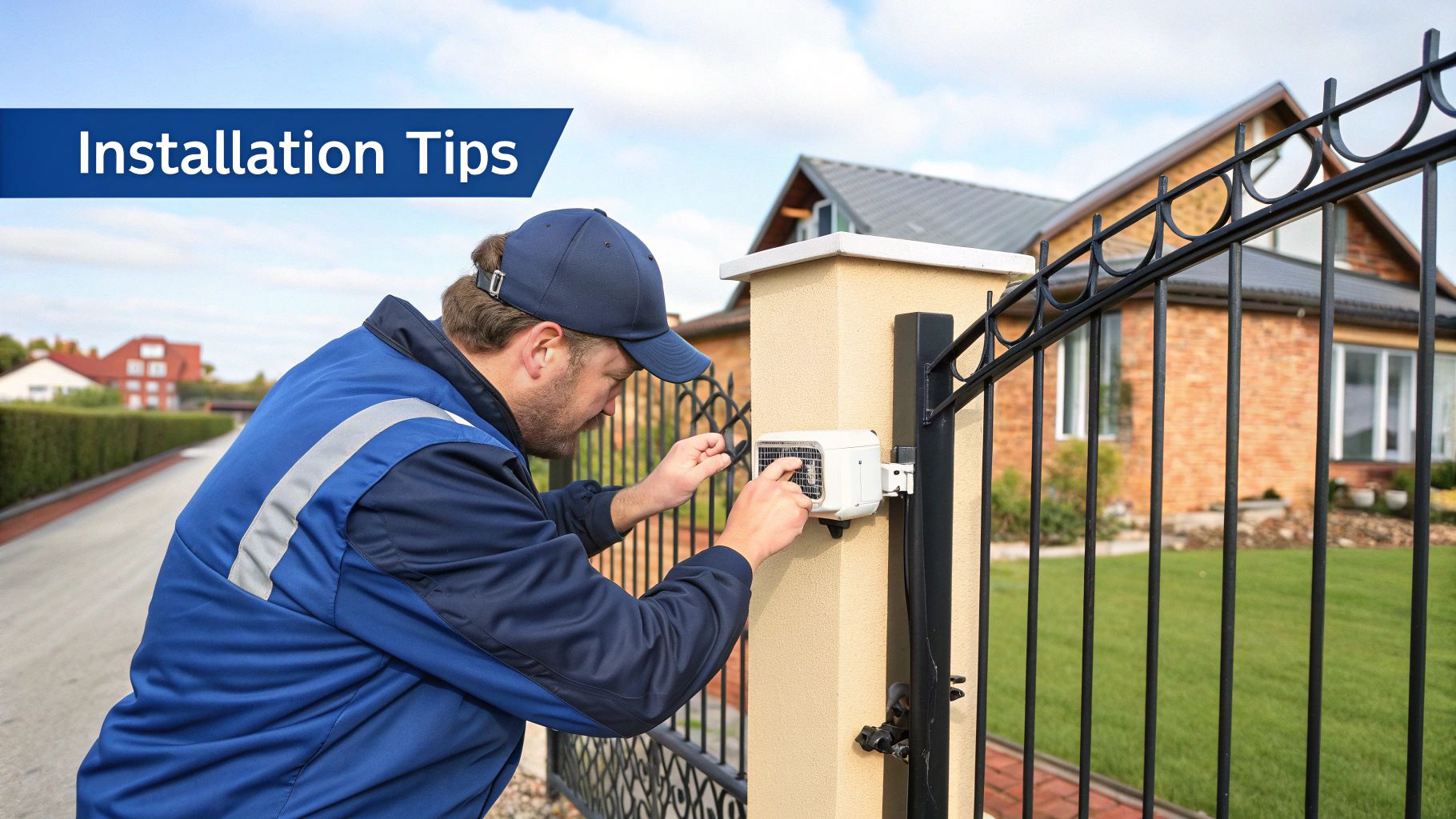
But, the second you start looking at more advanced, integrated systems, the case for calling in a professional becomes much, much stronger.
Why a Professional Installer Is Often Worth It
Think about it this way: a professional installer lives and breathes this stuff. They know the perfect height and angle to place an infrared beam to avoid it being triggered by the neighbour's cat or a rogue possum at 2 a.m. They also know exactly how to weatherproof the wiring to stand up to the salty Central Coast air, preventing annoying faults and corrosion down the track.
The real magic, though, is in making sure everything plays nicely together. Getting your gate alarm, your CCTV cameras, and your smart lighting to all communicate seamlessly is where their experience truly pays off. This is a massive industry for a reason. In fact, the Australian market for security alarm installation was valued at around AUD 5.2 billion in 2024, which just goes to show how many people trust the experts to get it done properly.
Getting it done right the first time saves you the headache of endless false alarms and troubleshooting. A pro ensures your system is reliable from day one, giving you genuine peace of mind, not just a new gadget to worry about.
Your Decision-Making Checklist
So, which path is right for you? It really comes down to your unique setup. A professionally installed system offers a reliable foundation, just like the other burglar alarms and security systems that keep your property safe. Here’s a quick checklist to help you figure it out:
- System Complexity: Are we talking about a simple, standalone sensor or a complex system that needs to connect to your Wi-Fi and other smart home devices?
- Your Skill Level: Be honest. Are you comfortable with drilling, running wires, and reading a technical diagram, or does that sound like a recipe for disaster?
- Time vs. Money: Do you have a weekend to spare for the project, or is your time valuable enough that paying a professional is actually the more cost-effective option?
- Tools Required: Do you already own the right tools for the job (drills, crimpers, multimeters), or would you need to buy them anyway, adding to the cost?
Answering these questions will give you a much clearer idea of whether to roll up your sleeves or pick up the phone.
Your Gate Alarm Questions, Answered
Alright, let's tackle some of the common questions we hear all the time. When you're looking to add a new layer of security to your place, it’s natural to have a few things you're wondering about. We've pulled together the queries that pop up most often from our clients across Sydney, the Central Coast, and Newcastle.
Let's clear the air and get you some straight answers.
What's a Gate Alarm System Going to Cost Me in Australia?
This is always the first question, and the honest answer is: it really depends. The price can swing quite a bit.
For a basic, off-the-shelf DIY magnetic sensor kit from your local Bunnings, you might only be out $100 to $200. It’s a simple solution for a simple job, no frills attached.
But if you’re thinking about a professionally installed system with all the trimmings—like invisible infrared beams, seamless smart home integration, and a video intercom—you're playing in a different league. For a seriously robust and reliable setup, the price tag could be anywhere from $800 to over $3,000. The final cost really comes down to the size of your gate, how tricky the installation is, and the specific brands you go with.
Will My Pets Trigger the Gate Alarm?
That’s a brilliant question, and a huge concern for anyone with fur-kids running around! The last thing you want is the alarm screaming its head off every time your dog decides to greet the postie.
The good news is that most modern motion detectors and beam sensors are built with "pet-friendly" or "pet-immune" technology. These clever bits of kit are calibrated to ignore movement from animals below a certain weight and size. When you chat with an installer, just make sure to mention you have pets. They'll pick the right sensors and fine-tune the sensitivity so your furry mates can enjoy the yard without causing a false alarm.
A properly set up pet-immune gate alarm gives you alerts that actually matter. It knows the difference between a real intruder and your dog chasing a ball, providing solid security without the constant false alarms.
Can I Fit a Gate Alarm to My Existing Automatic Gate?
You sure can! In almost every situation, adding an alarm system to an existing automatic gate is a straightforward job. There's no need to tear out your current setup and start over. Think of the alarm as an extra, smarter layer of security that works with what you already have.
The new sensors can be mounted discreetly on your gate and posts, and the control unit can usually tap into the same power source as your gate motor. It’s one of the most popular upgrades we do for property owners who want to beef up their security without the massive cost of a full gate replacement.
Do I Really Need a Professional Monitoring Service?
You don't have to, but it's an option that provides a whole other level of security. Here’s how the two choices stack up:
- Self-Monitored: This is what most people go for. When the alarm is triggered, the system pings an alert straight to your phone and sets off a loud siren on-site. For many, this is more than enough to spook an intruder and let you know something's up.
- Back-to-Base Monitoring: This is the premium option. A professional security company also gets the alert. If your alarm goes off, they’ll follow a set plan—usually calling you first, and if they can't reach you, sending a security patrol or the police to your property. It’s a fantastic choice if you travel a lot or just want that ultimate peace of mind, though it does come with a monthly subscription fee.
Ready to secure your property's first line of defence? The team at Advanced Comtech has been designing and installing reliable gate alarm systems for homes and businesses across the Central Coast for years. We handle everything from simple sensor setups to fully integrated smart security solutions. Let's have a chat about what you need. Learn more about our custom security solutions.