Ever wonder what makes the difference between spotty, unreliable Wi-Fi and a lightning-fast, stable internet connection? It often comes down to the unsung heroes of the digital world: professional data cable installers. These are the experts who design, run, and test the physical network cabling that forms the backbone of your home or office network, ensuring you get every bit of speed you're paying for.
Is Your Wi-Fi Slower Than the M1 at Peak Hour?
We’ve all been there. You’re in the middle of a crucial Zoom call from your home office on the Central Coast, the kids are streaming Bluey in the other room, and then it happens… the dreaded buffering wheel. Your video freezes, your voice goes robotic, and the connection drops. It’s the digital equivalent of being stuck in bumper-to-bumper traffic on the Spit Bridge on a long weekend.
This daily frustration is more than just a minor annoyance. For businesses in Newcastle, it's a productivity killer. For families in Sydney, it’s the source of endless arguments. We lean so heavily on Wi-Fi that we often forget there's a much more robust and reliable alternative.
The Real Solution Hiding in Your Walls
You've probably tried everything. You’ve moved the modem, bought those expensive Wi-Fi extenders, and maybe even had a few stern words with your router (we won't judge). While these tricks can offer a temporary fix, they’re often just a band-aid on a bigger problem. If you’re serious about getting a fast, stable connection, it's time to think about the solution you might have overlooked: professional data cabling.
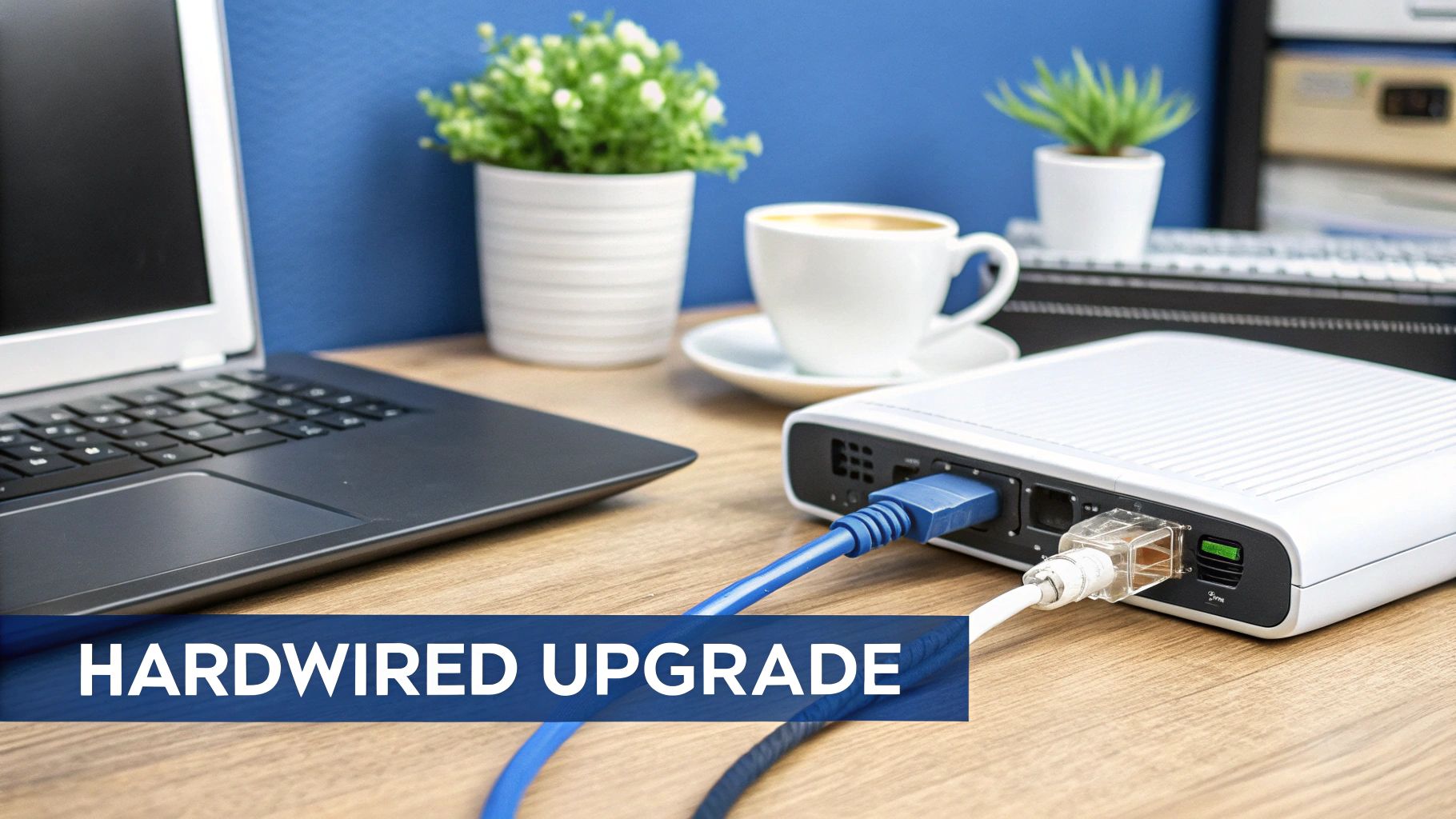
This isn’t about tripping over a flimsy Ethernet cord you picked up from Bunnings. We’re talking about creating a rock-solid, permanent network foundation for your property. A hardwired connection gives you a direct pipeline to the internet, completely free from the interference and signal drop-offs that plague Wi-Fi.
A professional installation ensures your network is built for performance. It eliminates common issues like signal dropouts, interference from your neighbour’s network, and the slowdowns that happen when everyone in the house is online at once.
Think of it like this: Wi-Fi is like trying to have a conversation by shouting across a crowded, noisy room. Sometimes the message gets through clearly, but often it gets lost in the chaos. A hardwired connection is like a private, direct phone call—crystal clear every time.
A properly installed data network brings some serious advantages:
- Unbeatable Speed: Finally get the full internet speed you pay for, without the signal loss that’s common with Wi-Fi.
- Rock-Solid Reliability: Say goodbye to random dropouts during video calls, online gaming, or streaming.
- Enhanced Security: Hardwired connections are far more secure than wireless networks, keeping your sensitive data safer from prying eyes.
This guide will walk you through everything you need to know about hiring data cable installers. From understanding the different types of cables to spotting a quality installation, we'll arm you with the knowledge to make the best choice for your home or business. In the meantime, you can explore our guide on how to boost your existing Wi-Fi signal for some tips you can use right now.
Decoding the Data Cable Maze
Trying to figure out the difference between Cat5e, Cat6, and fibre optic can feel like you need a degree in IT. The names sound complicated, but it's all pretty straightforward once you stop thinking about tech jargon and start thinking about something we all know too well: traffic.
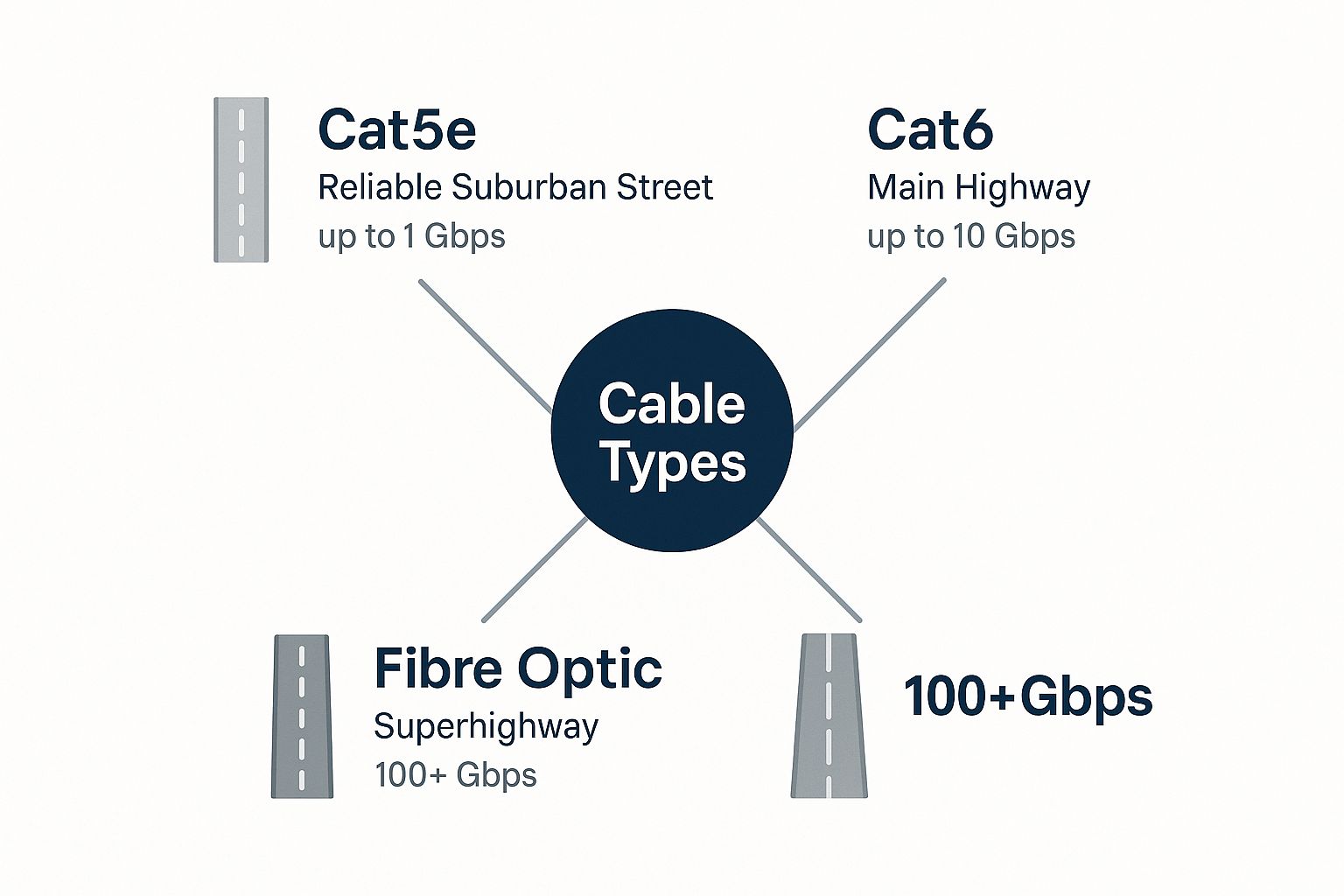
Let’s break it down with a simple analogy. Imagine your data network is the road system connecting your home or office to the rest of the world. The different types of cables are just different types of roads, each built to handle a specific amount of traffic.
Your Everyday Suburban Street: Cat5e
Think of Cat5e (Category 5e) cable as your quiet suburban street in a place like Umina or Warners Bay. It's reliable, it gets the job done, and it’s perfect for everyday traffic. We're talking about general web browsing, sending emails, and streaming a bit of Netflix in HD.
Cat5e can comfortably handle speeds up to 1 Gigabit per second (Gbps), which is more than enough for most standard household activities. It’s the cost-effective, dependable choice for basic connectivity, and for many homes, it's all you'll ever need for a solid, stable connection.
The Pacific Highway Upgrade: Cat6 and Cat6a
Now, what happens when the traffic gets heavier? That's where Cat6 comes in. Think of Cat6 as the Pacific Highway—a multi-lane freeway designed to handle a much higher volume of traffic moving at much faster speeds.
This is the cable you want when you’ve got multiple 4K streams running, serious online gaming happening, or large files constantly being downloaded in a home office.
Cat6 can handle speeds up to 10 Gbps over shorter distances, making it a significant step up from Cat5e. It's also built with better shielding to reduce "crosstalk"—think of it as better sound barriers on the highway to stop noise from other lanes interfering. Its slightly beefier cousin, Cat6a, can maintain those 10 Gbps speeds over longer distances, making it ideal for larger homes or offices where the signal needs to travel further.
The NorthConnex Tunnel: The Future is Fibre
Finally, we have fibre optic cable. This isn't just a bigger road; it's a completely different kind of transport system. Think of it as the brand-new NorthConnex tunnel—a futuristic superhighway that bypasses all the surface-level traffic, travels at incredible speeds, and is built to handle the demands of tomorrow.
Fibre optic cables use pulses of light to transmit data instead of electrical signals, which makes them insanely fast and completely immune to electrical interference. With potential speeds of 100 Gbps and beyond, fibre is the ultimate in future-proofing. It’s perfect for a tech-heavy household in Terrigal or a data-intensive business in the Sydney CBD that simply can't afford any slowdowns.
Choosing the right cable is all about matching the "road" to your "traffic." You don't need a six-lane freeway for a quiet cul-de-sac, but you can't run a city's worth of data down a single-lane street.
Choosing Your Network's Highway
To make things even clearer, here’s a quick comparison of the common data cable types to help you decide what's best for your home or business.
| Cable Type | Best For | Typical Speed | Future-Proofing Level |
|---|---|---|---|
| Cat5e | Everyday home use, browsing, HD streaming, email. | Up to 1 Gbps | Basic |
| Cat6 | 4K streaming, online gaming, demanding home offices. | Up to 10 Gbps | Good |
| Fibre Optic | Data-heavy businesses, tech-savvy homes, max performance. | 10 Gbps and beyond | Excellent |
Ultimately, understanding the right cable for your needs is the first step. The second is knowing where to strategically place your connections. For a deeper dive into planning the layout, check out our guide on professional data points installation. By picking the right cable and the right spots, you ensure your network can handle whatever you throw at it—both today and in the years to come.
What Happens When the Cabling Pros Arrive
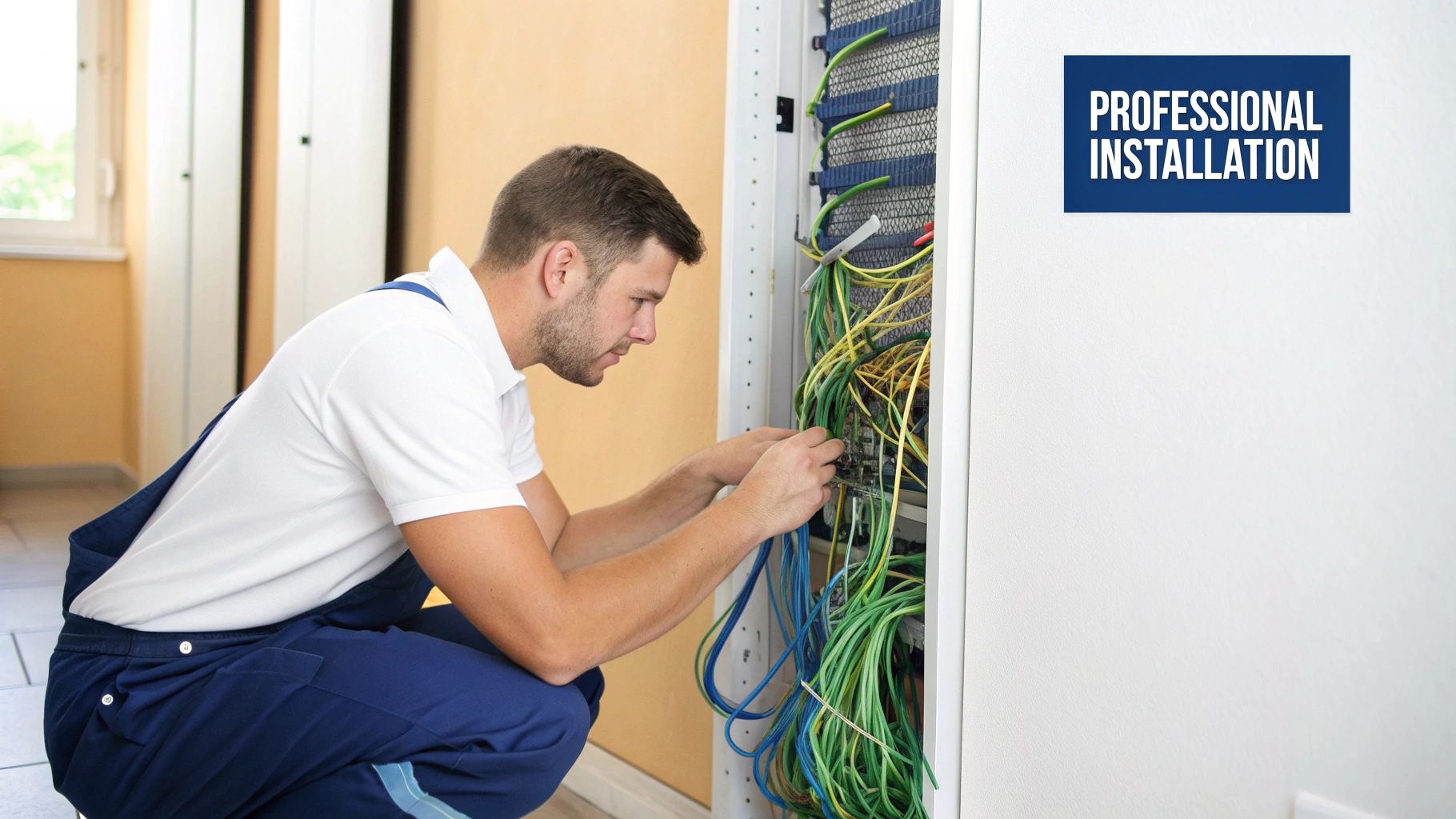
So, you've made the call. The thought of hiring data cable installers can feel a bit intimidating. Will they turn your home into a dusty mess? Are you going to be left with mysterious holes in your walls? Let's pull back the curtain on the whole process.
We'll follow a fictional mate, Dave from Gosford, as he gets his family home properly wired up.
Dave was completely over the constant Wi-Fi dropouts. With two kids learning from home and his own Zoom calls freezing mid-sentence, something had to change. After a quick chat and getting a clear, itemised quote, he booked the job. He was bracing himself for a scene from a chaotic reno show, but the reality was far more organised and a whole lot less dramatic.
The Initial Game Plan
The first thing the installer did wasn't drill a single hole—it was have a proper yarn. They walked through Dave's house with him, asking smart questions like, "Where does the family usually stream movies?" and "Which room is your main home office?" This isn't just small talk; it's a critical planning session.
Together, they mapped out the perfect spots for the data points. The goal is always to put them in logical locations to hide ugly cables and make life easier—behind the TV, near the office desk, and even one in the main bedroom for seamless late-night streaming. This collaborative approach makes sure the final setup actually works for how your family lives.
This initial consult is everything. A great installer listens to what you need and gives practical advice, not just starts pulling cables through the walls. They'll find the best, least intrusive pathways for the wiring, often using existing wall cavities and the ceiling space to keep things neat.
The Art of Concealed Cabling
Once the plan was sorted, the real work began. For Dave, this was the bit he was most curious about. How on earth do they get a cable from the modem at one end of the house to the study at the other without ripping the place apart?
The answer is a combination of skill and specialised tools. The installers used long, flexible rods to fish the cables through the ceiling, expertly navigating around timber beams and existing pipes. Think of it like keyhole surgery for your house—the aim is to get maximum results with minimal impact. They cut small, precise holes for the wall plates, making sure to lay down drop sheets to catch every bit of dust.
A professional installation is defined by what you don't see. The goal is for the cables to be completely hidden, leaving only clean, functional wall plates that blend into your home.
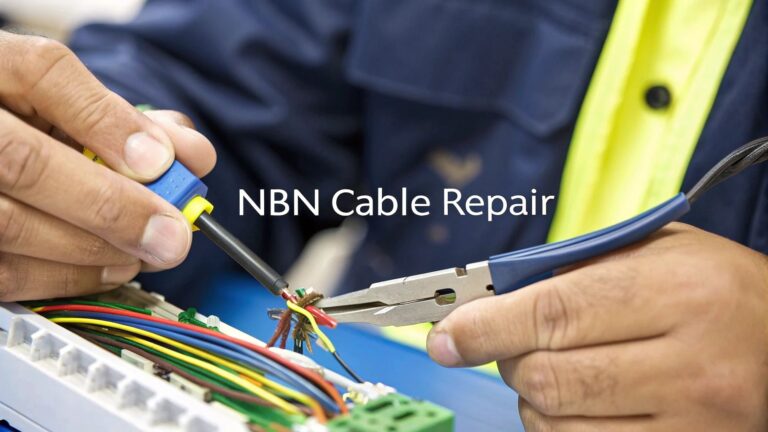
After running the cables, the next step is termination. This is where the installer meticulously connects the end of the data cable to the wall plate and the central patch panel. It’s a delicate job that demands precision because even one poorly connected wire can throttle your connection speed. It's one of the main reasons DIY attempts often end in frustration.
Testing and Tidying Up
With all the cables run and terminated, it was time for the moment of truth. The installer didn't just plug in a laptop and cross their fingers. They pulled out a professional network tester to certify every single connection.
This clever device sends signals down the cable to confirm a few key things:
- Connectivity: Is every one of the eight tiny internal wires properly connected from end to end?
- Speed: Can the cable actually deliver the full Gigabit speeds it's supposed to?
- Faults: Are there any breaks, shorts, or other issues causing interference along the cable's path?
Every point passed with flying colours. The installer then tidied everything up, vacuumed, and left Dave's home looking exactly as it did when they arrived. Except now, it had a supercharged network. The connection was now faster than a seagull stealing your chips at Terrigal beach.
The whole process, from that first chat to the final test, really shows the value of professional home networking installation services. For Dave, the result was a rock-solid, lightning-fast connection the whole family could rely on, without any of the mess or stress he had imagined.
Why You Should Ditch the DIY and Hire a Pro
We all love a good weekend project. A bit of painting, assembling some flat-pack furniture – it’s satisfying. But when it comes to running data cables through your home or office, stepping back and calling in a professional is one of the smartest moves you can make. A botched cabling job isn't just a messy eyesore; it's the hidden cause behind infuriatingly slow internet, constant connection dropouts, and troubleshooting nightmares that will have you ready to launch your modem into the sun.
Hiring professional data cable installers is about more than just dodging a tangled mess of wires behind the desk. It’s an investment in getting the performance you pay for, rock-solid reliability, and complete peace of mind.
Get the Performance You Paid For (and for the Future)
A pro doesn’t just yank a cable from point A to point B. They design a structured system built for maximum speed. They know exactly how to route cables to avoid electrical interference from power lines, how to respect the cable's bend radius (yep, bending a cable too tightly can wreck your signal!), and how to terminate every connection with precision for a perfect, lightning-fast link. This careful, experienced approach is what guarantees your network runs at peak performance from the moment it's switched on.
More importantly, a professional thinks about tomorrow, not just today. They can help you choose a cable like Cat6 or Cat6a, which might seem like overkill for your current needs but will have you ready for whatever comes next. Think 8K streaming, next-gen smart home tech, and data-hungry applications we haven't even dreamed of yet. It's about building an infrastructure that lasts.
It’s All About Compliance and a Clean Finish
Here in Australia, data cabling isn't the Wild West. It has to meet strict standards laid out by the Australian Communications and Media Authority (ACMA). A licensed installer is your guarantee that every part of the job is fully compliant, which is non-negotiable for safety, performance, and even your insurance policy. This isn't just best practice; it's a legal requirement to protect you from dodgy work.
And then there's the look of the thing. The visual difference between a DIY attempt and a professional job is night and day.
- DIY Result: Often ends with a "spaghetti junction" of cables snaking along skirting boards, messy holes drilled in the wrong places, and faceplates that just don't sit right.
- Professional Result: A clean, completely organised system. Connections are terminated neatly inside discreet wall plates that blend in, and all the wiring is hidden away inside walls and ceilings. It just works, and you'd never even know it's there.
Think of a professional installation not as a cost, but as a long-term investment in your property's value and reliability. It’s the difference between a network that works and a network that works flawlessly.
The need for properly managed cabling is bigger than ever. The Australian cable management market was valued at a huge AUD $798 million in 2024 and is forecast to hit AUD $1.84 billion by 2033. That explosive growth shows just how vital this digital backbone is becoming for homes and businesses. You can read more about it in the full Australian cable management market report.
At the end of the day, hiring a pro saves you from the frustration, hidden costs, and wasted weekends of a DIY job gone wrong. They have the right tools, the know-how, and the foresight to build you a network that will serve you well for years to come. For more tips on getting started, have a look at our guide on home network cable installation.
Cabling for More Than Just Your Laptop
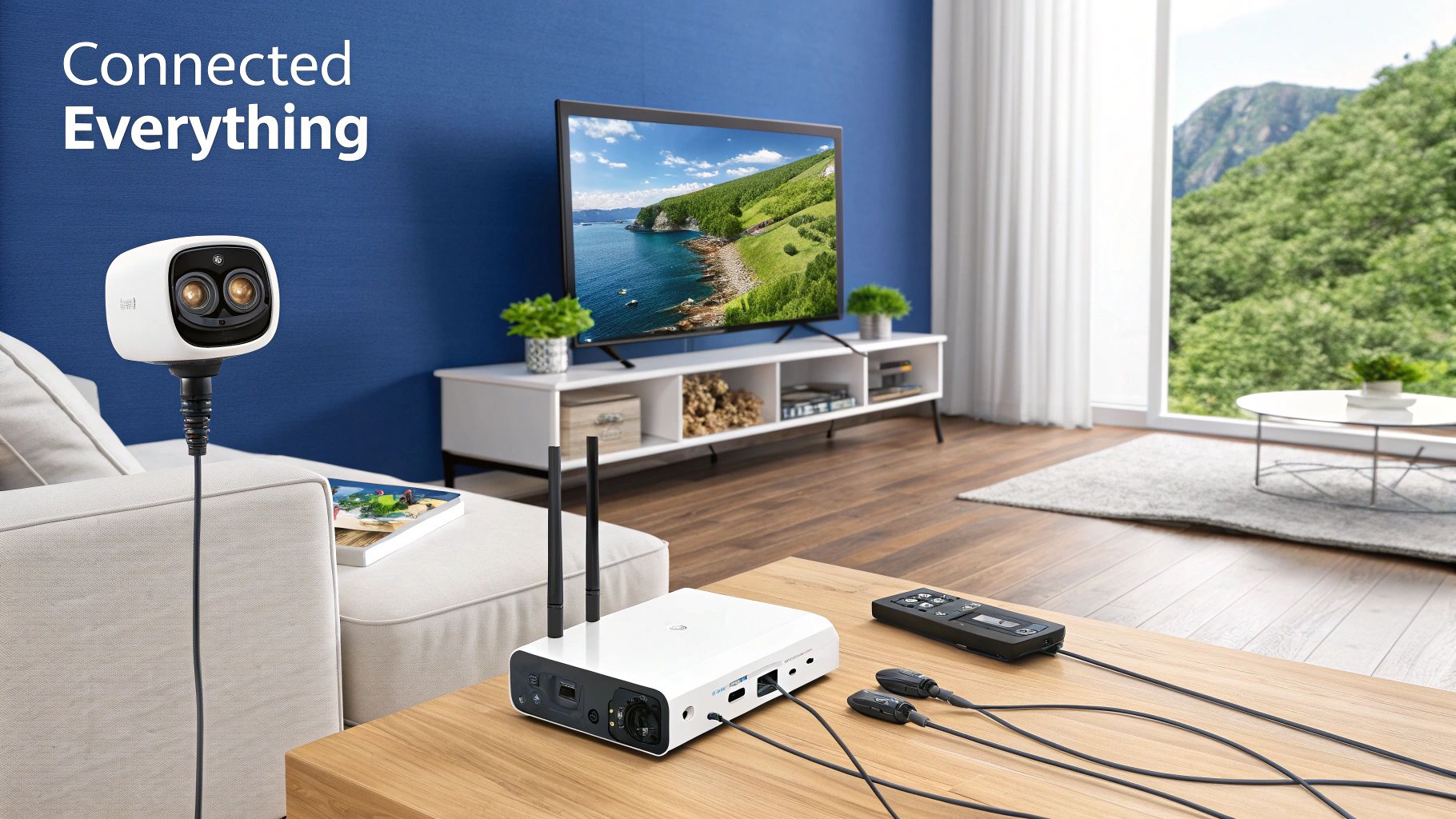
If you reckon professional data cabling is just about getting a better connection for your laptop, it’s time to think bigger. A properly installed network is the central nervous system of any modern home or office. It’s the invisible foundation for all the cool tech that makes life easier, safer, and a whole lot more entertaining.
Let's be honest, we've all seen those slick, automated smart homes on TV and thought, "I want that." The lights dim for movie night, the security cameras give you a crystal-clear view of the front yard, and the music follows you from room to room without a hitch. That seamless experience doesn't just happen with a patchy Wi-Fi signal. It runs on a rock-solid, hardwired data network.
Powering the Modern Central Coast Home
Picture this: you're settling in to watch the footy finals in glorious 4K. With a dedicated data point plugged directly into your TV, you get a flawless, buffer-free stream. No more watching the winning try through a pixelated mess just as the siren sounds.
A professional installation by experienced data cable installers unlocks this kind of potential all over your home:
- Smart Home Automation: Hook up your security cameras, smart lighting, and speakers directly to the network. You get instant response times and reliability that Wi-Fi can't match.
- High-Performance Home Office: For anyone working remotely from Newcastle to the Central Coast, a hardwired connection is non-negotiable for stable video calls and zippy file transfers.
- Flawless Entertainment: Make sure your 4K home theatre, gaming consoles, and multi-room audio systems have the bandwidth they need to perform at their best.
The Backbone of Sydney's Smart Businesses
For any business, a structured cabling system isn’t a luxury—it's the bedrock of your entire operation. It’s what keeps the wheels turning, the data flowing, and the customers happy. A weak network can bring productivity to a grinding halt.
Think about a bustling café in the Sydney CBD. The point-of-sale (POS) terminals need to process payments instantly, the security cameras have to record without fail, and the VoIP phone system must be crystal clear for taking orders. All of this relies on a meticulously planned and installed data network.
A professional cabling infrastructure isn’t just about connecting devices. It's about creating a reliable digital environment where your technology works for you, not against you.
This is where the bigger picture comes into focus. Our entire digital economy is built on this physical infrastructure. The Australian data centre market is a testament to this, projected to hit a massive AUD $8.58 billion by 2030. Huge data centres in Sydney act as the heart of our national connectivity, and they depend on world-class cabling to link Australia to the global network. You can discover more about the scale of Australia's data centre growth.
At the end of the day, whether you're building a smart home on the coast or running a competitive business in the city, investing in professional data cabling is about future-proofing your property for the connected world of tomorrow.
Choosing the Right Installers in Sydney and Newcastle
So, you’re ready to ditch that patchy Wi-Fi and get your place properly wired. Smart move. But a quick search for data cable installers in Sydney or Newcastle can leave you feeling a bit overwhelmed. How do you tell the real experts from the cowboys who might leave you with a messy job and a network that feels slower than dial-up?
It’s actually simpler than you might think. You just need to know what to look for. Hiring a fantastic installer isn't about grabbing the cheapest quote—it’s about finding a qualified, insured, and communicative professional who will nail the job on the first go.
The Non-Negotiables Checklist
Before you even think about comparing quotes, make sure any installer you're considering ticks these fundamental boxes. Think of this as your pre-flight check; if anything is missing, walk away.
- ACMA 'Open' Registration: This is the big one. In Australia, it's a legal requirement for anyone working with data cabling to hold a licence from the Australian Communications and Media Authority (ACMA). The ‘Open’ licence is what you need to see. It’s proof they’re qualified to do the job safely and to Aussie standards.
- Public Liability Insurance: Things can go wrong. Imagine an accidental hole drilled into a water pipe. You absolutely need to know you’re covered. Ask to see a current Certificate of Currency for their public liability insurance. Any legitimate pro will have this on hand.
- Real, Local Experience: Look for someone who knows their way around the types of buildings in your area. Whether it’s a heritage terrace in Newcastle, a modern Sydney apartment, or a big family home on the Central Coast, local knowledge makes a massive difference.
Spotting a True Professional
Once you've got the basics covered, a few other tell-tale signs can help you pinpoint a top-tier installer. A good technician is more than just someone who can pull a cable through a wall; they’re a problem-solver and a clear communicator.
A great installer will start by asking you lots of questions about how you actually use your internet. They'll want to get a real sense of your needs before they even dream of suggesting a solution. Clear, upfront communication is everything—they should explain your options in plain English, not hide behind confusing tech jargon.
A professional's goal is to give you a solution that works for you, not just to sell you the most expensive cable. They’ll offer a detailed, itemised quote so you know exactly what you’re paying for, with no nasty surprises.
Finally, do a quick check of their reviews. Look for detailed testimonials that mention things like the installer's professionalism, punctuality, and the quality of their workmanship. A long list of five-star ratings with no comments can sometimes be a red flag. A deeper dive into what makes a good data cable installer can give you even more insights.
Arm yourself with this checklist, and you can hire with confidence, knowing you’ll get a network that’s built to last.
Got Questions About Data Cabling? We've Got Answers.
We get it. Thinking about getting your place wired up properly often sparks a few questions. We hear these all the time from people across Sydney, Newcastle, and the Central Coast, so here are some straight-up answers to clear things up.
How Much Does Data Cabling Cost?
This is always the first question, and the honest answer is: it really depends. It's a bit like asking, "How much does it cost to paint a house?" The final price tag is tied directly to the size and complexity of the job.
A few key things will move the price up or down:
- Your Property's Size and Layout: Cabling a small apartment in Newcastle is a different ball game to wiring up a sprawling two-storey home in Terrigal. More space and more walls mean more work.
- The Type of Cable: Cat6 is the go-to for most new installations these days. But if you’re after top-tier performance, stepping up to Cat6a or even fibre optic cable will naturally come with a higher cost.
- Number of Data Points: The more ethernet ports you want installed around your home or office, the more the cost will reflect the extra materials and time on the tools.
- Ease of Access: Running cables is a breeze in a home with simple roof and wall access. It gets a lot trickier—and therefore a bit more expensive—when navigating things like double-brick walls or tricky layouts.
Any reputable data cable installer will insist on a site visit before giving you a detailed, itemised quote. This way, you know exactly what you’re paying for. As a ballpark figure, you can generally expect to pay somewhere between $150 to $300 per data point.
How Long Does an Installation Take?
You’ll probably be surprised at how quickly it all happens. For a typical Aussie home needing, say, five to ten data points, a skilled team can usually have the whole job wrapped up in a single day.
Of course, larger homes or more complex commercial projects might push into a second day, but your installer will always give you a clear timeline before they start.
A true professional’s goal is to get in, do a perfect job with the least amount of fuss, and get out, leaving behind nothing but a super-fast, reliable network.
Will My House Be Left in a Mess?
Not a chance! This is one of the biggest things that separates the pros from the cowboys. A professional installer has immense respect for your home.
They’ll use drop sheets to protect your floors and furniture, drill with precision, and have a non-negotiable clean-up process. That includes vacuuming up any dust from drilling. The only evidence they were ever there will be the neat wall plates and your amazing new connection.