Let’s be real for a moment. Waiting for a webpage to load feels a bit like being stuck in holiday traffic on the M1, inching your way towards Terrigal. For so many of us, the promise of fast, reliable internet just hasn’t panned out. What we’re left with is that dreaded buffering wheel and frozen screens, usually right when we need the connection most.
Is Your Internet Slower Than the Ferry to Woy Woy?
We’ve all been there. You’re settling in to watch the Knights game, and just as they’re about to score, the screen dissolves into a pixelated mess. Or maybe you’re on a crucial Zoom call from your home office in one of Sydney’s leafy suburbs, and your connection gives up the ghost mid-sentence. It’s beyond frustrating.
For years, countless people across the Central Coast, Newcastle, and even parts of Sydney have felt stuck in a digital dead zone. We were told the NBN would be the great equaliser, but for plenty of households, it’s been a bit underwhelming. You’re paying for a service that feels like it’s constantly struggling to keep up, and the idea of multiple people streaming, gaming, and working from home at the same time feels like pure fantasy.
It’s the modern Aussie dilemma: you just want an internet connection that works, without having to hold your breath every time you click a link. The good news? There’s a new solution on the block, and it’s not coming from underground cables. It’s being beamed down from space.
Enter Starlink Satellite Internet
This is where things get interesting. Picture an internet connection sent directly to your home from a huge web of satellites orbiting the Earth. That’s the core idea behind the Starlink satellite system, and it was built from the ground up for people who are just plain tired of being let down by traditional broadband.
Think of it as the ultimate answer to those connectivity problems. Instead of relying on ageing copper wires or mobile towers that get congested, Starlink gives you a direct, high-speed link to the web. For all the families and businesses left behind by the NBN rollout, this is a massive deal. It actually means:
- No more buffering: Binge-watch your favourite shows in crystal-clear high definition without a single interruption.
- Seamless remote work: Jump on video calls with confidence, knowing your connection won’t let you down.
- Happy gamers: Get the low latency you need to stay competitive in online games.
This isn’t just a small step up; it’s a giant leap forward. It’s about finally getting the internet experience we were always promised—one that’s fast, reliable, and can handle whatever you throw at it. It’s time to stop waiting and start connecting the way you’re meant to.
What Exactly Is Starlink Satellite Internet?
So, what’s all the fuss about this Starlink satellite internet? If you’re picturing one of those massive, clunky dishes from the 90s that took up half the backyard, you can scrap that image. Starlink is a whole different beast, and it’s much, much smarter.
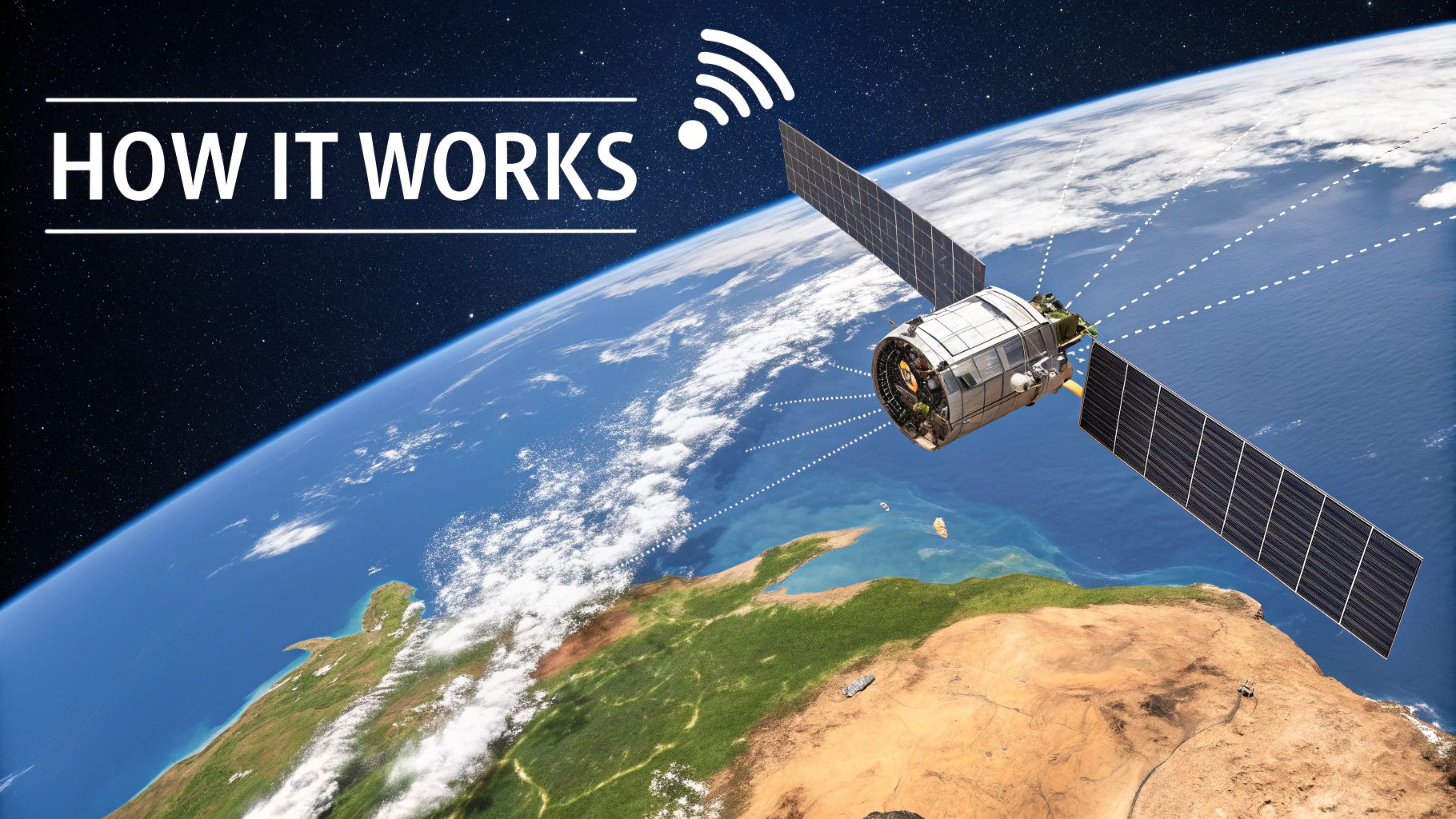
The secret sauce is all about location, location, location—of the satellites, that is. Traditional satellite internet relies on enormous satellites orbiting way out in space, about 35,000 kilometres away. Sending a signal that far and back is like trying to have a real-time conversation with someone in Perth from your lounge room in Sydney. You’re going to get a noticeable delay and the connection can be patchy at best.
The Low Earth Orbit Difference
This is where Starlink completely changed the game. They launched thousands of smaller, powerful satellites into what’s called Low Earth Orbit (LEO). These guys are zipping around much closer to home, only a few hundred kilometres up.
That proximity makes a massive difference. Instead of your data taking a long, slow trip into deep space, the signal path is incredibly short and direct.
Think of it like this: the old satellite internet was like Australia Post sending a letter across the country—it gets there, but it takes a few days. Starlink is like a direct express train from Central to Gosford. It’s fast, direct, and you’re barely left waiting around.
This clever setup is what gives Starlink its incredible speed and, just as importantly, its low latency. Latency is just the technical term for lag—that frustrating delay between you clicking something and the action actually happening. For gamers on the Central Coast trying to compete online or anyone on a video call from Newcastle, low latency is absolutely essential.
Because the satellites are so close, that lag is drastically cut down, making everything from online gaming to remote work feel snappy and responsive. It’s the kind of performance you’d expect from a top-tier fibre connection in the city, but it’s now available pretty much anywhere.
Built for Australian Conditions
This space-age tech is perfectly suited for our local needs, from the leafy suburbs of Sydney to the rolling hills of the Hunter Valley. As of early 2025, Starlink now covers 100% of Australia, finally bringing a genuinely reliable broadband option to areas that have been left behind for too long.
With download speeds hitting up to 220 Mbps, it offers a serious upgrade for anyone stuck in an internet blackspot. You can find more details about how Starlink’s LEO network is transforming connectivity across the country on leading tech analysis sites.
Of course, once that lightning-fast signal reaches your home, it still needs to get to all your devices. A powerful router and a well-planned network are key to making the most of those speeds, especially in larger homes. To ensure every corner of your house gets a strong signal, it’s worth understanding the difference between simple extenders and a more robust setup, which you can explore in our guide on WiFi extenders vs. mesh networks.
How Does Starlink Stack Up Against the NBN?
Alright, let’s get right to it. Is a Starlink satellite connection genuinely better than the NBN service you’ve got now? If you’re stuck in a known blackspot or just plain fed up with internet that drops out at the worst possible moment, this is the question that really matters. It’s time for a proper head-to-head comparison to see which one actually delivers.
For a lot of people, the short answer is yes—Starlink is a massive leap forward.
Picture a family in a Wyong blackspot who used to struggle just to get a single Netflix stream to buffer. After switching, they can suddenly have three people streaming, gaming, and working from home all at once, without a single hiccup. The change can be that dramatic.
This high-speed internet solution is proving to be a genuine game-changer for homes and businesses all across the Central Coast and Hunter regions.
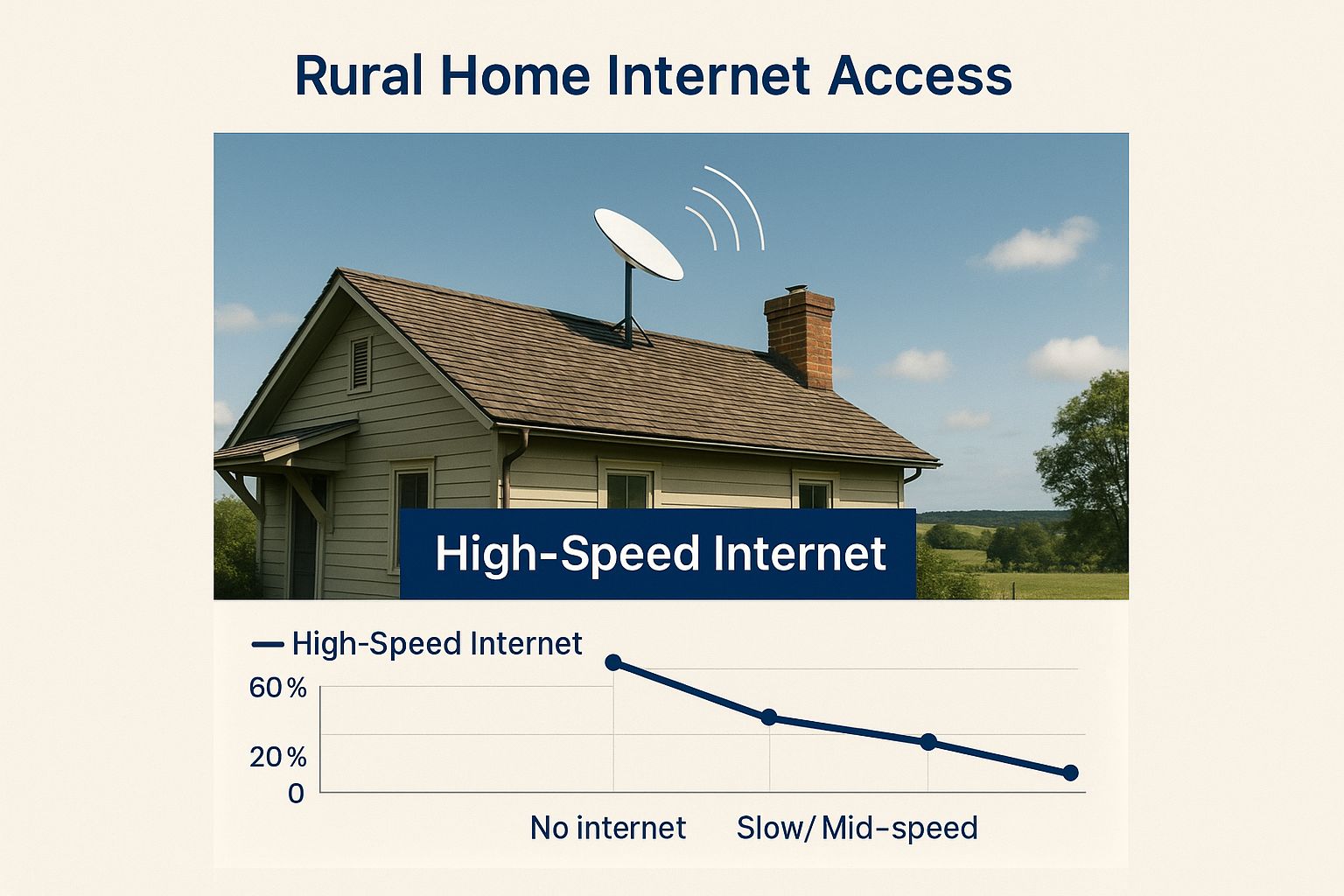
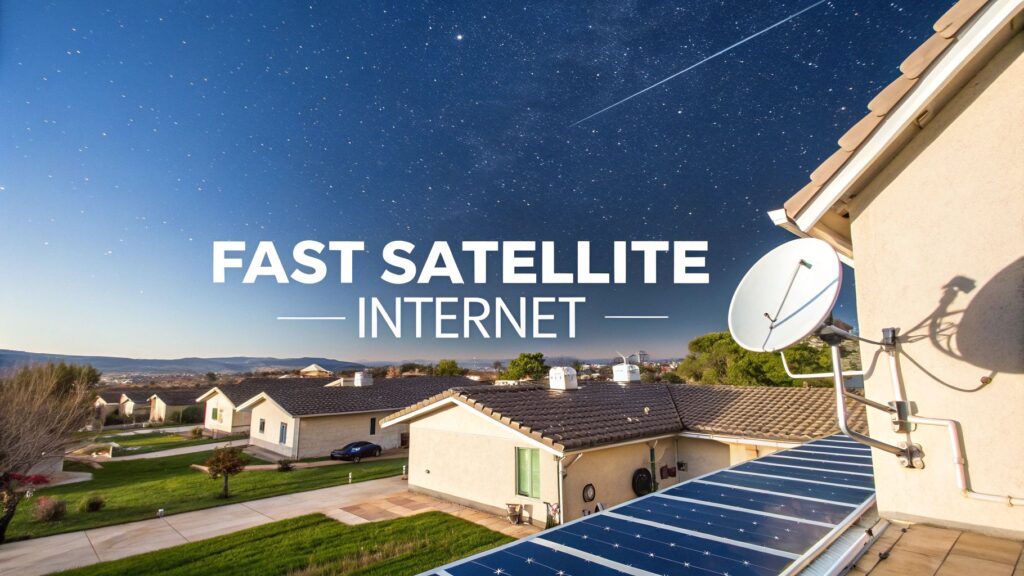
This image really captures the new reality for so many regional homes—a simple dish connecting them to a world of fast, reliable internet, finally closing that frustrating digital gap.
The Speed and Latency Showdown
When you dig into the raw numbers, the difference becomes incredibly clear. A lot of NBN connections in our area, especially the older Fibre to the Node (FTTN) or Fixed Wireless technologies, really battle to deliver consistent speeds. You’ve probably noticed this yourself during peak hours when everyone in the neighbourhood jumps online.
Starlink is just built differently. Since SpaceX started launching its satellites back in 2019, the network has consistently offered download speeds anywhere from 25 Mbps to over 200 Mbps. More importantly, the latency (or lag) often sits below an impressive 30 ms.
That’s a world away from the old satellite internet services where latency could top 600 ms, making Starlink a truly viable option for everyday Aussies. If you want to dive deeper, you can read more about Starlink’s global performance statistics and its expansion.
For a small business in the Hunter Valley, this isn’t just about convenience—it’s absolutely essential. It means their EFTPOS machine doesn’t drop out mid-sale and online bookings land in their inbox instantly. That’s a level of reliability their old connection could never promise.
Quick Comparison: Starlink vs Typical NBN
So, how does Starlink really compare to the common NBN services we see around the Central Coast? Here’s a quick, side-by-side look.
| Feature | Starlink Satellite | NBN (Fibre to the Node / Fixed Wireless) |
|---|---|---|
| Typical Download Speed | 50-200+ Mbps | Highly variable, often 25-50 Mbps, can slow down at peak times |
| Typical Upload Speed | 10-20 Mbps | Often struggles, typically 5-10 Mbps |
| Latency (Ping) | Very low, around 20-40 ms (great for gaming/video calls) | Can be high (30-100+ ms), especially on Fixed Wireless |
| Reliability | Very consistent, but can be affected by extreme weather | Varies by location; prone to congestion and infrastructure issues |
| Best For | Rural areas, NBN blackspots, users needing high performance | Urban/suburban areas with good NBN infrastructure |
This table makes it easy to see why Starlink is such an attractive option for anyone who has been let down by older internet tech. It simply delivers where it counts.
Of course, getting that amazing speed from the dish on your roof to the devices inside your home is the final, crucial step. A professional Starlink installation with high-quality wiring makes all the difference. To get the absolute most out of your new connection, it’s well worth looking into a proper data cabling installation to guarantee top-notch performance in every room.
Installing Your Starlink Kit Like a Local Pro
So, the big white box from SpaceX has finally landed on your doorstep. It’s a pretty exciting moment, but now comes the real question: what’s next? While the Starlink satellite kit is designed to be pretty user-friendly, getting the installation just right is the key to unlocking those seriously impressive speeds.
Let’s be honest, nobody wants to spend their weekend wrestling with a satellite dish on a hot tin roof. The goal is to get it done properly the first time. This means finding the perfect spot for ‘Dishy’—the affectionate nickname for the Starlink dish—so it has a clear, wide-open view of the sky.
Finding the Perfect Spot for Dishy
Your Starlink dish needs a clear line of sight to the sky. It sounds simple, but here on the Central Coast and in the Hunter, we’ve got plenty of beautiful, big gum trees that love to get in the way. Even just a few branches swaying in the breeze can cause your connection to drop out, which is the last thing you want mid-movie or during an important Zoom call.
Before you even think about ladders, the very first step is to use the Starlink app. Walk around your property with your phone pointed at the sky, and the app will scan for obstructions. It’s a brilliant little tool that will show you the best—and worst—places to mount your dish.
Remember, the dish doesn’t necessarily point straight up. It automatically tilts and aims itself towards the optimal part of the sky, so a wide, clear view is far more important than a central roof position.
Mounting and Cabling Like a True Pro
Once you’ve found that sweet spot, you need to figure out how you’ll mount it. The basic stand that comes in the box is fine for a temporary setup on the ground, but for a permanent, reliable connection, a proper roof mount is the way to go. This gets it high above any potential ground-level obstacles like sheds or fences.
Next up is the cable. Running it neatly from the roof into your home without creating a leaky, tangled mess is where a bit of planning really pays off. You want to drill a clean entry point, seal it properly against the classic Southerly Buster, and hide the cable so it’s not an eyesore. This is often the part where a DIY job can start to feel a bit overwhelming.
While plenty of people successfully set up their own Starlink, getting it perfect often requires the right tools and know-how. If you’re not keen on heights or just want a flawless finish, bringing in an expert is a smart move. For a stress-free experience, you can learn more about our professional Starlink installation on the Central Coast to ensure your setup is secure, neat, and ready to deliver maximum performance from day one.
Understanding the Costs of Starlink in Australia

Alright, let’s talk numbers. When you’re sick of the spinning wheel of death and just want internet that works, the cost is obviously a major factor. So, what are we looking at to get Starlink set up at your home here in Australia?
First up, there’s a one-off payment for the hardware kit. This is your ticket to the show – the box with your Dishy, the Wi-Fi router, and all the cables you need to get started. It’s the initial investment to finally break free from dodgy internet.
From there, it’s a simple monthly subscription fee. This gets you access to the whole satellite network and, the best part, comes with unlimited data. That means no more watching your usage like a hawk or getting hit with surprise fees for streaming too much Netflix. Just one flat, predictable cost for a seriously impressive connection.
How Does It Compare to the NBN?
So, how does this stack up against your current NBN plan on the Central Coast or in Newcastle? Let’s be honest, the upfront hardware cost for Starlink is a bigger pill to swallow than a typical NBN setup, which might only have a small connection fee, if any.
But when you dig into the monthly costs, it’s a different story. A standard residential Starlink plan usually sits at around A$139 per month. Sure, you can find cheaper NBN plans, but if you’re chasing high-speed tiers, you’ll find they quickly climb into that A$100-A$150 bracket anyway. And often, you’re paying for speeds you never actually get, especially if you’re in a regional blackspot.
The real value isn’t just a dollar-for-dollar comparison. It’s an investment in reliability. You’re paying for a service that actually delivers what it promises, ending the daily frustration of a connection that just can’t keep up.
What You Get for Your Money
Let’s break it down. Your money isn’t just going towards faster downloads; you’re getting a complete package that genuinely changes how you use the internet at home.
- One-Time Hardware Kit: The standard kit is currently A$599 in Australia. This includes everything you need for a basic DIY setup.
- Monthly Subscription: The standard plan is A$139 per month for unlimited, high-speed internet at your registered address.
- No Lock-In Contracts: This is a big one. You can cancel anytime without getting stung by penalty fees, giving you a level of flexibility that many NBN providers don’t offer.
Once you’ve got this incredible internet speed piped into your home, you’ll want to make sure it’s properly protected. For some easy-to-follow advice on keeping your new connection safe, have a look at our guide on how to secure your WiFi network. It’s the final piece of the puzzle for a fast, reliable, and secure setup.
Your Starlink Satellite Questions Answered
We get a heap of questions from locals around the Central Coast, Sydney, and Newcastle about making the jump to a Starlink satellite connection. It’s a big decision, so it’s only natural to have a few things you want to clear up first.
Here are the straightforward, no-fluff answers to the most common queries we hear.
Does a Classic Southerly Buster Affect the Signal?
That’s a brilliant question, and one we get all the time. You’ll be happy to know that Starlink is surprisingly tough and handles most classic Aussie weather without breaking a sweat. Your old internet might have dropped out at the first sign of a storm, but Starlink is built to be more resilient.
While an absolutely torrential downpour might cause a brief dip in performance, it’s generally far more stable during a storm than old fixed-line services that can be knocked out by local power outages or damaged lines.
The dish even has a built-in heater to melt ice and snow—not that we need it much around here!
Can I Take My Starlink Camping at Seal Rocks?
Absolutely! This is easily one of the best things about Starlink and a total game-changer for anyone who loves getting away. With the right plan (called Starlink Roam), you can pack up your dish and take it on the road with you.
Imagine setting up camp at your favourite spot and still having blazing-fast internet. As long as you have a power source and a clear view of the sky, you can get a high-speed connection almost anywhere.
It’s perfect for grey nomads exploring the coast or digital nomads who want to work from somewhere a bit more scenic than the home office.
Is Starlink a Good Choice for Sydney or Newcastle Suburbs?
It definitely can be, especially if you’re one of the unlucky ones stuck on a painfully slow NBN connection with no sign of an upgrade. The biggest hurdle in more built-up areas isn’t the technology itself, but finding a spot to put the dish.
Tall apartment buildings, neighbouring houses, and big leafy trees can all block the signal.
Before you even think about ordering, the best thing to do is use the Starlink app on your phone. Just walk around your property, and it will scan the sky for any potential obstructions, telling you instantly if you can get a solid, reliable connection.
The key takeaway here is planning. A few minutes with the app can save you a lot of hassle and confirm whether Starlink is the right fit for your suburban home.
Do I Need a Professional to Install My Starlink?
Starlink is designed for a pretty simple DIY setup, and plenty of people get it done themselves without any dramas. The kit comes with a basic stand that’s fine for getting it up and running on the ground.
However, if you’re not a fan of heights or you want a really clean, professional install with cables hidden away neatly, then hiring a local expert is a fantastic idea.
A professional will have the right safety gear and tools to mount the dish in the absolute perfect spot for the best possible speeds. Plus, they’ll handle the trickier parts like running cables through walls and making sure everything is properly weatherproofed. It’s often the final step in ensuring your home network is as robust as it can be. If you’re looking to optimise your entire setup, you might find our guide on home networking installation services helpful.
Ready to finally ditch your slow, unreliable internet? Advanced Comtech has the expertise to get your Starlink satellite system installed perfectly, so you can enjoy a fast, stable connection from day one. Get in touch with our local team at https://advancedcomtech.com.au to find out how we can help.