Picture this: you're cruising home to the Central Coast after a long day battling the traffic in the city. You tap a single button on your phone. Instantly, the air con kicks in, your lights slowly fade on to a welcoming glow, and your favourite after-work playlist starts streaming through the house.
Sounds like something out of a futuristic movie, right? Well, it's not. That's the magic of a home automation control system.
So What Exactly Is a Home Automation System?
Let's cut through the tech talk. A home automation control system is basically the brain of your smart home. It's the conductor of an orchestra, making sure your lights, speakers, security cameras, and blinds all work together in perfect harmony—with you holding the baton.
It's the crucial piece of the puzzle that saves you from juggling a dozen different apps on your phone just to get things done. No more opening the Kogan app for your lights, then switching to the Sonos app for your music.
A proper central system gets all your gadgets talking to each other, acting as one cohesive unit. This creates a home that’s genuinely in tune with your lifestyle, making everyday life a whole lot easier.
From a Cool Gadget to a Must-Have
What started as a niche toy for tech enthusiasts is quickly becoming a standard feature in Aussie homes, whether it's a slick Newcastle apartment or a family place in Terrigal. This isn't just a passing trend, either—the numbers tell the story.
The Australian home automation market hit a staggering AUD 3.97 billion in 2024 and is projected to skyrocket to AUD 13.01 billion by 2033. This explosion is being driven by everything from rising energy costs (we all want to save a buck on power!) to better internet infrastructure across the country. You can dive deeper into the full research on the Australian home automation market to see just how fast things are changing.
This massive growth means these systems are more reliable, powerful, and accessible than they've ever been. They're delivering real, tangible benefits that go way beyond just impressing your mates.
A true home automation system doesn't just let you turn things on and off from your phone. It makes your home anticipate your needs, creating a living space that is genuinely responsive and intelligent.
Here's a quick summary of the core functions and real benefits you get from a central control system.
What a Home Automation System Does for You
| Core Function | What It Means in Plain English | A Real-Life Example |
|---|---|---|
| Centralised Control | You can manage absolutely everything from one spot—a single app, a wall-mounted touchscreen, or even just your voice. | Telling your voice assistant "I'm home" triggers the lights, music, and air conditioning all at once. |
| Automation | You can set up 'scenes' or schedules that happen automatically without you lifting a finger. | A "Good Morning" scene that gently raises the blinds, starts the coffee machine, and plays the news at 7 AM every weekday. |
| Integration | It makes sure all your smart devices, even if they're from different brands, work together seamlessly without any technical headaches. | Your smart lock telling your security camera to start recording when the front door is opened. |
At its heart, it’s all about making your daily routines feel effortless. It’s about building a home that works for you, not the other way around.
Meet the Brains of Your Smart Home
Every great team needs a captain, and in a smart home, that job goes to the central hub or controller. You can think of it as the ultimate project manager for your house—the one device that coordinates the whole show. It's the brains behind the entire operation, making sure every gadget you own plays nicely together.
Imagine trying to get your Samsung TV, Google Nest speaker, and a Kogan smart plug to cooperate. Without a hub, it's like they're all speaking different languages. The hub steps in as a universal translator, creating a single, unified network where all your devices can finally communicate.
This is the key piece of kit that stops you from juggling a dozen different apps just to get through your morning routine. It's like a universal remote on steroids, pulling everything together into one simple interface.
The Two Flavours of Home Automation Hubs
When it comes to picking a hub for your place on the Central Coast, you've generally got two main options. Each has its own strengths and weaknesses, really depending on how hands-on you want to be.
-
Professionally Installed Systems: These are the big guns, systems like Control4 or Crestron. They’re designed and put in by experts who handle all the tricky programming behind the scenes. This path gives you unmatched reliability and power, and it's perfect for anyone who just wants a system that works, no fiddling required.
-
DIY Hubs: For the more tech-savvy out there, you've got options like Home Assistant or Hubitat. These give you incredible flexibility and control, but they do come with a steeper learning curve. You'll be the one setting up all the rules and integrations, which can be a fun project if you've got the patience for it.
No matter which path you choose, the goal is the same: to create a cohesive ecosystem. A well-implemented hub is the difference between a collection of cool gadgets and a genuinely intelligent home.
Why a Central Hub Is a Game-Changer
So, why even bother with a central hub? Can't you just use all the separate apps? You certainly can, but a dedicated controller takes things to a whole new level. It unlocks the real magic of automation, allowing for far more complex and reliable "scenes" and routines.
For instance, a hub can kick off a "Movie Night" scene that doesn't even rely on your Wi-Fi. It can talk directly to your smart blinds, telling them to close, dim the lights down to 30% brightness, and fire up your home theatre system—all at once, with zero delay.
By bringing everything under one roof, you create a smart home that's more powerful and responsive. It’s this centralised approach that forms the foundation of the best audio-visual and smart home systems, making them feel seamless and intuitive day-to-day. Your home starts to anticipate what you need, rather than just waiting for you to tell it what to do.
How Your Smart Devices Talk to Each Other
Ever wonder how yelling at your smart speaker in the kitchen magically turns on a light in the lounge room? It’s not some kind of high-tech sorcery, mate. It all comes down to the different ‘languages’, or communication protocols, your devices use to chat with each other.
Think of your home network like a party. Some conversations are loud and cover the whole house, while others are quiet little chats in the corner. Understanding who's talking and how is the key to building a smart home that doesn't drop out or lag right when you need it.
This is where all the different bits and pieces come together to make the magic happen—the sensors, the central hub, and the devices you use to control everything.
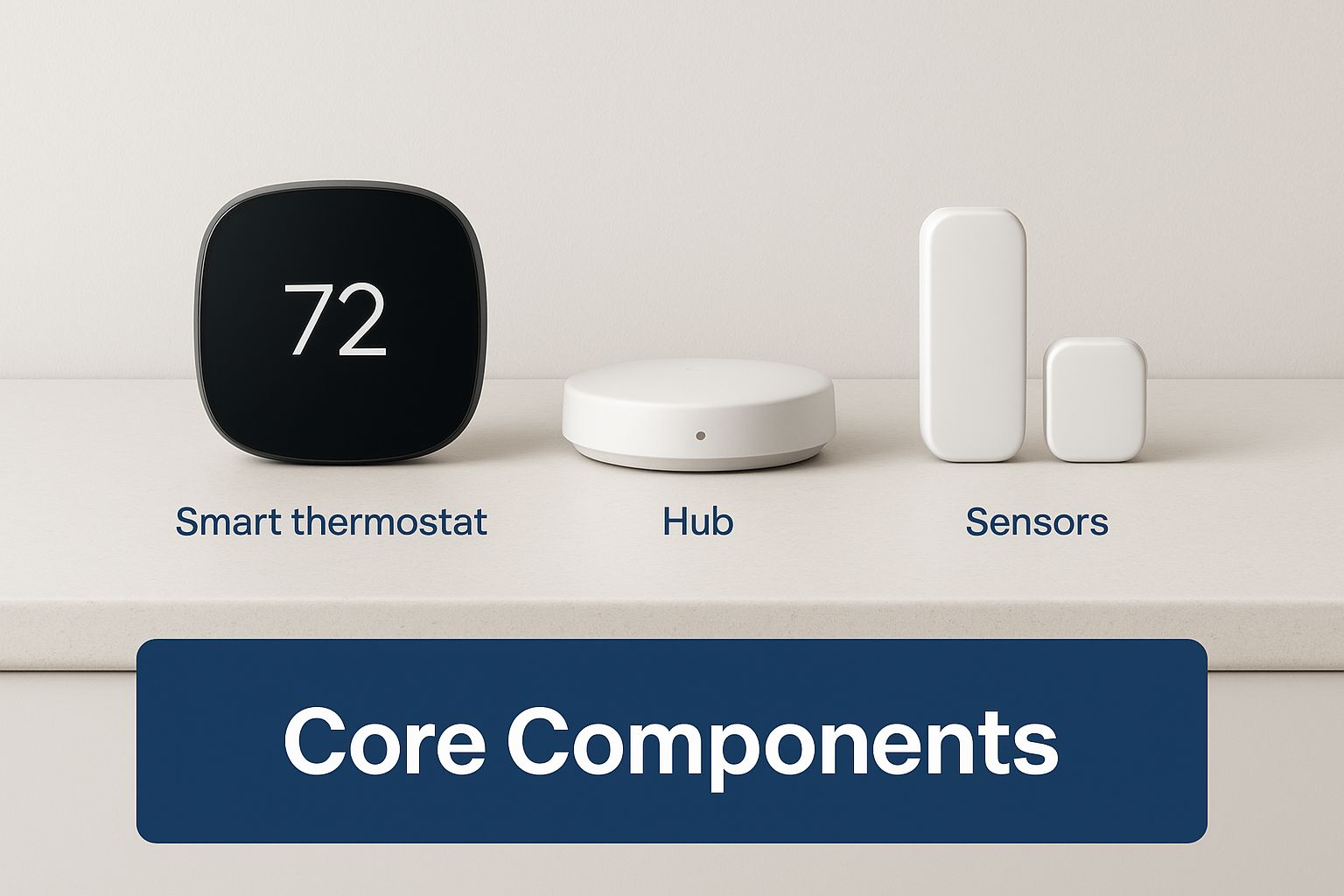
As you can see, the central hub is the brain of the operation. It takes in all the signals from your sensors and then tells your lights, locks, and speakers what to do.
The Main Languages of Your Smart Home
Your devices use a few main protocols to get the message across. Each one is like a different radio frequency, with its own set of strengths and weaknesses depending on the job.
-
Wi-Fi: This is the big one. It's great for anything that needs to send a lot of data, like streaming high-definition video from your security cameras. The only catch is that it can get a bit congested if you have dozens of devices all trying to shout over each other, which is why a solid home network is non-negotiable.
-
Zigbee & Z-Wave: These two are designed for efficiency. They use much less power and create their own special 'mesh' network, so they don't clog up your main Wi-Fi. This makes them absolutely perfect for smaller gadgets like motion sensors, smart light switches, and door locks that only need to send tiny bits of information.
The secret sauce for Zigbee and Z-Wave is their mesh network design. Each device acts like a little repeater, passing messages along to its neighbours. This creates a super-reliable network that actually gets stronger and extends its reach with every new device you add.
This is a totally different approach to your standard Wi-Fi network. If you want to dive deeper into how home networks are structured, our guide comparing Wi-Fi extenders versus mesh systems breaks down how these different technologies provide coverage.
To make things a bit clearer, here's a quick look at how these common protocols stack up against each other. It should give you a good idea of which one might be right for your different smart devices.
Wi-Fi vs Zigbee vs Z-Wave: A Quick Comparison
| Protocol | Best For | Pros | Cons |
|---|---|---|---|
| Wi-Fi | High-bandwidth devices (cameras, speakers) | Fast speeds, widely available, no hub needed for many devices | Can be power-hungry, can congest your network |
| Zigbee | Lighting, sensors, and general automation | Low power, fast response, strong mesh network, open standard | Can face interference from Wi-Fi (2.4 GHz), may require a hub |
| Z-Wave | Security (locks, alarms), sensors, switches | Excellent reliability, avoids Wi-Fi interference, low power | Slower than Zigbee, less common than Wi-Fi, often needs a hub |
Ultimately, choosing the right protocol is about matching the device to the task.
The New Kid on the Block: Matter
Then there’s Matter, the new universal translator that’s just arrived on the scene. Backed by the big guns like Apple, Google, and Amazon, its entire purpose is to get all your smart gear working together seamlessly, no matter who made it. It's designed to tear down the walls between different brands, so you don’t have to stress about whether your Google speaker will play nice with your Apple-compatible light bulb.
Picking devices that speak the right language is crucial for a home automation system that just works. For the heavy data lifting, stick with Wi-Fi. For pretty much everything else, Zigbee or Z-Wave will give you rock-solid performance without slowing down your Netflix stream.
Right, let's talk about how you actually run the show. A brilliant home automation system is pointless if you need a pilot's licence to use it. The whole idea is to make life simpler, and thankfully, there are a bunch of ways to control your setup, from the phone you're probably holding right now to just using your voice.
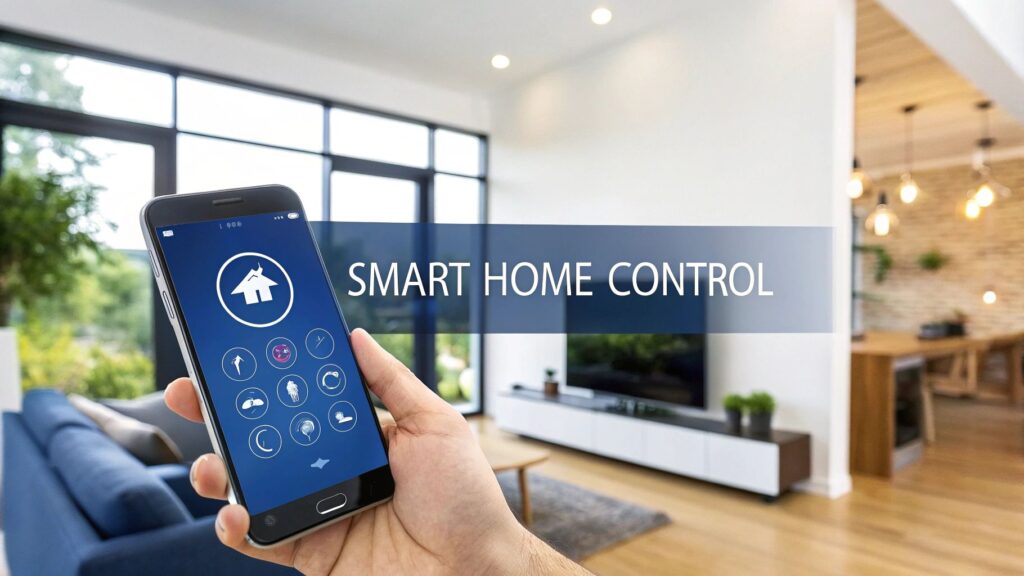
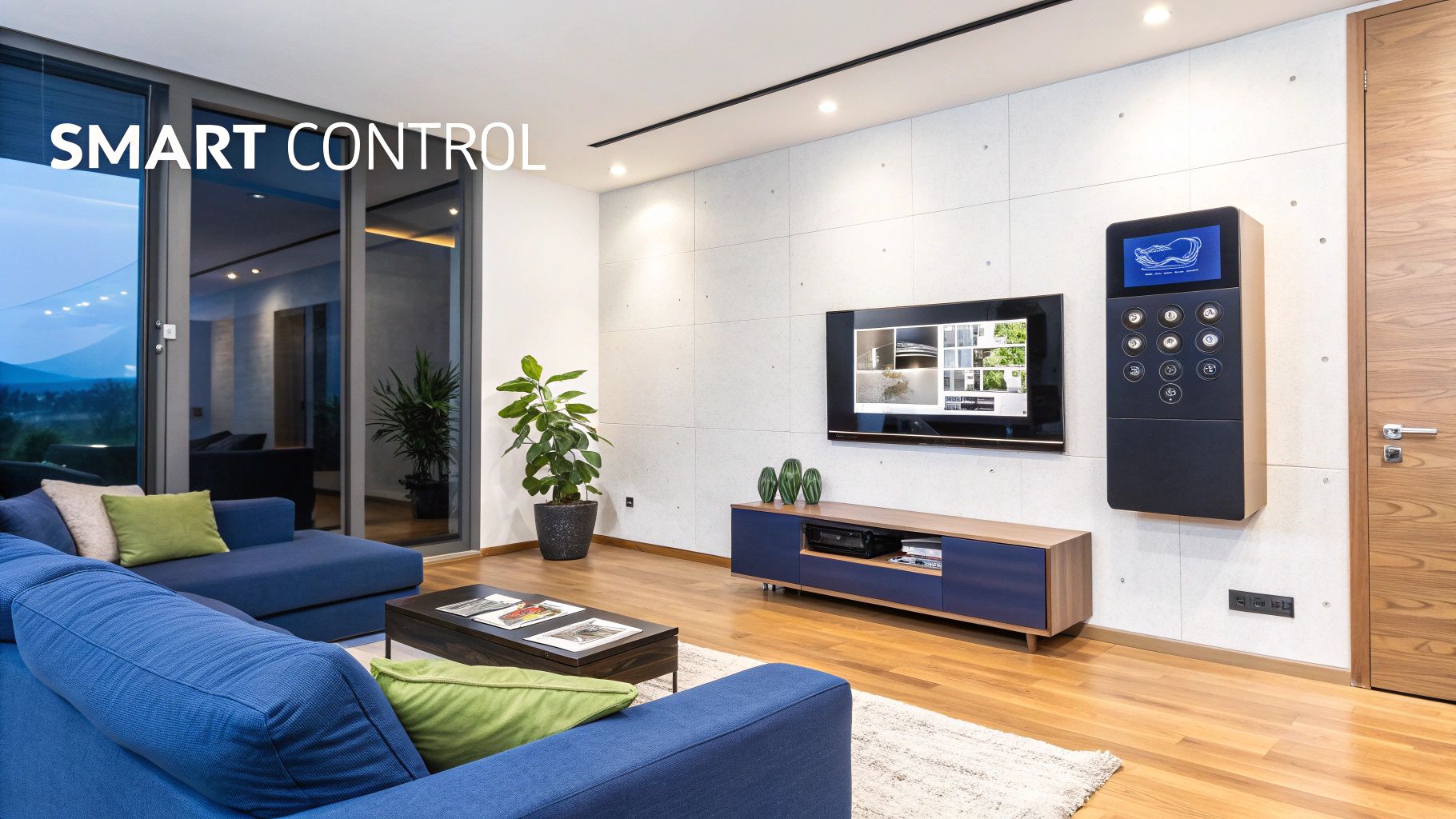
First up, the command centre that's always with you: your smartphone app. This is your all-access pass, letting you tweak every setting, set schedules, and check on devices from anywhere—whether you're chilling on the couch in Gosford or sunbaking on the Gold Coast. For a more fixed solution, a lot of people are installing slick, wall-mounted touchscreens. They look great and give everyone in the family an easy-to-use, central hub to manage the home.
Hands-Free and Automated Control
Now for the really cool stuff. Voice control has completely shaken things up. It feels like magic, but it's just smart tech. There's nothing better than walking in with arms full of groceries and saying, "Hey Google, I'm home," and watching the lights pop on and the air con kick in.
This kind of convenience is a big reason why the Aussie smart home market is absolutely taking off. It's forecast to rocket from AUD 4.25 billion in 2024 to a massive AUD 15.86 billion by 2033, as more of us get a taste for it. If you're curious, you can dig into these Australian smart home market trends to see how fast things are moving.
But the real dream is a home that anticipates what you need. That’s where automated schedules and 'scenes' enter the picture.
A 'scene' is basically a lifestyle shortcut. It’s a bundle of commands that all fire at once with a single tap or phrase, setting the perfect atmosphere for an activity without you having to lift a finger.
Bringing Scenes to Life
Instead of fiddling with individual lights and devices, scenes let you conduct the whole orchestra at once. Imagine a family in Newcastle getting ready for their weekly movie night. They could have a "Movie Night" scene that, with one tap, does all this:
- Dims the main lounge lights to a cosy 20% brightness.
- Turns on the cool, coloured LED strip lighting behind the telly.
- Quietly lowers the motorised blinds.
- Fires up the TV, soundbar, and whatever streaming box they use.
In a few seconds, the room is completely transformed, turning a standard night in into a proper cinema experience. It’s this kind of seamless integration that makes a house full of gadgets feel like a genuinely smart, helpful home.
Real-World Benefits for Your Aussie Home
It’s easy to get caught up in the novelty of telling your house what to do, but what are the genuine, day-to-day perks of a home automation control system? We’re talking about real, tangible advantages for homeowners everywhere, from the Hunter Valley to Sydney's North Shore. This is about making life simpler, safer, and even a bit lighter on the wallet.
Slash Those Pesky Power Bills
Let’s start with a big one: saving money. With energy prices always on the rise, a smart home can be your secret weapon against bill shock. Imagine a system that knows when everyone has left for the day and automatically powers down the lights and adjusts the air con.
It’s not just about flicking switches off, either. Your system can learn your family’s routines, optimising your heating and cooling to run only when it’s actually needed. It can even be clever enough to lower your blinds during a summer scorcher, keeping the house naturally cooler and taking the pressure off your air conditioner.
Unbeatable Peace of Mind
Next up is security, which is a massive reason why many Aussies make the switch. A proper control system brings your locks, cameras, and alarms together, creating a single, cohesive shield around your home.
A truly smart security system doesn’t just react to problems—it proactively protects your home. It’s the difference between having a simple alarm and having a digital watchdog that’s always on duty.
Here’s how it all comes together in the real world:
- Smart Locks: Get an alert on your phone the moment the kids get home from school. You can even create temporary access codes for tradies or cleaners, meaning you never have to hand out a physical key again.
- Integrated Cameras: If a motion sensor is tripped at night, your system can instantly turn on the outdoor lights and stream a live feed from your security cameras straight to your phone, no matter where you are.
It’s all about having complete visibility and control, which brings that priceless feeling of security. If you're looking to bolster your defences, our detailed guide on smart home security systems is a great place to start.
This growing desire for both security and convenience is driving some serious investment. The Australian smart home market is valued at AUD 3.17 billion in 2024 and is expected to more than double in the next decade.
Pure, Unadulterated Convenience
At the end of the day, it’s all about making life just that little bit easier. For a busy family, it’s about automating the morning rush. For older Aussies wanting to stay in their own homes longer, it’s voice commands that handle lights and appliances.
And for anyone who’s ever gotten comfy on the couch only to realise they left the kitchen light on? It’s pure, unadulterated bliss.
Bringing It All Together with Real Setups
All this theory about hubs and protocols is well and good, but what do home automation control systems actually look like in a real Aussie home? Let's take a look at a couple of setups to see this stuff in action. It really shows how you can mould the technology to fit exactly what you need.
First, we'll head up to Newcastle to see what we'll call "The Entertainer's Dream." This place is purpose-built for someone who loves having mates over. The owner, a die-hard Knights supporter, wanted a system that was all about creating an incredible atmosphere for social gatherings.
At the press of a single "Party Mode" button, the house comes alive. The multi-room audio system kicks in with a killer playlist, perfectly synced from the kitchen all the way to the outdoor barbie area. At the same time, the smart lights switch to a vibrant, colourful scene, and the motorised blinds drop for a bit more privacy. It completely transforms the vibe, turning a simple get-together into a real event.
The Energy-Smart Family
Now, let's duck down the M1 to the Central Coast to visit "The Energy-Smart Family." Their focus was totally different. They weren't looking for party tricks; they wanted to get a handle on their power bills and run a more efficient household. Their system is the quiet hero working behind the scenes.
The heart of their setup is a smart thermostat that’s learned the family’s daily routine, so the air conditioning isn't pointlessly chilling an empty house. It’s also hooked into their rooftop solar system. This allows it to cleverly schedule energy-hungry jobs, like running the pool pump, for the middle of the day when they’re generating free electricity. They can even pull up an app on their phones to see exactly where every watt is going, making it easy to spot more ways to save.
These two homes couldn't be more different, but they both rely on a central control system to make it all happen. One is built for lifestyle, the other for practicality—proving automation can be customised for any family's needs.
Whatever your goal is, a solid foundation is non-negotiable. For all these different devices to communicate without any drama, you need a seriously robust network. You can find out more about what it takes to build this backbone by reading up on professional home networking installation services.
Your Smart Home Questions Answered
Jumping into the world of home automation control systems can feel a bit like learning a new language. We get it. We’ve answered a fair few questions from folks around Sydney, Newcastle, and the Central Coast, so we’ve put together the most common ones to clear things up.
Think of it as a friendly chat over the fence, but about smart tech instead of the weather. No jargon, just straight-up answers.
How Much Does a Smart Home System Cost?
This is always the first question, isn't it? And the honest answer is: it really depends. You can get started with a few smart speakers and light bulbs for a couple of hundred dollars. On the other end of the scale, a fully integrated, professionally installed system can easily run into the tens of thousands.
For a solid, reliable setup that genuinely makes a difference, a good starting budget often falls somewhere in the $5,000 to $15,000 range. This usually gets you a central hub, smart lighting, and some basic climate and security controls. The best way to approach it is to figure out your main goal first—are you trying to slash power bills, boost security, or just enjoy some serious convenience? Start there, and build out.
Do I Need a Super-Fast Internet Connection?
Not necessarily, but you absolutely need a reliable one. Many of the core devices, like your light switches and sensors running on Zigbee or Z-Wave, don't even use your Wi-Fi. They form their own little mesh network to talk to each other, which is incredibly efficient.
However, for the more demanding stuff like streaming high-definition video from security cameras or playing music throughout the house, a stable connection is non-negotiable. A dodgy internet connection is probably the number one cause of smart home headaches.
Is My Smart Home Secure from Hackers?
It’s a great question, and definitely something to take seriously. The good news is that modern home automation systems are designed with security as a top priority. Professional-grade systems, in particular, use heavy-duty encryption to keep your data and your home safe.
The biggest vulnerability is often the home network itself, not the smart home gear. A poorly secured Wi-Fi network is like leaving the front door of your digital house unlocked for anyone to wander through.
The great thing is, you can take simple but powerful steps to protect yourself. Using strong, unique passwords for all your devices and ensuring your home network is properly configured are the most important first steps. For a more detailed guide, check out our post on how to secure your Wi-Fi network for some easy-to-follow, practical tips.
Ready to stop juggling a dozen different apps and start living in a truly connected home? The team at Advanced Comtech has been designing and installing custom smart home systems across the Central Coast, Sydney, and Newcastle for years. We handle everything from the initial chat to the final handover, making sure your system is reliable, secure, and genuinely easy to use. Give us a call to find out what's possible for your home.