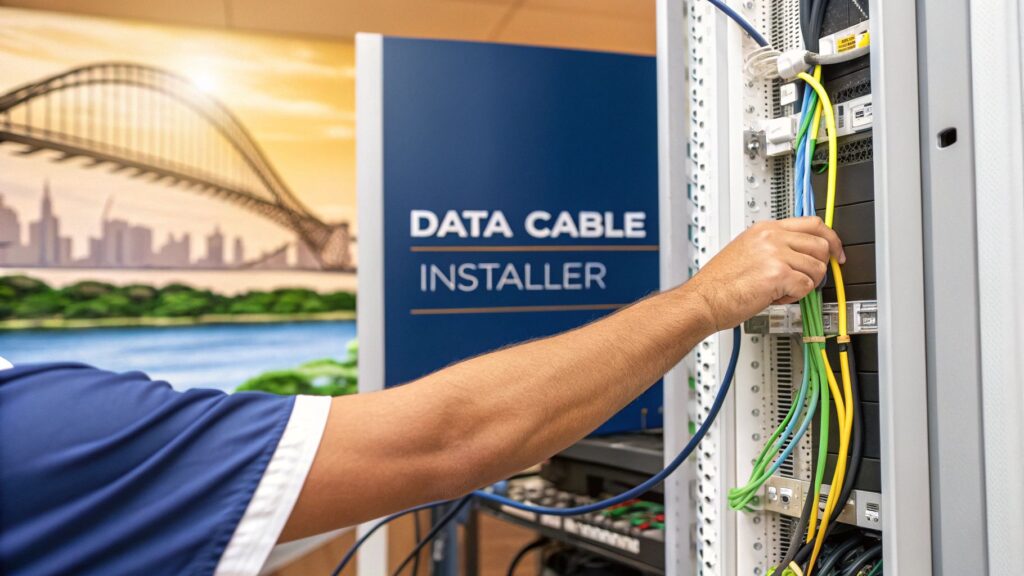
Let's be honest, that desperate "data cable installer near me" search usually starts right when your Wi-Fi signal is more unreliable than a politician's promise. Or maybe you're staring at a tangled nest of cables in your new office that looks like a bowl of spaghetti, wondering where on earth to begin. You just need someone reliable, a local legend who shows up and gets the job done properly.
Why Finding the Right Cabler Matters
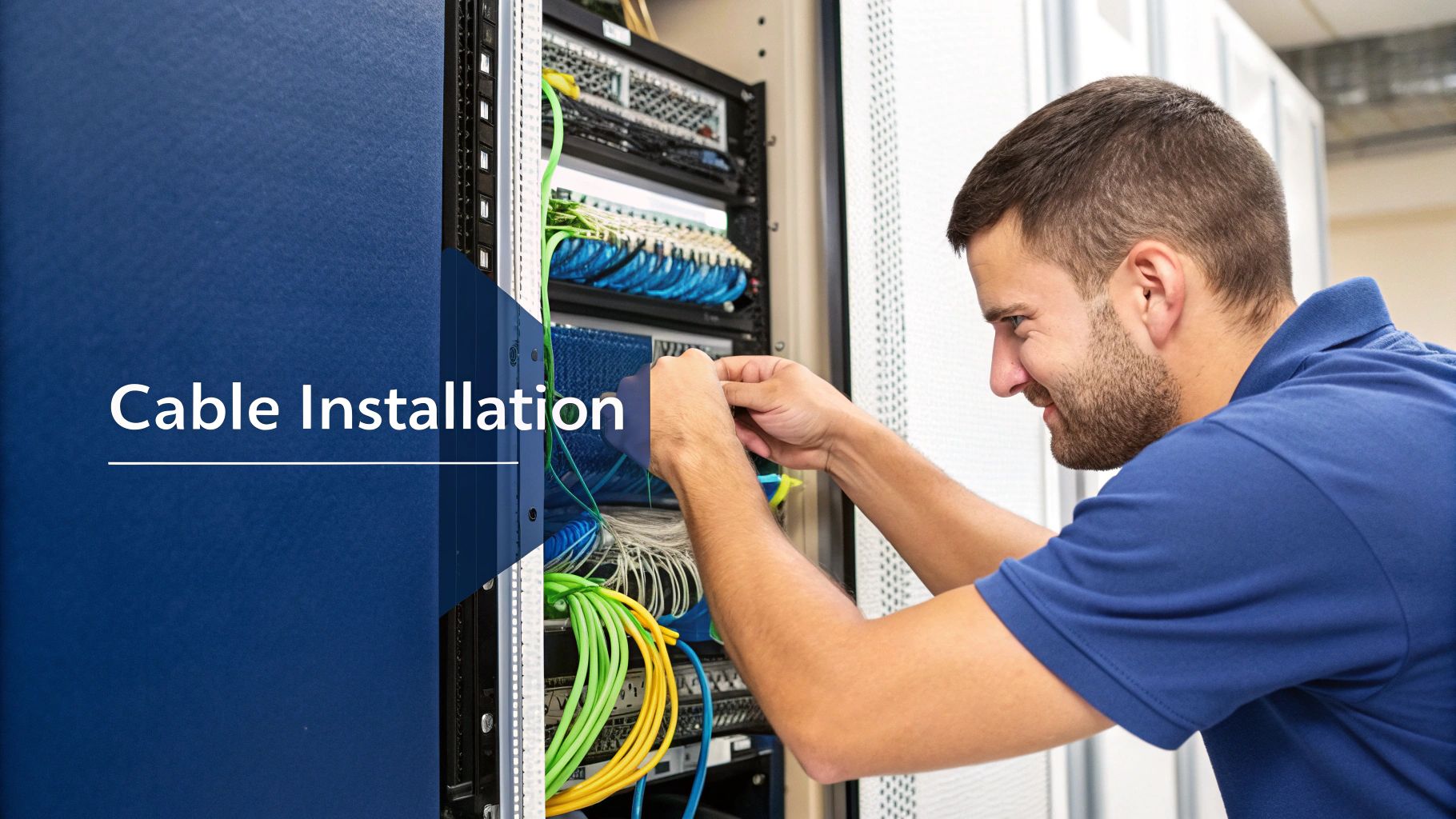
We've seen it all. Whether you're in Sydney, up the Coast, or out in Newy, that feeling of network panic is a universal language. Picture this: Dave from accounts is trying to run payroll, but the connection keeps dropping out. He's about two minutes away from throwing his monitor out the window. That's the kind of chaos a dodgy cabling job creates. This guide is your straightforward plan to cut through the tech-speak and find a true professional.
This is about more than just plugging in a few cables. It's about building a stable, fast, and safe network that won't become a headache later on. A rushed or sloppy job can mean years of frustrating dropouts, slow speeds, and even genuine safety risks.
Finding a top-notch installer isn't about luck. It's about knowing what to ask and what to look for right from the start. We'll walk you through it.
The Growing Demand for Quality Connections
The need for skilled installers is absolutely booming across Australia. Between new infrastructure projects, the explosion of data centres, and our endless appetite for high-speed internet, the industry is growing at a serious pace.
To put it in perspective, the Australian cable management market was valued at around AUD $1.2 billion in 2024 and is expected to more than double by 2033. This huge growth highlights just how vital proper data infrastructure has become for our homes and businesses. If you're curious, you can dig into the specifics in this detailed report about the Australian cable management market.
This guide will give you the practical know-how to navigate this crowded space. We’ll cover:
- The difference between a quick fix and a proper, future-proof installation.
- How to tell a real professional from a cowboy with a crimper.
- The key questions that will reveal an installer’s true expertise.
By the time you're done reading, you’ll have the confidence to pick the right person for your project. To get a head start, check out our guide on finding a quality data cable installer.
Ever feel like you need a translator when talking to a tech tradie? You’re not alone. Think of this as your cheat sheet for cutting through the jargon and figuring out if a data cable installer really knows their stuff.
It's tempting to jump straight to "how much?", but that's only one piece of the puzzle. Asking the right questions upfront can save you a world of hurt later on—from dodgy connections to a network that moves at a glacial pace.
Let's dive into how you can sort the seasoned pros from the cowboys.
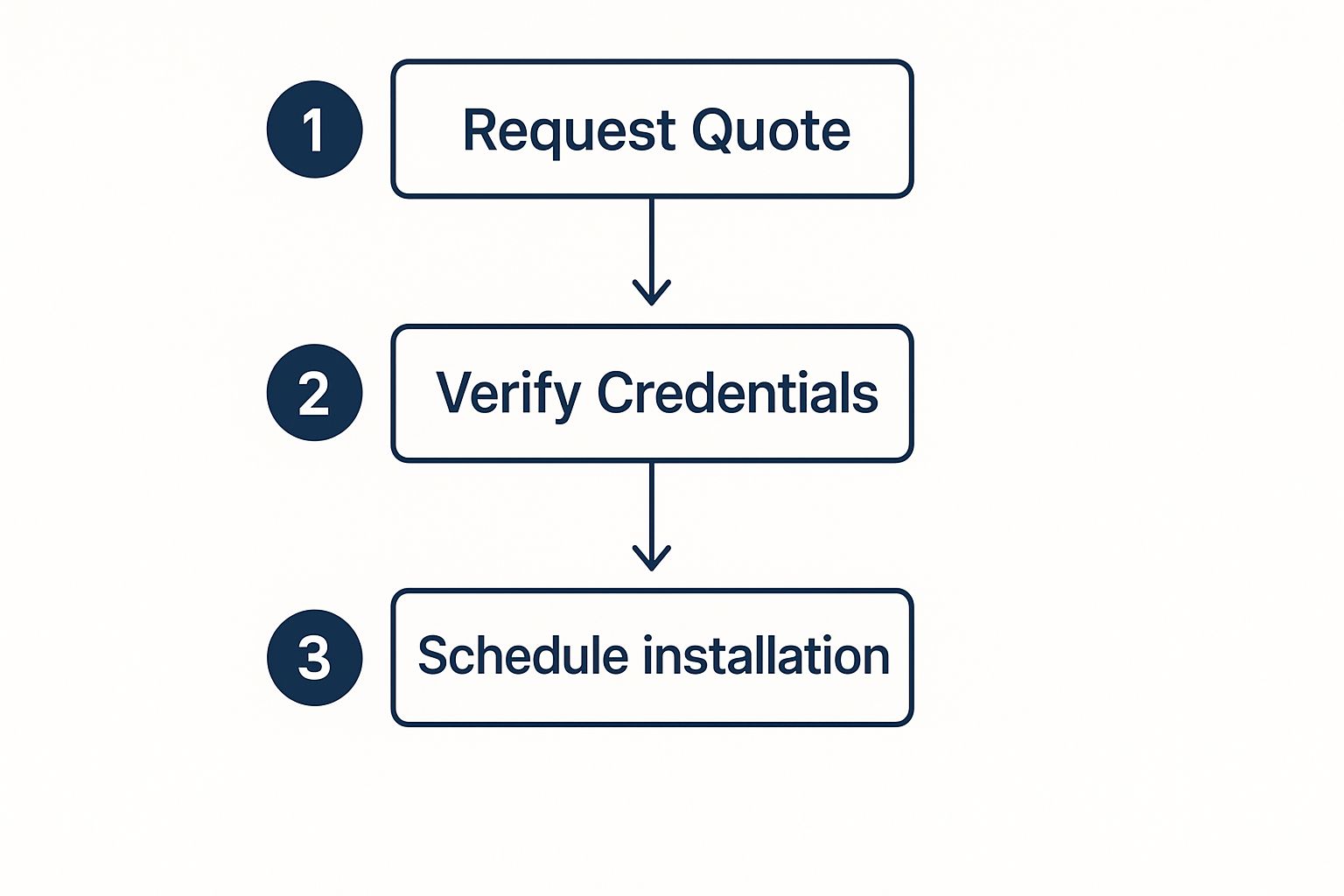
As you can see, getting a quote is just the start. The real work begins when you start vetting their skills before signing anything.
The Essential Questions to Vet Your Installer
Think of this as a friendly interrogation. The answers you get will tell you everything about their experience, the quality of their work, and their overall professionalism.
A great place to start is with their credentials. Any legitimate data cabler in Australia must be registered with the Australian Communications and Media Authority (ACMA). It’s not optional; it’s the law.
A simple question like, “Are you an ACMA registered cabler?” is a fantastic first filter. A confident “yes” followed by their registration number is exactly what you want to hear. Any hesitation is a massive red flag.
Next, get a feel for the gear they use. Asking, "What brand of cable and components do you typically install?" isn't about being picky—it's about ensuring quality. Look for reputable brands like Clipsal, Panduit, or Siemon. These guys back their products with solid warranties and meet strict Australian standards.
If they give you a vague answer like "just the standard stuff," it could mean they're using cheap, imported gear that might fail when you need it most. For a better idea of what a quality job looks like, check out our guide on installing data cable.
Finally, ask for proof of their workmanship. A messy server rack is more than just an eyesore; it’s a sign of a messy work ethic and a future maintenance nightmare. A quick, “Can you show me a few photos of your cable management in previous jobs?” will speak volumes about their attention to detail.
Key Questions for Your Data Cabling Installer
To make this even easier, I've put together a quick-reference table. Use it to vet potential installers and understand what their answers really mean for your project's quality and longevity.
| Question to Ask | What a Good Answer Looks Like | What a Red Flag Answer Looks Like |
|---|---|---|
| Are you an ACMA registered cabler with an Open Licence? | "Yes, of course. My licence number is [provides number]. It allows me to work on all types of cabling infrastructure." | "What's ACMA?" or "Yeah, I've got a mate who's registered." or "You don't need one for this sort of job." |
| What brands of cable and components do you use? | "We primarily use reputable brands like Clipsal, Panduit, or Siemon because of their reliability and warranties." | "We just use the standard stuff," or "Whatever the wholesaler has on special." |
| Can you show me photos of your past work, specifically cable management? | "Absolutely. Here are a few examples from recent projects. We take pride in keeping our racks neat and labelled." | "I don't really have any photos on me," or "It just gets hidden behind the wall anyway, right?" |
| How do you test and certify your installations? | "We use a Fluke network tester to certify every single point to Australian Standards. We'll provide a full report." | "We just plug it in and see if it works." |
Asking these questions gives you a clear picture of who you’re about to hire. A true professional will welcome them and have solid answers ready to go, giving you confidence that your network is in good hands.
Spotting a Pro vs. a Pretender
A quality data cabling job is more than just getting a signal; it’s the difference between a rock-solid network and years of frustrating dropouts. Let's be honest, anyone can buy a pair of crimpers from Bunnings and call themselves a cabler. But that doesn’t make them a professional data cable installer near me or you. Knowing what separates a tidy, professional installation from a dodgy, corner-cutting mess is crucial.
We’ve all seen the horror stories. 'Cowboy Kev's' handiwork often looks like a chaotic tangle of mismatched cables stuffed into a wall cavity, held together with a prayer and a few zip ties. Sure, it might work for a bit, but it's an absolute nightmare to troubleshoot later.
Now, contrast that with 'Pro Pete's' job—every cable is meticulously managed, clearly labelled, and perfectly terminated. That's the standard you should be aiming for.
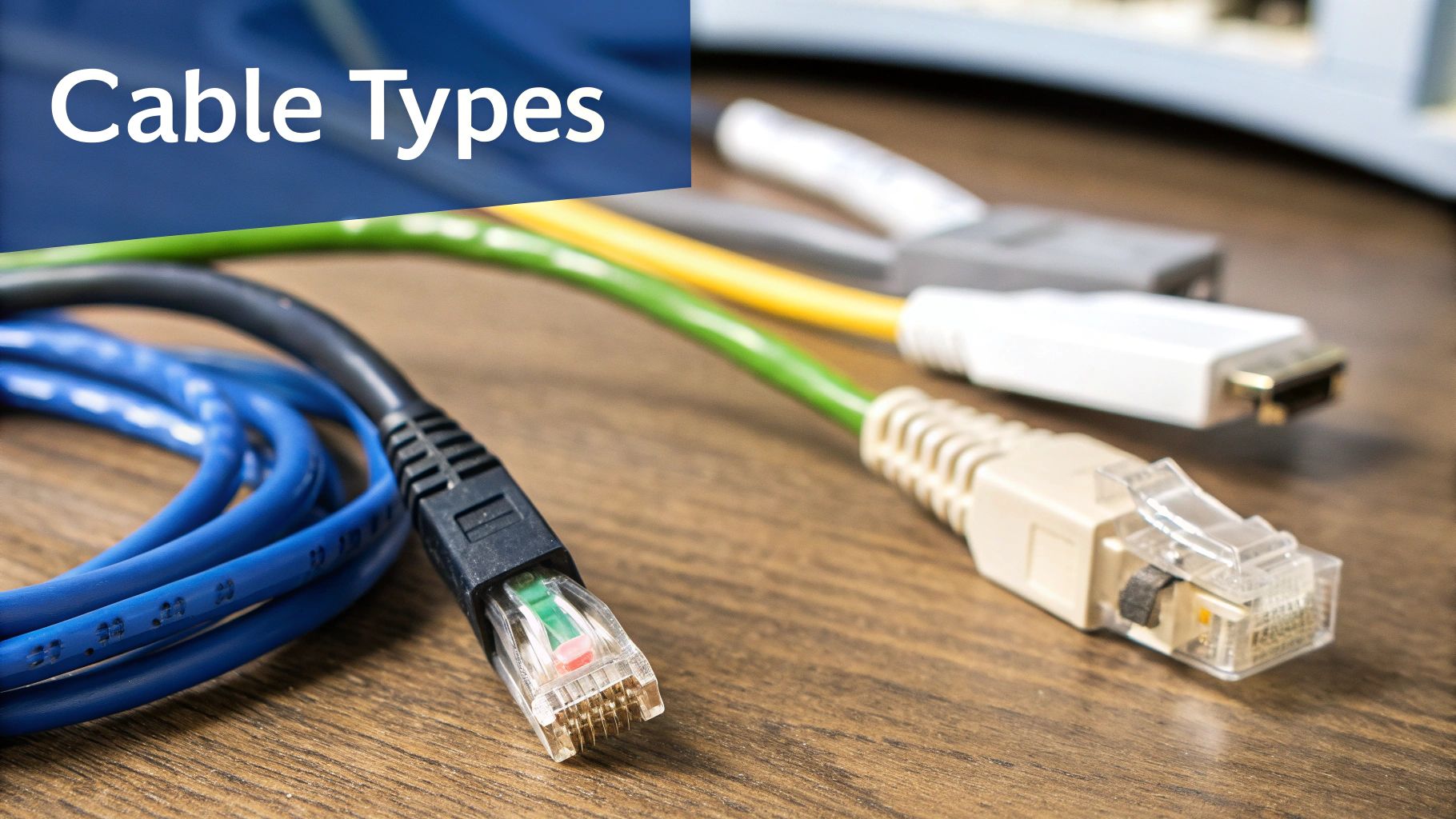
Signs of a Quality Installation
The proof is always in the details. A true professional leaves behind undeniable evidence of their expertise, and it usually includes a few key things.
- Neat Cable Management: Look for cables that are bundled neatly with velcro ties (not tight plastic zip ties that can damage the cable!). They should run parallel to each other and have gentle, sweeping bends instead of sharp, signal-killing kinks.
- Clear Labelling Schemes: This is non-negotiable. Every single cable and data point should be clearly and logically labelled at both ends. It might seem small, but this saves countless hours (and dollars) if you ever need to troubleshoot or make changes down the line.
- Quality Components: Professionals don't use cheap, no-name gear. They rely on reputable brands for their jacks, patch panels, and cables to ensure every part of your network meets Australian standards and won't fail you when you need it most.
The real mark of a professional job is the final report. A top-tier installer will use a network certification tester (like a Fluke tester) to verify that every single cable run meets the required performance standards for its category. Always, always insist on seeing this report.
The Bigger Picture in the Cabling Industry
The demand for high-quality data cabling isn't just a local trend; it's part of a massive wave of growth across our region, driven by everything from 5G rollouts to expanding data centres.
To put it in perspective, the Asia Pacific wire and cables market was valued at AUD $124 billion in 2024 and is tipped to soar to nearly AUD $204 billion by 2032. You can read more about this incredible market expansion in recent industry analysis.
This boom means more work for qualified installers, but it also creates more opportunities for cowboys to jump in and cut corners. Knowing these signs of quality helps you ensure you’re hiring a genuine expert, not just another pretender.
So, What’s the Real Cost of Data Cabling in Sydney?
Let's cut to the chase and talk numbers. When you start searching for a "data cable installer near me," one of the first questions is always about the price. While a one-size-fits-all answer doesn't exist, I can definitely give you the inside scoop on what shapes a quote here in Sydney, Newcastle, and up on the Central Coast.
As a ballpark figure, you’re probably looking at a range of $150 to $250 per data point for a pretty standard job. But, and this is a big but, that number can shift significantly depending on the specifics of your project.
The Big Factors That Move the Price Tag
The final cost you see on an invoice is a blend of the materials used and the labour required, both of which are heavily influenced by the unique layout and structure of your space.
Here’s what a professional installer is thinking about when they build your quote:
- The Cable Itself: Are we running standard Cat6 for your office computers? Or do you need the grunt of Cat6a for higher speeds and future-proofing? Maybe it’s a full-blown fibre optic run between buildings. Each option has a very different material cost.
- The Difficulty of the Job: Getting a cable through the open ceiling of a new commercial fit-out is straightforward. Fishing that same cable through three double-brick walls in a 100-year-old heritage building? That's a completely different ball game, demanding a lot more time and expertise.
- How Many Points You Need: It’s simple maths, really—installing 50 data points will cost more than installing five. The good news is that the price per point usually comes down on bigger jobs, so it’s not just a case of multiplying the single-point price.
I remember a situation with two businesses of a similar size. One went for the rock-bottom quote they found online and has been wrestling with network gremlins ever since. The other paid a bit more for a certified, properly planned installation and now has flawless connectivity, saving a fortune in downtime and IT support calls.
It really is a classic case of you get what you pay for. A quality cabling job isn't just another bill to pay; it’s a critical investment in the digital foundation of your property. For a more detailed breakdown, our complete guide on data cabling installation is a great resource.
Future-Proofing Your Home or Office Network
When you're thinking about network cabling, it’s easy to focus on just getting a good Wi-Fi signal for your Netflix binge tonight. But really, it’s about laying the groundwork for all the tech that’s just around the corner, making sure your property is ready for whatever comes next.
This is a one-time investment that pays off for years. A well-designed structured cabling system becomes the backbone for everything—from your NBN and 5G connections to the ever-growing army of smart home gadgets, office IoT devices, and high-def security cameras.
Built for Tomorrow, Not Just Today
Think about how much our data needs have exploded in the last decade alone. Now, try to picture what the next ten years will bring. Getting a professional to install high-quality cabling now means you won't have to tear your walls open again when the next big thing in tech drops.
We're seeing this on a massive scale with the growth of data centres across Australia. That market is tipped to be worth around AUD $8.58 billion by 2030, with huge hubs in Sydney and Melbourne driving the need for faster, more reliable infrastructure. You can get a sense of just how big this is by exploring the latest Australian data centre market analysis.
Your home or office is basically its own mini data centre, so treating its network with that same forward-thinking approach is just plain smart.
Choosing the right cabling today is like pouring a solid foundation before building a house. It supports everything you build on top of it, ensuring stability and performance for years to come.
Getting your data points installation right is at the heart of all this. It ensures every single device, whether it's a smart TV or a mission-critical office server, has a solid, hardwired connection waiting for it. A good local data cable installer can design a system that not only meets your needs today but has the headroom to handle what's coming tomorrow.
Your Data Cabling Questions Answered
We get asked the same questions all the time, so we’ve pulled them together here to give you the straight answers. No fluff, no jargon—just the info you need when you're searching for a data cable installer near me.
What’s the Difference Between Cat6 and Cat6a?
Think of it like this: Cat6 is your trusty, reliable ute. It's perfect for most homes and small offices, handling today's gigabit speeds without breaking a sweat. It gets the job done well.
Cat6a, on the other hand, is the high-performance model. It's built for much faster speeds—we're talking up to 10 Gigabits—over longer distances and has better shielding to stop electrical interference in its tracks. If you’re future-proofing a new office or just want the best performance possible, Cat6a is a smart investment.
The biggest mistake we see is people paying for premium Cat6a cable, only for it to be installed poorly. A badly terminated Cat6a cable performs no better than a standard Cat6 one. The quality of the installation is every bit as important as the cable you choose.
Do I Really Need a Licensed Installer?
Yes. One hundred percent. Here in Australia, it’s not just a good idea, it's the law. Anyone working on telecommunications cabling must be registered with the Australian Communications and Media Authority (ACMA).
Hiring a licensed cabler means they know all the technical and safety standards inside and out. Going with someone unlicensed is a huge risk—it could void your insurance and leave you with a faulty, unreliable, and potentially unsafe network.
Can’t I Just Use Wi-Fi for Everything?
Look, Wi-Fi is fantastic for convenience. We all use it. But for the devices that absolutely need a rock-solid, fast, and secure connection, nothing beats a cable.
Think about your main work computer, your smart TV for streaming, or your security cameras. A hardwired connection gives you faster speeds, lower latency (no lag!), and is way more reliable than the best Wi-Fi signal. For a deeper dive, have a read of our guide on professional data cable installation.
Ready to get your network sorted by a local expert who turns up on time and does the job right? Get in touch with Advanced Comtech today for honest advice and a no-obligation quote. Find out more at https://advancedcomtech.com.au.