So, you’ve just lugged a brand-spankin' new TV home from JB Hi-Fi, and that old, chunky entertainment unit is looking seriously tragic. You’ve got visions of a clean, floating screen, but the big question is rattling around your head: what’s the real cost to mount a TV on the wall?
For a standard, no-frills professional job in the Sydney, Newcastle, or Central Coast areas, you can generally expect to fork out somewhere between $120 and $200. This is your starting point, covering the labour for a dead-simple installation on a Gyprock wall.
Your Quick Guide to TV Mounting Costs
Nobody likes getting stung with a surprise bill, especially after you've already dropped a grand or two on a new telly. Think of that $120-$200 figure as your entry fee. It’s what you pay for a seasoned pro to rock up with the right gear, find the wall studs without turning your wall into Swiss cheese, and make sure your pride and joy is mounted securely—not destined for a spectacular, floor-shattering demise.
Of course, that’s just the basic install. A bit like ordering a coffee, once you start adding the fancy stuff like hidden cables or a schmick bracket, the price will naturally creep up. But for now, that's your ballpark figure.
To make it even clearer, here's a quick table breaking down the potential costs you might run into.
Quick Cost Snapshot for TV Wall Mounting
| Service Component | Estimated Cost Range (AUD) |
|---|---|
| Basic Installation Labour | $120 – $200 |
| Standard Fixed TV Bracket | $30 – $80 |
| Tilting or Full-Motion Bracket | $80 – $250+ |
| In-Wall Cable Concealment | $75 – $150 |
| Mounting on Brick/Concrete | Add $40 – $80 |
This table should give you a solid idea of how different bits and pieces contribute to the final price. The total cost really boils down to how tricky the job is and the hardware you pick.
Regional Price Differences at a Glance
Ever noticed how a flat white costs more in a trendy Sydney CBD laneway than it does in a classic Newy café? TV mounting services work in a similar way—where you live matters. While there are national averages, local market rates definitely influence the final quote you'll get.
Looking at data from across Australia, the typical range for a standard installation sits around $80 to $160. This gives you a decent benchmark. For more detailed breakdowns, you can often find useful data on sites like Oneflare.com.au.
This infographic gives a handy snapshot of what to expect in our service areas.
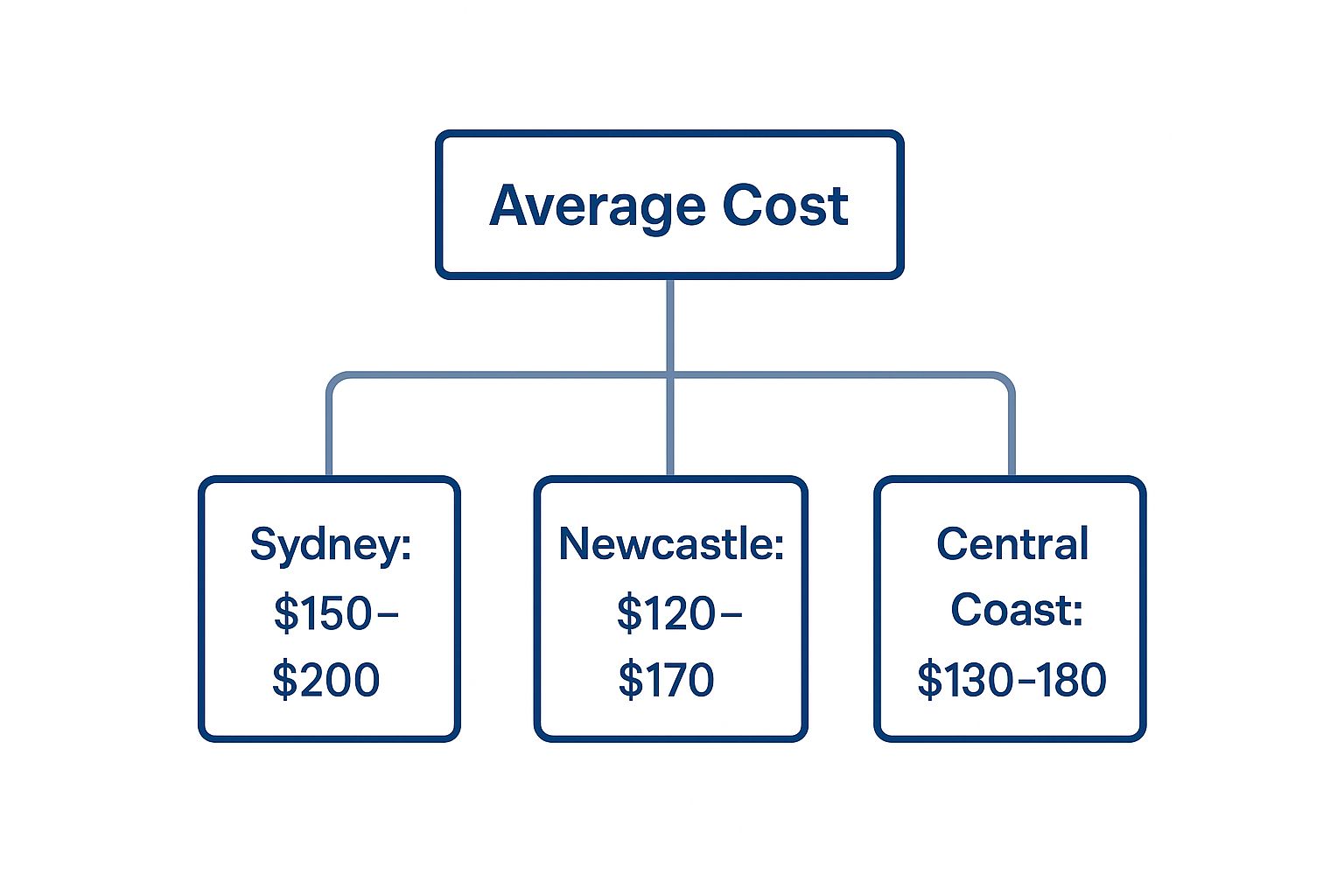
As you can see, Sydney prices tend to be on the higher side. Newcastle is often a bit kinder to the wallet, and the Central Coast usually lands somewhere in the middle.
It's also important to remember that this cost is purely for the physical mounting. If you’re also dealing with a dodgy signal that makes the footy look like a pixelated mess, that's a whole other kettle of fish. You might want to check out our guide on the cost of TV aerial installation and services for more on that.
How Your Bracket Choice Affects Your Wallet
Ever walked into JB Hi-Fi and felt a bit dizzy staring at that giant wall of TV brackets? You're not alone. The bracket you choose is one of the biggest factors influencing the final cost to mount a TV on the wall, and it's easy to feel overwhelmed by the choices.
To make it simple, let's picture three neighbours living in a new estate on the Central Coast, all getting their TVs mounted on the same day.
Meet Fixed Fred: The Budget-Conscious Choice
First up is 'Fixed Fred'. Fred's a simple bloke; he just wants his new TV sitting flat against the wall in his rumpus room. He’s not fussed about fancy angles or movement.
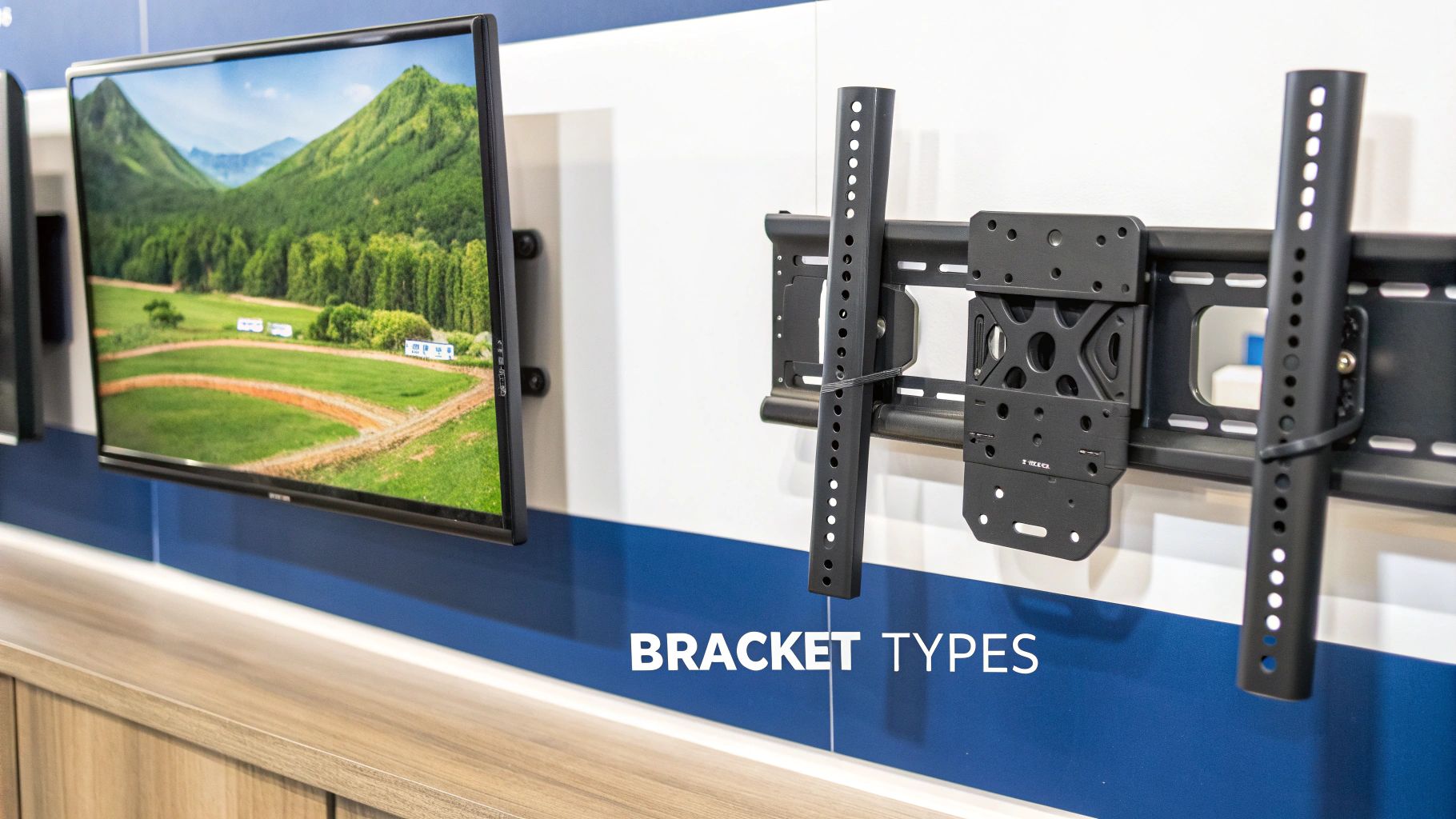
Fred goes for a fixed mount. This is your most basic and affordable option. It holds the TV securely in one spot, almost like a picture frame. It’s perfect for situations where you’ll always be watching from the same spot, directly in front of the screen. Because it's a straightforward bit of hardware, it's the cheapest of the bunch.
Tilting Tanya: For Practical Viewing
Next door, 'Tilting Tanya' has a problem. Her living room cops a wicked amount of afternoon sun, creating a nasty glare on the screen right when she wants to watch the footy.
Tanya needs a tilting bracket. This type costs a little more than Fred's but allows her to angle the TV vertically, usually up to 15 degrees. That small adjustment is a game-changer for knocking out glare or for mounting the TV slightly higher than eye level, like over a fireplace. The extra mechanism adds a bit to the price tag, but for Tanya, it's money well spent.
The bracket type you select directly impacts the overall TV mounting cost. Simpler designs are more affordable, while those offering greater flexibility come at a premium. Choosing the right one is about balancing your viewing needs with your budget.
Full-Motion Fiona: The Ultimate Flexibility
Finally, there's 'Full-Motion Fiona'. Fiona has an open-plan kitchen and living area in her home near Newcastle. She wants to be able to see the TV from the couch, the dining table, and even while she’s at the kitchen bench.
Fiona invests in a full-motion (or articulating) bracket. This is the Ferrari of TV mounts. It can tilt, swivel, and extend out from the wall on a retractable arm, giving you maximum viewing flexibility. This complexity means it's the most expensive option, but it solves Fiona's problem perfectly. Getting this kind of professional setup is key, which you can learn more about in our guide on expert TV installation and mounting.
The price difference between these options is pretty significant. A basic fixed bracket might only set you back $30 to $80, while a tilting one could be in the $80 to $120 range. Jump up to a quality full-motion mount, though, and you could be looking at anywhere from $100 to over $250, depending on its size and features.
Why Your Wall Type Is Part of the Equation
You might think a wall is just a wall, but to a professional installer, every wall has its own personality—and that personality plays a huge role in the final bill. The cost to mount a TV on your wall often comes down to what’s hiding behind the paint. Are we talking about a modern Gyprock wall, an old-school double brick classic from a Newcastle terrace, or solid concrete?
Let’s picture an installer’s typical day on the Central Coast. The first job is in a new build in Gosford, and it’s a standard Gyprock wall. The installer whips out a stud finder, locates the sturdy timber beams inside, and has the TV securely mounted in under an hour. It’s a clean, straightforward job—the bread and butter of TV mounting. This is the simplest and, you guessed it, most affordable scenario.
Different Walls, Different Challenges
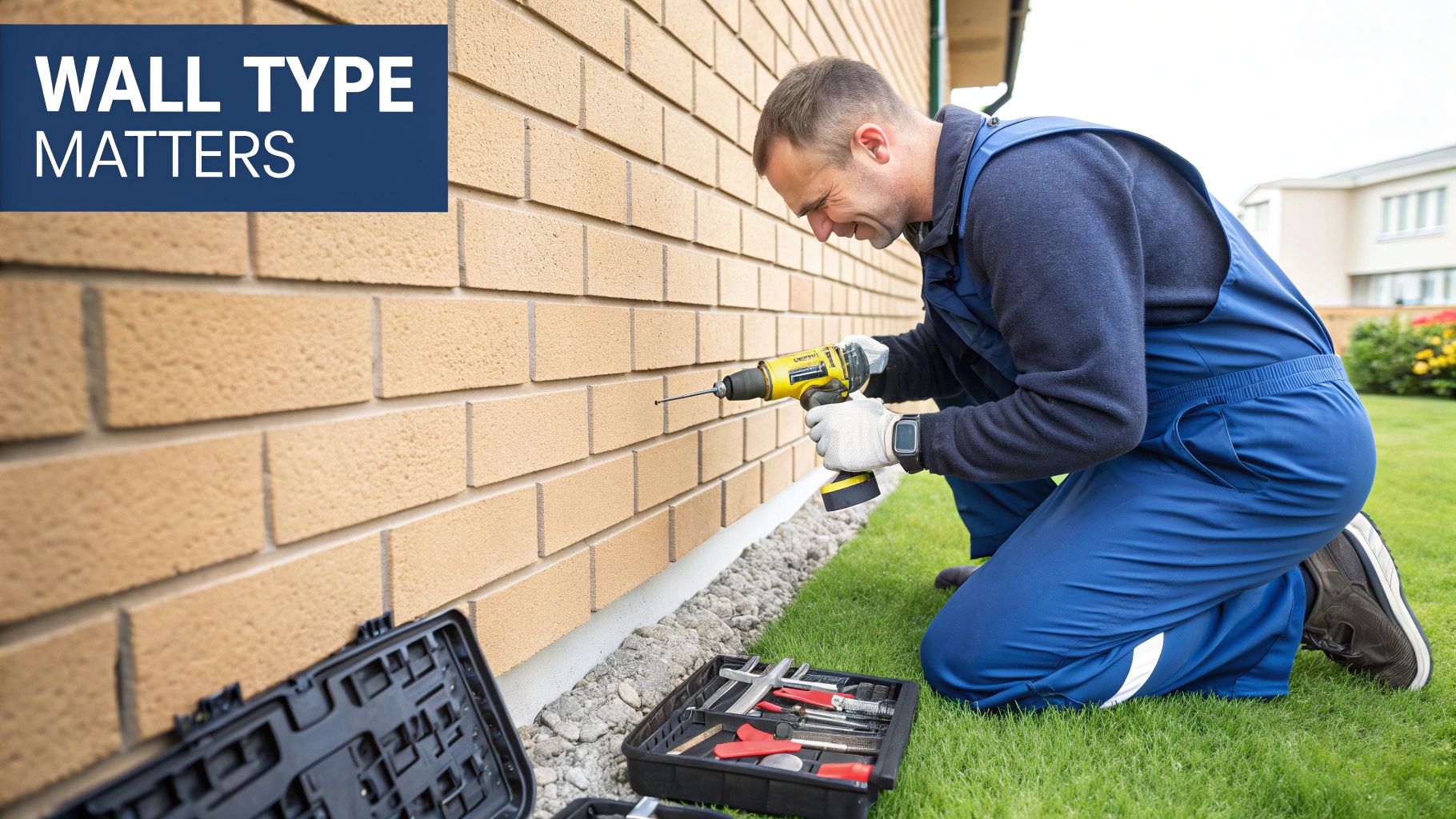
But the next job is a completely different beast. This time, it’s an older terrace house in inner-city Sydney with a beautiful, but stubborn, double brick wall. The stud finder is useless here. Instead, out comes the heavy-duty hammer drill.
Drilling into brick or concrete isn't just about making a hole. It demands specialised masonry drill bits, a lot more muscle, and specific hardware like wall plugs (anchors) to make sure the screws have something solid to grip onto. The whole process is slower, louder, and takes more gear and expertise.
The type of wall dictates the tools, time, and techniques required for a secure mount. A simple plasterboard job is a quick sprint, while tackling brick or concrete is more like a marathon—and that’s reflected in the labour cost.
Because of all this extra work, you can expect an additional charge, often between $40 and $80, for mounting on harder surfaces like brick or concrete. The installer isn't trying to rip you off; they're simply factoring in the extra time and specialised equipment needed to do the job safely and securely. After all, using the wrong tools on a brick wall can lead to a wobbly mount or, much worse, a TV that comes crashing down.
Common Wall Types and Their Impact
To give you a clearer picture, here’s what’s going through your installer’s mind when they first see your wall:
- Gyprock/Plasterboard: The most common wall type in modern Aussie homes. The key is finding the timber studs behind the board to anchor the mount. For a pro, this is a quick and easy job.
- Double Brick: Very common in older homes around Sydney and Newcastle. This requires a powerful drill and proper masonry plugs. It’s a much tougher job that takes more time and adds to the cost.
- Concrete: Often found in apartment buildings and some newer constructions. Just like brick, it demands heavy-duty tools and specific anchors, making it a more expensive installation.
Knowing your wall type is a huge step in figuring out the final cost. For a deeper dive into the whole process, our guide on TV mounting installation covers all the essentials you need to know before you book a tradie.
Looking Beyond the Obvious: What Else Affects the Price?
So, you've factored in the labour and picked out a bracket. You’re all set, right? Well, not quite. The things that can really blow out your budget are the sneaky extras that often don't come up until the installer is standing in your lounge room.
Let's imagine Dave from Davistown for a second. Dave was chuffed. He’d found a local installer online with a fantastic quote to get his new 65-inch beauty on the wall. But when the tech showed up, the curveballs started. "So, you'll want these cables hidden, won't you?" and "Ah, there's no power point here… we'll need to sort that." Suddenly, Dave’s ‘bargain’ had almost doubled. Don't get caught out like Dave.
The Cable Conundrum
You know that super clean, 'floating TV' look from the catalogues? That doesn't happen by accident. It's the result of wrangling that messy spaghetti of HDMI, power, and aerial cords and getting them out of sight. You could just let them dangle, but let's be honest, that ruins the whole sleek vibe you were going for.
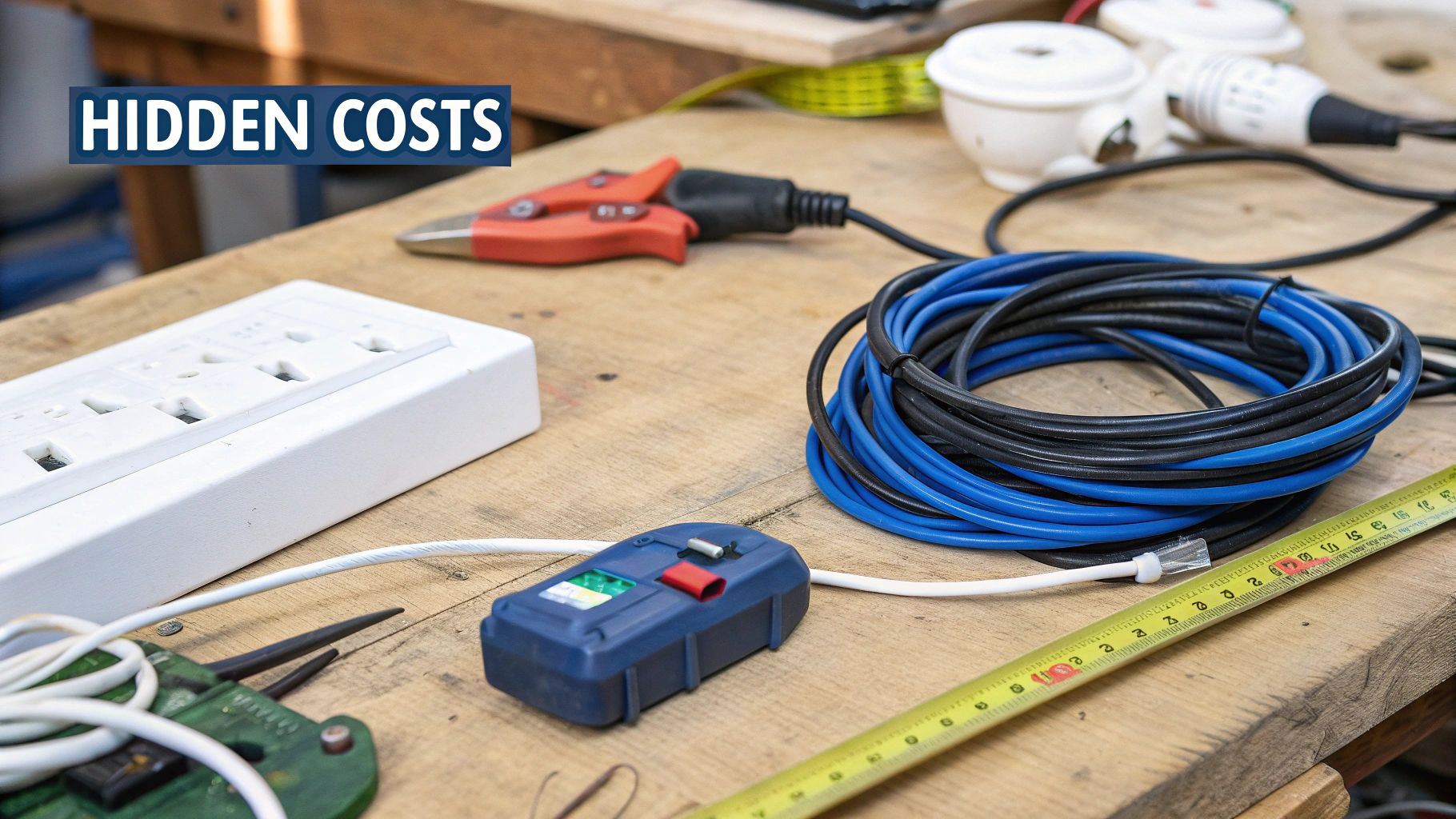
This is where professional in-wall cable concealment comes in. It's probably the most common 'extra' you'll come across. Your installer will carefully fish the cables through the wall cavity, running them from behind the TV down to an exit point near your entertainment unit.
Hiding cables inside the wall is what truly separates a DIY-looking job from a pro finish. It’s clean, it’s safe, and it looks fantastic, but it’s almost always an added cost on top of the basic mounting service.
This service will typically add another $75 to $150 to your final bill. The price can shift depending on your wall type—Gyprock is much easier to work with than solid brick—and what’s lurking inside the wall cavity, like insulation or fire-breaks. The principles are quite similar to other in-wall wiring, so it can be useful to understand more about what’s involved with installing data cables to get a better picture.
Power Point Problems
Here’s another classic budget-buster. You've found the absolute perfect spot for your TV—it’s centred, at the right height, everything. The only problem? The nearest power point is on the other side of the room. Running a ghastly extension cord up the wall is simply not an option.
This means you’ll need a brand-new power point installed right behind the TV.
And here’s the crucial bit: your TV installer is almost certainly not a licensed electrician. For safety and legal reasons, they can’t just whip up a new power outlet for you.
You'll need to hire a separate, qualified sparky for that job. This is a totally separate cost you need to account for, and it can be a significant one. The cost to install a new TV point can range anywhere from $200 to $400, depending on the complexity of the wiring. You can learn more about what goes into this and how costs are worked out by checking out this comprehensive guide on localperthelectrician.com.au.
Knowing about these potential add-ons from the get-go means you can get a truly realistic quote and sidestep any nasty surprises on installation day.
DIY vs. Calling a Pro: Is It Worth the Risk?
It’s the classic Aussie dilemma. You’re standing there, new TV in the box, a shed full of tools, and that little voice in your head whispers, “How hard can it be? She’ll be right.” The temptation to save a few quid by mounting the TV yourself is strong, especially after watching a couple of YouTube tutorials.
https://www.youtube.com/embed/06b-W0nW2mA
On one hand, you have the weekend warrior armed with a stud finder (that may or may not be accurate) and a healthy dose of optimism. On the other, you have a seasoned professional who’s mounted hundreds of TVs and can get the job done in under an hour—perfectly level, secure, and with no surprise holes in the wall.
The Risks of a DIY Disaster
Going the DIY route can feel empowering, but it comes with a few hair-raising risks. We’re not just talking about a slightly crooked screen that will annoy you for the rest of time. A botched job can have serious, and seriously expensive, consequences.
Imagine the horror of drilling directly into a water pipe or slicing through an electrical wire you had no idea was there. What starts as a simple money-saving project can quickly spiral into an emergency call-out for a plumber or a sparky, costing you far more in the long run.
Then there's the ultimate nightmare: the sickening crash of your brand-new 75-inch screen taking a nosedive because you missed the stud by a centimetre. Suddenly, that $150 you saved on installation seems pretty insignificant compared to the cost of replacing your TV.
A professional installer isn't just paid for their time; they're paid for their experience, precision, and the peace of mind that comes with knowing your expensive new television won't become a piece of modern art on your floor.
Should You Do It Yourself? A Quick Checklist
Still not sure which path to take? Run through this quick checklist. If you can confidently tick all these boxes, you might be ready to tackle the job yourself. If not, it’s probably smarter and safer to just call in an expert.
- Do you have the right tools? We’re talking a quality stud finder, a power drill with the correct bits (especially for brick), a spirit level, and all the necessary fasteners. Your old drill from 1998 might not cut it.
- Are you confident finding wall studs? Missing a stud is the number one cause of TV mounting failures. You need to be 100% sure you're drilling into solid timber, not just plasterboard.
- Do you know your wall type? As we've covered, mounting on brick is a totally different ball game than on Gyprock. Using the wrong technique or anchors can lead to disaster.
- Do you have a mate to help? Trying to lift and hold a large, awkward TV while lining it up with a bracket is a recipe for a bad back or a dropped screen. It’s absolutely a two-person job.
If you hesitated on even one of these points, calling a pro is the wisest move. It’s a small price to pay for a fast, safe, and perfectly executed installation that you won't have to worry about.
Finding a Good Tradie Without Getting Ripped Off
So, you’ve decided to sidestep the DIY drama and get a pro in. Smart move. But now for the slightly tricky part: finding someone reliable who won’t sting you with ‘big city’ prices for a job that should only take an hour. It can feel a bit like a minefield out there, but with a little homework, you can find a top-notch installer without getting fleeced.
Knowing where to even start looking is half the battle. A quick Google search is fine, but honestly, word-of-mouth recommendations from friends or neighbours are absolute gold. Nothing beats a referral from someone you trust who can vouch for a tradie’s quality work.
Questions to Ask Before You Commit
Getting a quote shouldn’t be a one-line text message. Any true professional will be more than happy to answer your questions and walk you through the process. This is your chance to sort the real experts from the cowboys.
Before you give anyone the green light, make sure you grill them on a few key things:
- Are you insured? This one’s a deal-breaker. Public liability insurance is there to protect you and your property if anything goes pear-shaped.
- Can I see photos of your previous work? A good installer will have a portfolio of their work. It’s a sign they take pride in what they do and gives you a clear picture of their standard of quality.
- Does your quote include everything? Get them to be specific. Does the price cover the bracket, all labour, GST, and any little extras like cable concealment?
A vague quote is a massive red flag. A professional will provide a detailed breakdown of costs, so you know exactly what you're paying for before they even pick up a drill.
How to Get a Rock-Solid Quote
To dodge any nasty surprises when the bill comes, be as specific as you can when you first reach out. Don’t just ask, "How much to mount a TV?" Give them all the juicy details they need to give you an accurate cost to mount a TV on the wall.
Here’s a little template you can pinch:
"Hi, I'm looking for a quote to mount a [Your TV Size]-inch TV onto a [Gyprock/Brick] wall in [Your Suburb]. I’d also like to get a price for concealing the cables within the wall. Could you please provide an itemised quote?"
A simple message like that tells them exactly what they need to know and shows you’re a savvy customer. It’s a lot like finding a good data cable installer; you’re looking for someone who is qualified, experienced, and totally transparent. By asking the right questions from the get-go, you can hire with total confidence.
Common Questions About TV Mounting
We get a lot of questions about this stuff, so we’ve rounded up the usual suspects to give you quick, no-nonsense answers. Think of this as the final chat over the fence to clear up any lingering queries you might have about the cost to mount a TV on a wall.
Can You Mount a TV on Any Type of Wall?
Pretty much! Most TVs can be safely mounted on the common wall types you’ll find in Aussie homes, like Gyprock, brick, and concrete. The trick is using the right gear for the job.
For plasterboard, the installer needs to find the timber studs behind it for a rock-solid fixing. For brick and concrete, they’ll need a brawnier drill and special plugs. The only real showstopper is a wall in seriously poor condition. A pro can suss out your wall and use the correct hardware to make sure your TV stays put.
Does the Size of My TV Affect the Installation Cost?
You bet it does. While many installers have a standard fee for TVs up to about 65 inches, the really big units (think 75 inches and up) often cost a bit more to mount.
It’s a simple matter of logistics. A massive, heavy screen might require a beefier, more expensive bracket and, crucially, two people to safely lift and position it. It’s always a good idea to mention your TV's size when you're getting a quote to avoid any surprises on the day.
Keep in mind, a bigger TV isn't just a bigger picture—it's a bigger job. Extra weight and size mean more labour and stronger hardware, which will be reflected in the final cost.
How Long Does a Professional Installation Take?
For a straightforward job—mounting a standard-sized TV on a Gyprock wall with no cable concealment—a seasoned professional can usually have you sorted in about an hour. They’ll be in and out before you’ve finished your cuppa.
However, if you’re after the full shebang, like hiding all the cables inside the wall cavity or getting a new power point installed, the job can take quite a bit longer. Depending on the complexity, you could be looking at anywhere from two to four hours.
Ready to get that TV off the cabinet and onto the wall without any of the guesswork? The team at Advanced Comtech has been helping homeowners across the Central Coast, Sydney, and Newcastle get a perfect, professional finish for years. Get in touch with us today for a stress-free quote!