Think of a commercial burglar alarm as more than just a loud box you stick on a wall. It's really a sophisticated defence system built to catch anyone trying to get into your business when they shouldn't be. Its core job is to protect your assets, your people, and your livelihood by scaring off intruders and letting you or the authorities know the second there's a problem.
Why Your Business Is More Vulnerable Than You Think
Let’s paint a picture. It’s a quiet Tuesday morning on the Central Coast. You rock up to your workshop, coffee in hand, ready to smash out a big day. But something’s off. The side door is busted open, and one look inside tells you everything you need to know—your tools, computers, and stock have vanished.
This isn’t just a scene from a movie; it's a gut-wrenching reality for far too many Aussie business owners. It’s so easy to slip into that "she'll be right, it won't happen to me" mindset, but the honest truth is that businesses without obvious security are sitting ducks. The emotional fallout from a break-in, from feeling violated to the sheer stress of picking up the pieces, is often a much heavier burden than the financial hit.
The Real Cost of a Break-In
Forget just the value of what was nicked for a moment. The knock-on effects can absolutely cripple a small business. You’ve got the downtime while you wait for the coppers, the bill for repairs, and the nightmare of navigating insurance claims. It’s a huge, unwelcome distraction that stops you from doing what you’re meant to be doing: running your business.
This infographic really puts into perspective the vulnerabilities local businesses face, showing the average financial damage and how long you could be out of action.
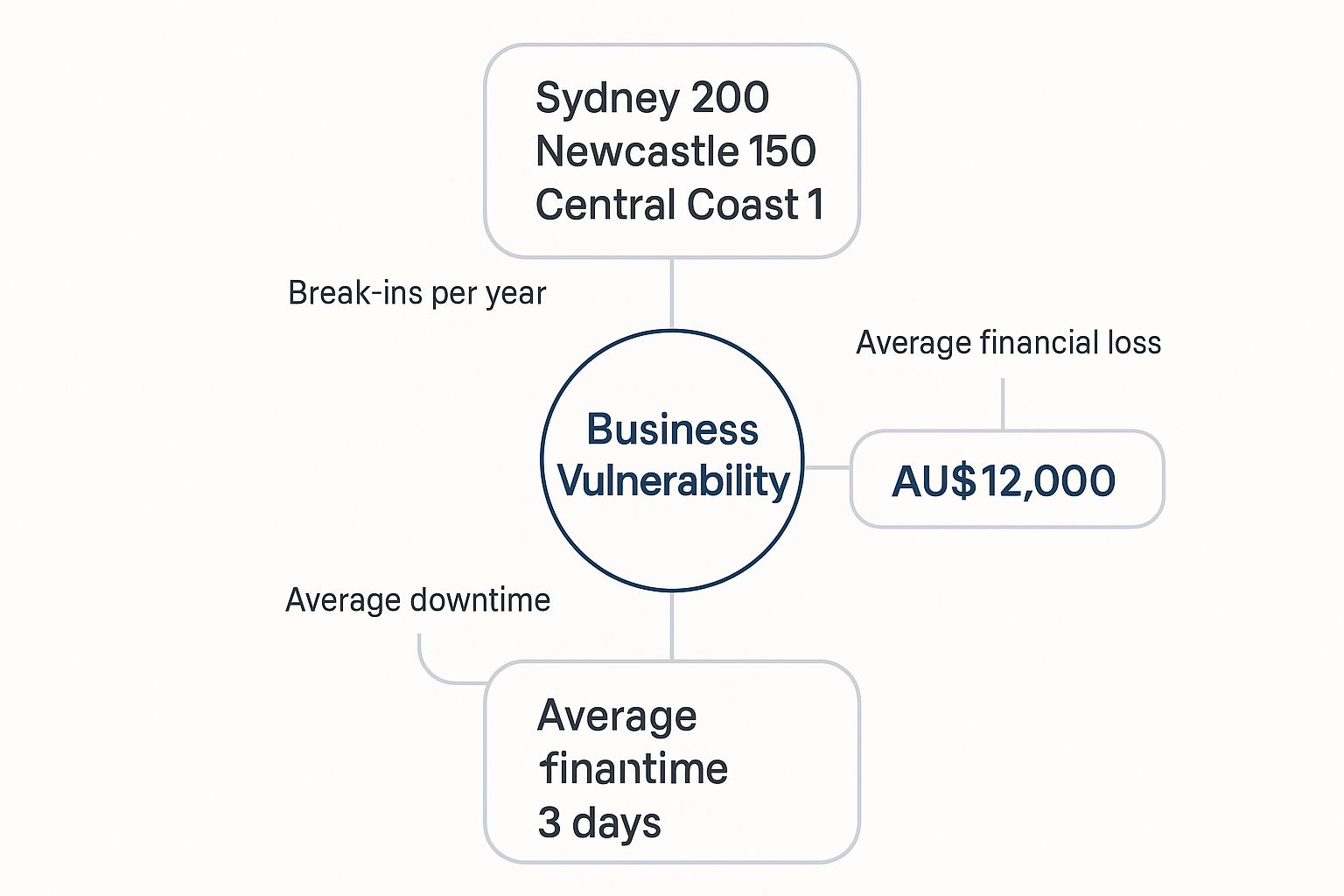
The numbers don't lie. A single incident can easily cost thousands of dollars and shut you down for days, which makes a strong case for getting your security sorted before something happens.
It's a Nationwide Problem
And this isn't just a headache for businesses in Sydney or Newcastle. Over in Perth, for example, commercial burglary is still a major issue, with 679 break-and-enter cases reported in 2024 alone. While home break-ins have dropped slightly, businesses—especially those that look like an easy target—are still very much on the radar for thieves. These kinds of stats really hammer home why a proper commercial burglar alarm is an essential, non-negotiable investment.
A commercial burglar alarm does so much more than make a racket. It’s a powerful deterrent that sends a clear message to criminals: this business is not an easy target. It gives you invaluable peace of mind when you finally lock up and head home for the night.
Securing your livelihood starts with getting real about the risks. Once you’ve done that, you can start looking into the different types of burglar alarms and security systems out there and build a proper shield around all your hard work.
Decoding Your Commercial Alarm System Options
Stepping into the world of commercial security can feel a bit like trying to order a coffee in a language you don’t speak. You'll hear terms like wired, wireless, monitored, and self-monitored thrown around… but what on earth does it all mean for your Newcastle cafe or Sydney warehouse?
Let's cut through the jargon and break it down in plain English.
Think of it like choosing a vehicle. You wouldn't use a small hatchback to haul construction supplies, and you wouldn't use a massive truck for a quick trip to the shops. The right alarm system is the one that's a perfect fit for the job – protecting your business.
Wired vs Wireless Systems: The Nuts and Bolts
First up, let’s look at how all the pieces of your alarm system actually talk to each other. This is the foundational choice you'll make.
- Wired Alarms: These are the old-school workhorses of the security world. Every sensor, keypad, and siren is physically connected with cables that are run through your walls and ceilings. The big advantage here is rock-solid reliability; there’s no wireless signal to interfere with. This makes them a fantastic choice for large industrial sites or new buildings where you can easily hide the cables during construction.
- Wireless Alarms: The modern, flexible alternative. These systems use secure radio frequencies to link all the components together. The installation is much faster and cleaner since there’s no need to drill holes and run wires everywhere. This makes them ideal for renters, heritage-listed buildings on the Central Coast, or any business that needs a top-notch system installed with minimal fuss.
Modern wireless tech is incredibly secure, but if you're curious about how it all works, the principles are the same for businesses and homes. We explore the technology in more detail in our guide to wireless home alarm systems.
Monitored vs Self-Monitored Systems: Who Answers the Call?
This is probably the most critical decision you'll make. When an alarm trips, what happens next? Who's listening?
A self-monitored system puts you in the driver's seat. When a sensor is triggered, an alert gets sent straight to your smartphone. From there, it's your call. You can check your security cameras, call a staff member, or ring the police. It’s an affordable option that gives you direct control, but the responsibility rests squarely on your shoulders. What if you're in a meeting, on a flight, or in a spot with no reception?
That’s where a professionally monitored system comes in. Think of it as having your own dedicated security team on standby.
When your alarm is triggered, it sends an immediate signal to a professional, 24/7 monitoring centre. A trained operator verifies the alert and can dispatch the police or a security patrol to your business premises in minutes.
This is what we call "back-to-base" monitoring, and it's the gold standard for commercial security. It guarantees a rapid, professional response every single time, whether you're asleep, on holiday, or just away from your phone. It's the ultimate peace of mind.
The demand for these smarter, more reliable systems is surging. Projections show the Australian burglar alarm market is expected to reach $10.6 billion AUD by 2031, largely driven by businesses seeking this kind of robust protection. You can see more on these trends in the full research on the burglar alarm market in Australia.
Commercial Alarm System Types at a Glance
To help you visualise the options, here’s a quick comparison of the main system types. This should give you a better idea of what might be the right fit for your business.
| Alarm Type | How It Works | Best Suited For | Typical Cost |
|---|---|---|---|
| Wired & Monitored | Physical cables connect all devices to a control panel that alerts a 24/7 monitoring centre. | Large warehouses, new constructions, high-value asset storage, businesses needing top-tier security. | Higher initial installation cost, plus ongoing monthly monitoring fees. |
| Wireless & Monitored | Devices communicate via radio frequency with a panel that alerts a 24/7 monitoring centre. | Retail stores, offices, heritage buildings, and businesses wanting professional response with flexible installation. | Moderate installation cost, plus ongoing monthly monitoring fees. |
| Wired & Self-Monitored | All devices are hardwired, and the system sends alerts directly to your phone/email. | Businesses with on-site staff or owners who can respond immediately to alerts themselves. | Higher initial installation cost, but no ongoing monitoring fees. |
| Wireless & Self-Monitored | Wireless devices send alerts directly to your phone. The easiest system to install. | Small offices, pop-up shops, low-risk environments, or as a budget-friendly starting point. | Lowest upfront cost and no ongoing monitoring fees. |
Ultimately, choosing the right alarm isn't about picking the most expensive or feature-packed option. It’s about finding the one that perfectly suits your business's unique risks and operational needs. Knowing the difference between these core types is the first step toward having an informed chat with a security professional and building the right shield for your hard work.
The Key Features That Actually Make a Difference
Not all alarms are created equal. A basic box that just screams when a door opens is one thing, but a modern commercial burglar alarm is a seriously clever piece of kit designed to outsmart would-be thieves. Let's get past the tech-speak and look at the features that genuinely protect your business.
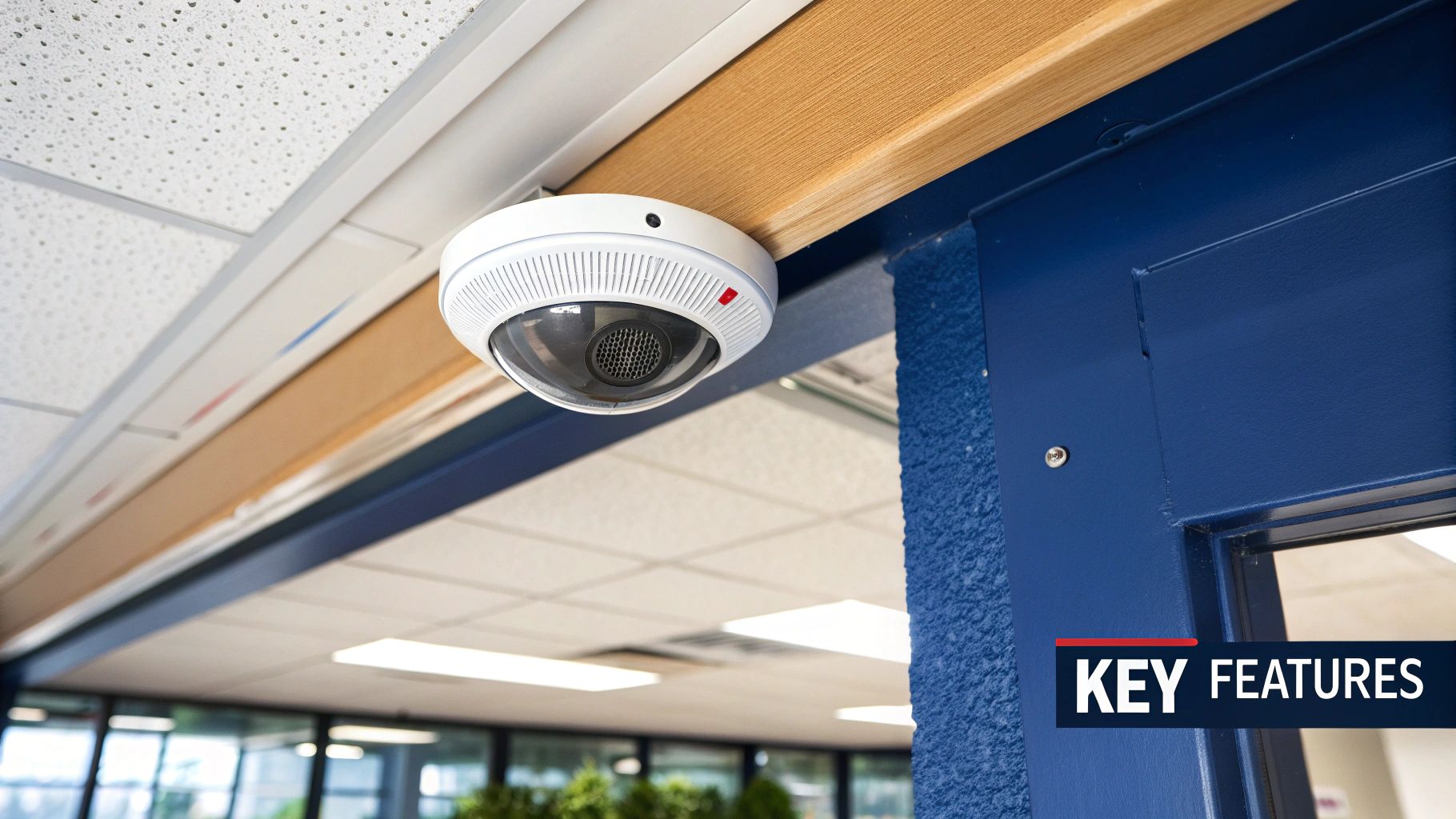
Think of these features as different players on a footy team. Each one has a specific job, but they all work together to create an unbeatable defence for your workshop, cafe, or office.
The Unseen Guardians of Your Premises
The real magic of a modern commercial burglar alarm is its network of smart sensors. These are the eyes and ears of your system, constantly on the watch for anything out of the ordinary.
-
Smart Motion Sensors: These go way beyond just detecting movement. Today’s sensors use infrared tech to pick up on body heat, so a gust of wind or a falling box won't trigger a false alarm. You can even get pet-friendly ones, so the neighbourhood cat doing its rounds won't have you jumping out of bed at 2 AM.
-
Door and Window Reed Switches: Simple but incredibly effective, these are your first line of defence. A pair of magnets creates a closed circuit when a door or window is shut. The second that circuit is broken by someone forcing it open, the alarm is triggered instantly.
-
Glass-Break Detectors: A savvy thief might try to bypass a reed switch by smashing a window instead of prying it open. That’s where these detectors come in. They’re basically specialised microphones tuned to the very specific sound frequency of shattering glass, adding a crucial layer of security for any business with a large storefront or glass-panelled doors.
The Australian security market is booming, with forecasted growth from $3.1 billion AUD in 2024 to around $7.9 billion AUD by 2033. This surge is largely driven by businesses adopting these smarter technologies, like advanced motion sensors and integrated monitoring, to stay one step ahead of criminals.
Back-to-Base Monitoring: The Ultimate Backup
While sensors are great at detecting a problem, back-to-base monitoring is what guarantees a professional response. When an alarm is triggered, it sends an alert straight to a 24/7 monitoring centre where trained operators are ready to act.
They’ll verify the alarm—often by calling you or checking camera feeds—and can dispatch a security patrol or the police to your premises in minutes. It's the difference between a loud noise and a guaranteed response, providing true peace of mind.
Remote Access: Your Eyes on the Prize
Let me tell you about Sarah, who runs a boutique clothing store in Newcastle. One night, around 11 PM, she got a notification on her phone: "Motion Detected – Stockroom." Her heart jumped into her throat. But instead of panicking, she just opened her security app.
She could immediately see a live feed from her stockroom camera, which was linked to her alarm system. And there he was—some bloke trying to pry open the back window. From her phone, she instantly activated the system's deafening siren and called the coppers. The intruder scarpered, and the police arrived moments later to a secured, albeit slightly rattled, business.
This is the power of smartphone integration. It transforms your alarm from a reactive noisemaker into a proactive security tool. You can arm or disarm the system from anywhere, check in on live cameras, and get instant alerts. Pairing a top-notch alarm with a robust system of commercial security cameras creates a formidable defence, giving you complete control and visibility over your business, no matter where you are.
How to Choose the Right Alarm for Your Business
Alright, so you’re convinced you need a proper commercial burglar alarm. Good on you. But now comes the tricky bit: how do you choose the right one? It's definitely not a one-size-fits-all situation. The alarm system that works wonders for a jewellery shop in The Rocks won't be the same one needed for a sprawling warehouse out near Beresfield.
Picking an alarm is a bit like choosing a work ute. You need to know what you’ll be carrying, where you’ll be driving, and what features are non-negotiable before you even think about stepping into a dealership. Let's walk through how to figure out exactly what your business needs.
Start With a Security Self-Assessment
Before you even chat with a security pro, take a walk around your premises with a critical eye. This isn't just about spotting the obvious weak points; it's about understanding the unique rhythm of your business. Grab a notepad and start thinking about these key areas.
-
Physical Layout: Where are your entry points? Think beyond the front door. Are there back doors, roller doors, easily accessible windows, or even skylights?
-
Valuable Assets: What are you actually protecting? Is it high-value, easily portable stock like laptops and electronics, or heavy machinery that’s harder to shift? The type of asset will influence the type of sensor you need.
-
Staff Access: Who comes and goes, and when? Do you have staff working late, or cleaners coming in after hours? Understanding these patterns helps determine needs for different access codes or partitioned alarm zones.
This simple audit gives you a solid foundation. It helps you move from a vague "I need an alarm" to a much clearer "I need to protect two roller doors, a front office with large windows, and monitor who's disarming the system after 7 PM."
Key Questions to Ask Potential Security Providers
Once you've got a handle on your own needs, you're ready to talk to the experts. But not all security companies are cut from the same cloth. A good provider won't just sell you a box of gear; they’ll be a genuine partner in protecting your business.
To sort the pros from the cowboys, here are some crucial questions you need to ask any potential provider.
-
Are You Fully Licensed and Insured? This is a non-negotiable first question. Ask for their Master Security Licence number. A legitimate, professional company will have this ready and won't hesitate to share it.
-
What’s Your Local Experience? Have they worked with businesses like yours in the Central Coast, Sydney, or Newcastle area? A company familiar with local crime trends and council regulations is always a better bet.
-
Where is Your Monitoring Centre Located? If you’re opting for back-to-base monitoring, you want to know that the team watching over your business is based here in Australia, not in an overseas call centre. A local monitoring centre understands the geography and can liaise more effectively with local police.
Choosing a security partner is about more than just technology. It’s about trusting that when the worst happens at 3 AM on a Sunday, a real person who knows the local area is ready to respond immediately.
-
What Are Your Response Protocols? When an alarm is triggered, what happens next? Do they call you first? Do they dispatch a patrol car? Do they have video verification to reduce false alarms? Understanding their step-by-step process is vital.
-
Can the System Grow with My Business? You might only need a basic setup now, but what happens in two years when you expand next door? A good system should be scalable. Make sure you can easily add more sensors, cameras, or even integrate automatic security systems like automated gates or access control down the track.
Choosing the right commercial burglar alarm isn't a rushed decision. By taking the time to assess your own risks and thoroughly vetting potential partners, you can select a system that provides genuine, reliable protection for your hard-earned assets.
What to Expect From Installation and Maintenance
So, you’ve picked out the perfect commercial burglar alarm for your business. Great stuff. But getting it installed isn't just a case of sticking a few sensors on the wall and flicking a switch. A professional installation is a meticulous process, and knowing what to expect can save you a lot of headaches down the track.
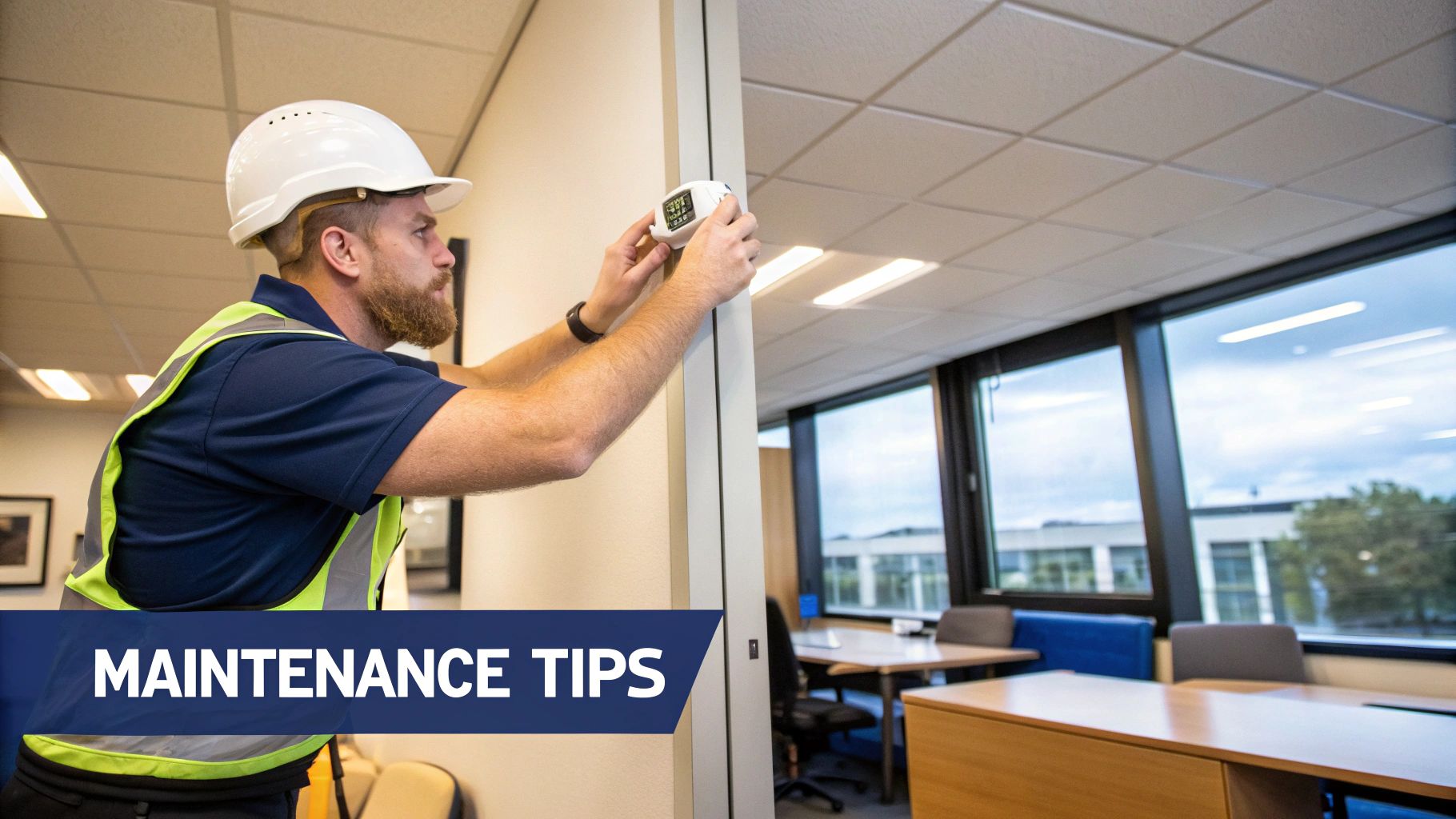
Think of it like getting a custom fit-out for your ute. You wouldn't just chuck your tools in the back and hope for the best. You’d get custom drawers and racks designed to fit perfectly, making sure everything is secure and exactly where you need it. A professional alarm installation is the same—it’s all about precision.
The Professional Installation Process
The process usually kicks off with a detailed site survey. A qualified technician will walk through your premises, identifying the best spots for sensors, keypads, and the main control panel. They're not just looking for obvious entry points; they're thinking like a burglar, spotting vulnerabilities you might have missed.
Correct sensor placement is absolutely crucial. A motion sensor pointing at a heater or a window that gets direct afternoon sun is a recipe for false alarms. A professional knows how to position each component for maximum coverage and reliability, ensuring the system is calibrated perfectly for your specific environment. The same principles that go into a high-quality home alarm installation apply here, but scaled up for a commercial setting.
Once the gear is in place, the technician will walk you through the entire system. This handover is your chance to get comfortable with everything, from arming and disarming to understanding what different alerts mean. Don't be shy—ask as many questions as you can.
Keeping Your System in Top Nick
Here's the thing about a security system: it’s not a "set and forget" deal. Just like your work vehicle, it needs regular check-ups to perform reliably when you need it most. Neglecting maintenance is like never changing the oil in your ute and then being surprised when the engine seizes up on the M1.
Routine maintenance ensures that every part of your commercial burglar alarm is working as it should. It keeps you compliant with both insurance policies and local regulations, which often require annual inspections by a certified technician.
A well-maintained alarm system isn't just about ticking boxes. It's about ensuring that your first line of defence is always ready to go, giving you genuine peace of mind that your business is protected around the clock.
This proactive approach helps catch small issues before they become big problems. A simple battery replacement or software update can be the difference between a successful alert and a system failure during a break-in.
A Simple Maintenance Checklist
While a full annual service should always be handled by a professional, there are a few things you can do yourself to keep your system healthy.
- Monthly Visual Checks: Take a quick look at your sensors, keypads, and control panel. Make sure nothing is obstructed, damaged, or covered in dust. Check that the "ready" light is green on your keypad.
- Regular System Tests: Most modern systems have a test mode. Once a month, put your system into test mode (let your monitoring company know first!) and open a few doors or windows to make sure the sensors are working.
- Keep the Area Clean: Dust and cobwebs can interfere with motion sensors. Give them a gentle wipe with a dry cloth every now and then to keep them clear.
Following a simple schedule like this, combined with an annual professional service, will ensure your commercial burglar alarm remains a reliable guardian for your business for years to come.
Your Commercial Alarm Questions Answered
We get a lot of questions about commercial security systems, and for good reason. It's a big decision, and you need to get the details straight before you commit. Here are some of the most common queries we hear from business owners across the Central Coast, Sydney, and Newcastle, with straightforward, no-fluff answers.
How Does Back-to-Base Monitoring Actually Work?
This is a big one, and it’s a great question. The simplest way to think about back-to-base monitoring is like having a dedicated security guard whose only job is to watch your alarm panel 24/7.
When a sensor at your business—say, a door switch or a motion detector—gets triggered, it doesn't just set off a loud siren. It instantly fires off a secure signal over a phone line or the mobile network to a high-security monitoring centre. These centres are staffed around the clock by trained professionals.
An operator sees the alert pop up on their screen immediately. Their first move is to follow a pre-agreed plan, which usually means calling you or your designated contacts to check if it's a real emergency or just a false alarm (like an employee accidentally tripping the system). If they can't get a hold of you, or you confirm there’s a problem, they dispatch a security patrol car or the local police to your premises straight away. It’s a guaranteed, professional response, every single time.
What Happens If the Power Goes Out?
Picture this: a massive southerly buster is rolling up the coast, and the power flickers out across your entire industrial estate. The last thing you want to worry about is your security system going down with it.
Thankfully, you don't have to. Every professionally installed commercial burglar alarm comes with a crucial backup battery. This battery is designed to kick in the very second the mains power is cut, keeping your whole system—sensors, keypad, and the communication link—fully operational for hours.
This backup power is a non-negotiable feature. It ensures your business remains protected during blackouts, storms, or even if a savvy burglar tries to cut the power from the outside before attempting a break-in.
The system also sends a notification to the monitoring centre to let them know it’s running on battery power, so you're always kept in the loop.
Is My NBN Connection Good Enough for an Alarm System?
In most cases, absolutely. Modern alarm systems are designed to be incredibly efficient, using hardly any of your internet bandwidth. The signals they send are just tiny packets of data, not massive video streams, so your day-to-day NBN use for things like sending emails or processing payments won't be affected at all.
However, the real gold standard for communication is what’s called a dual-path system. This just means your alarm uses both your NBN connection and a separate 4G mobile network connection as a backup. If your internet ever drops out—whether it’s a network outage in your area or someone cutting the line—the system seamlessly flips over to the 4G network. It never loses contact with the monitoring centre. It’s the ultimate belt-and-braces approach to security.
Can a Good Alarm System Lower My Insurance Premiums?
This is the question every business owner loves to ask, and the answer is often a resounding yes!
Insurance companies are all about managing risk. A business with a professionally installed and monitored commercial alarm is simply a much lower risk in their eyes. By having one, you’re showing that you’re serious about protecting your assets, which massively reduces the chances of a costly break-in and a subsequent claim.
Many insurers offer substantial discounts on business insurance premiums for properties with a monitored alarm. The exact discount varies, but it can often be enough to offset a good chunk of the monthly monitoring fee. It’s always worth having a chat with your insurance broker to let them know you’re upgrading your security—you might be very pleasantly surprised by the savings. It really is a win-win.
Ready to get clear, honest answers tailored to your specific business needs? The team at Advanced Comtech has been helping business owners across the Central Coast, Sydney, and Newcastle protect their livelihoods for years. We'll cut through the jargon and design a commercial burglar alarm system that works for you. Get in touch with us today for a no-obligation chat and a free quote.