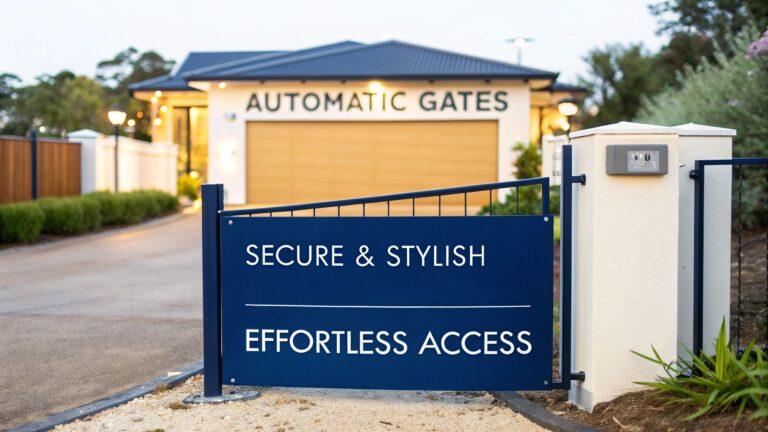
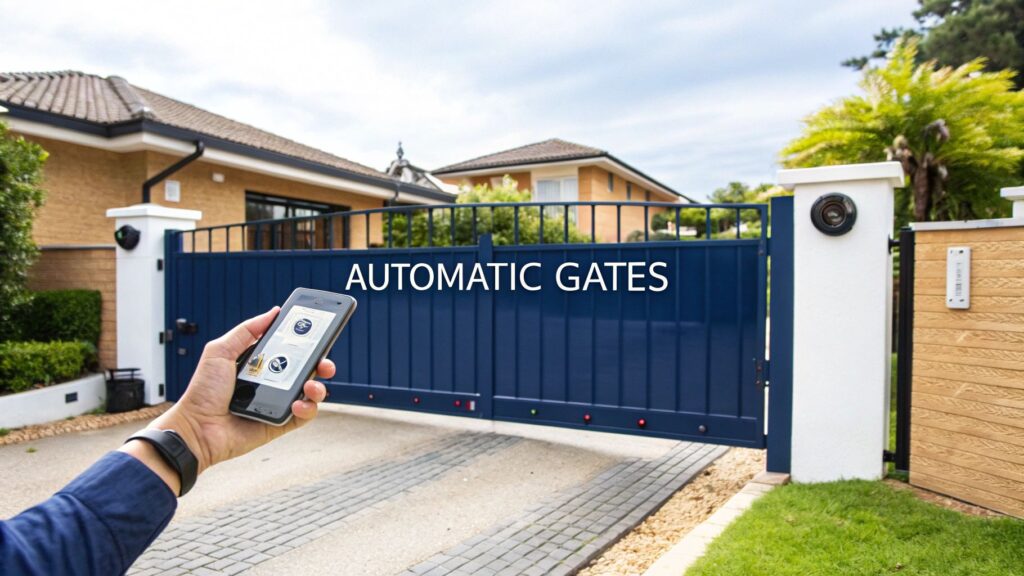
Automatic gate systems are essentially motorised setups that let you open and close your driveway gate with a remote or sensor, ditching the need to do it by hand. They've become a go-to upgrade for Aussie homes, offering a massive boost in convenience, security, and kerb appeal. Say goodbye to jumping out of the car in the rain!
The End of the Mad Dash in the Rain
We’ve all been there. You’re pulling into your driveway after a long crawl up the M1 from Sydney, and just as you arrive, the sky opens up. The absolute last thing you feel like doing is getting soaked while wrestling with a heavy, wet gate. It's a moment every homeowner from Newcastle to the Central Coast has dreaded, and it's usually when you start dreaming of a better way.
The reality is, automatic gates have moved well beyond being a luxury item for sprawling estates. For modern Aussie life, they’re a game-changing upgrade—a practical solution to those daily annoyances while seriously beefing up your property's security.
More Than Just Convenience
Let's forget the dry, technical definitions for a moment and think about what really matters: the practical difference it makes to your day. It’s about more than just staying dry; it’s about creating a seamless, stress-free transition from the busy world outside to your private sanctuary.
An automatic gate is your home’s first line of defence and its first handshake. It sets the tone for security, convenience, and style, making it one of the most impactful upgrades you can make.
And this isn't just a feeling; it’s a genuine trend. The demand for automatic gate systems across Australia is on the rise, driven by increasing urbanisation and a much bigger focus on home security. In fact, the wider fencing market, which includes automated gates, is set to grow significantly in the coming years. That just goes to show how many Aussies are investing in smarter, safer properties.
What This Guide Will Cover
Think of this guide as your complete, no-fluff roadmap to understanding everything about automatic gate systems. We're here to paint a clear picture of what effortless convenience, serious security, and a noticeable boost to your home's value really looks like. We will explore:
- The Key Components: We’ll break down all the parts that make your gate tick, from the motor right through to the sensors.
- Your Main Options: A straightforward comparison between swinging and sliding gates to help you find your perfect match.
- Smart Home Integration: Discover how you can connect your gate to your digital life, a key part of creating modern smarthomes for living.
- Costs and Installation: We’ll give you a transparent look at what to budget for and how to prepare for a smooth installation.
By the end of this, you'll have all the info you need to choose the perfect setup for your property. Let's get started.
Understanding What Makes Your Gate Tick
So, you’ve decided an automatic gate system is the go, but what’s actually going on under the bonnet? It might seem complex, but it’s really just a well-coordinated team of components working together. Think of it like a crew, where each member has a specific job to ensure everything runs smoothly, safely, and reliably every single time you arrive home.
Let’s break down the A-Team and see how each part plays its crucial role. No confusing jargon here, just a straight-up look at the tech that makes the magic happen.
The Brains and the Brawn
At the heart of every automatic gate system, you have two superstars working in perfect harmony: the control panel and the motor. One does the thinking, and the other does all the heavy lifting.
The control panel is the undisputed brain of the entire operation. It’s a clever bit of kit, usually housed in a weatherproof box, that receives signals and tells everyone else what to do. When you press that button on your remote, this is where the command lands first.
Then you have the motor, which is the pure muscle of the team. This is the powerhouse that physically moves your gate, whether it’s a hefty timber slider or a sleek aluminium swinger. The motor’s power is matched to the gate's weight and how often you'll be using it. Getting this match right is non-negotiable for a long-lasting system.
This simple decision tree can help visualise which type of motor might be right for your property.
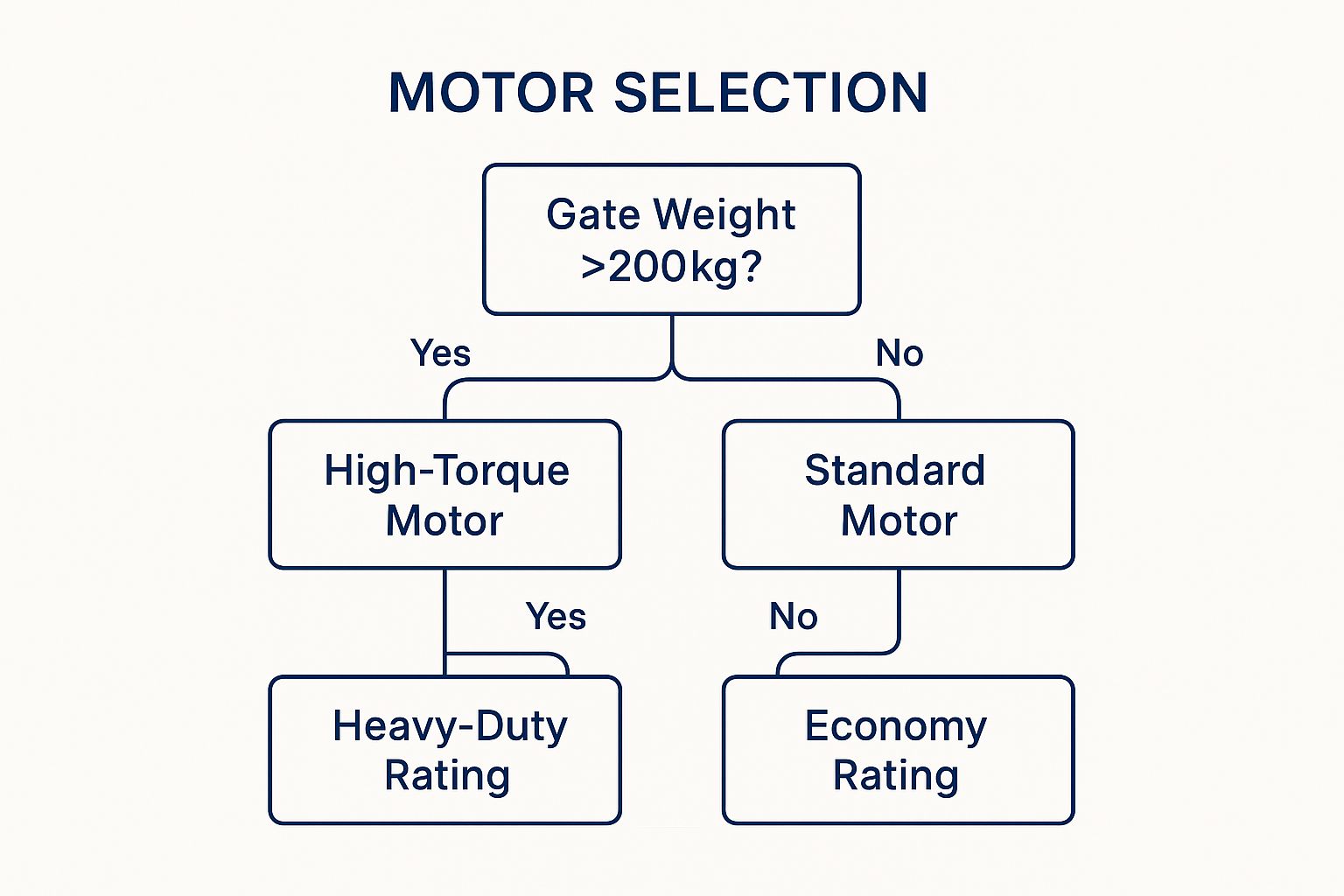
As you can see, heavier gates and frequent use demand a more robust motor to handle the workload without burning out.
Your Automatic Gate System's A-Team
Here’s a quick-glance summary of the main parts and what they do, so you know exactly what's what.
| Component | Its Role on the Team |
|---|---|
| Control Panel | The brain. It receives your command and tells the motor what to do. |
| Motor | The muscle. This is the powerhouse that physically opens and closes the gate. |
| Access Device | Your key. It could be a remote, keypad, or smartphone app. |
| Safety Sensor | The guardian. It stops the gate if an obstruction is detected. |
It’s this simple yet effective collaboration that makes automatic gate systems such a reliable addition to any property.
Access and Safety: The Supporting Crew
The brains and brawn are nothing without their support crew. This is where your access devices and safety sensors come into play, making the whole system both convenient and secure.
Your access device is your magic wand. It's how you tell the gate to open or close. This could be a classic remote control you keep in the car, a keypad mounted near the gate, or even an app on your smartphone. The options for access control systems on the Central Coast have grown massively, giving you complete control from anywhere.
Finally, and most importantly, you have the safety sensors. These are the ever-watchful guardians of your gateway. Usually installed as a pair of photoelectric beams across the opening, their job is to detect any obstruction—a car, a pet, or a person.
If anything breaks that invisible beam while the gate is closing, the system will immediately stop and reverse. This feature isn’t just a nice-to-have; it’s an essential safety standard that prevents accidents and gives you total peace of mind.
Together, this team works seamlessly. The access device sends a signal to the control panel, which then commands the motor to start moving. All the while, the safety sensors stand guard, ready to intervene if needed. It’s this simple yet effective collaboration that makes automatic gate systems such a reliable addition to any home on the Central Coast, in Sydney, or up in Newcastle.
Swinging vs Sliding Gates: Finding Your Perfect Match
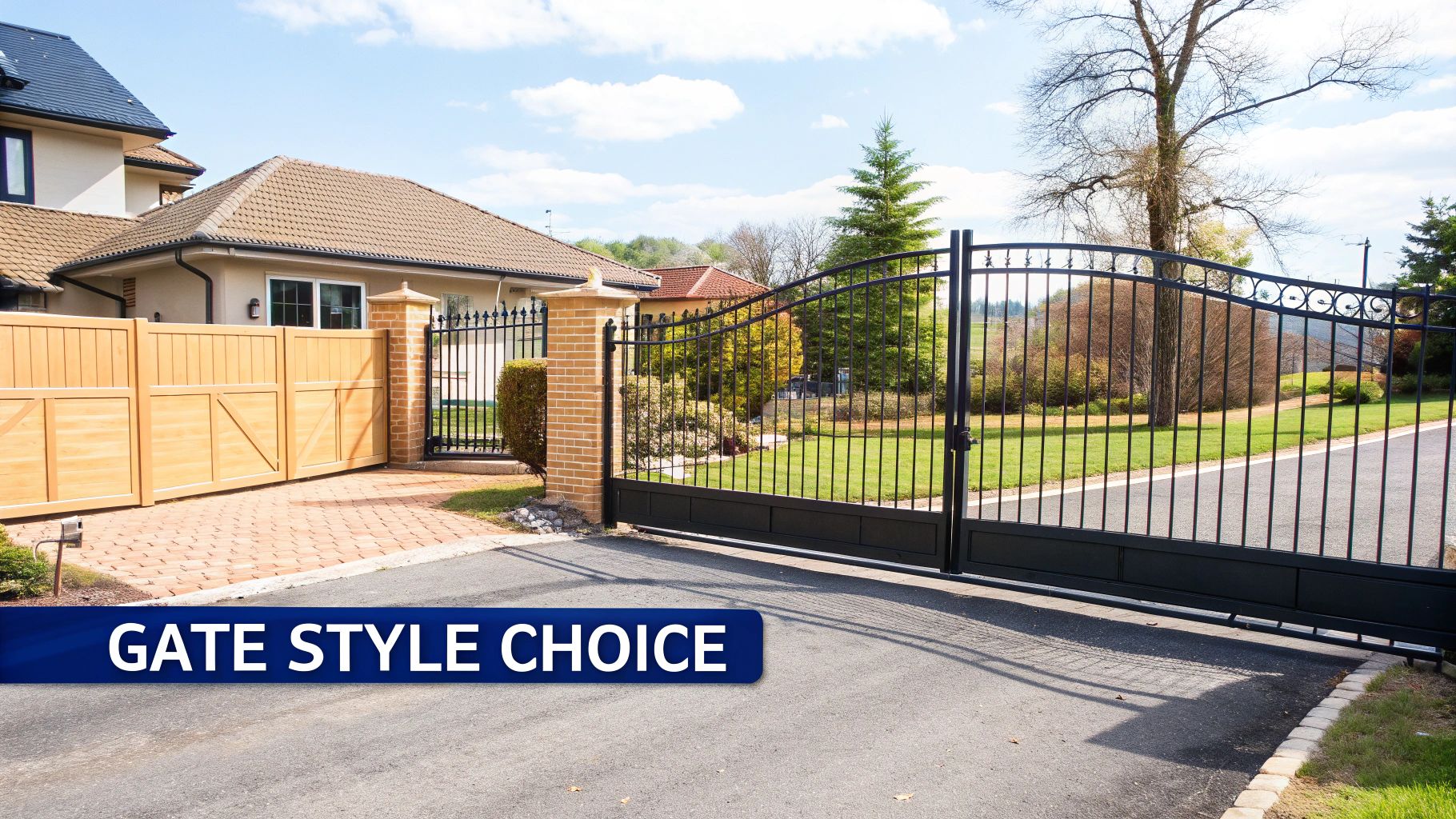
Alright, let’s get down to the big decision. Choosing between a swinging and a sliding gate is a bit like picking between a Ute and an SUV—what's perfect for your mate's place in Newcastle might be totally impractical for your sloping block on the Central Coast. Both are brilliant options, but they serve different needs and fit different spaces.
This isn't just about looks; it's about the practicalities of your property. We're going to weigh up the pros and cons of both styles, considering the critical factors that matter most. By the end of this, you’ll have a crystal-clear idea of which style is the undisputed champion for your home.
The Classic Appeal of Swinging Gates
Think of swinging gates as the traditional front door to your property. They have a timeless, elegant look and can open either inwards or outwards, creating a grand sense of arrival. For many homeowners, especially those with a bit of space to play with, the classic charm is hard to beat.
They are often mechanically simpler than their sliding counterparts, which can sometimes translate to a lower initial cost. However, there’s one major catch: they need a lot of clear, flat space to swing open.
This is the non-negotiable part. If your driveway slopes up towards your house, an inward-swinging gate is a no-go—it’ll scrape the ground. Similarly, you can’t have it swinging out over a public footpath. You need to have enough room on your property for the entire arc of the gate's movement, which is a real challenge on smaller or awkwardly shaped blocks.
Swinging gates are fantastic when you have the luxury of space. They offer a classic, welcoming aesthetic but demand a level, unobstructed area to operate, making them unsuitable for sloped or short driveways.
The Space-Saving Power of Sliding Gates
Now, let’s talk about the sliding gate—the practical, space-savvy hero for modern Aussie properties. Instead of swinging open, a sliding gate rolls sideways on a track, running parallel to your fence line. This is an absolute game-changer for anyone with a challenging driveway.
Got a steep incline? No worries. Is your driveway on the shorter side, leaving no room for a swing arc? A slider is your best mate. Because it moves sideways, it doesn't intrude into your driveway space at all, making it the perfect solution for most residential blocks where every square metre counts. This design also tends to be more robust against high winds, a definite plus for coastal properties.
Of course, there's a trade-off. Sliding gates require a long, narrow space for the gate to retract into when it opens. You’ll need a clear run along your fenceline that’s at least the width of your driveway opening, plus a little extra for the motor and tail. If you've got garden beds, trees, or a pedestrian gate right where the track needs to go, it can complicate things.
Swinging vs Sliding Gates Head-to-Head
So, how do you choose? It really comes down to your property's unique layout and your personal priorities. To make the decision easier, let’s put them side-by-side in a direct comparison. This table breaks down the key differences to help you decide which gate type is the best fit for your property.
| Consideration | Swinging Gates | Sliding Gates |
|---|---|---|
| Space Needed | Requires a large, clear swing area. Unsuitable for short or sloped driveways. | Needs a long, narrow space along the fence line for the gate to retract into. |
| Best For | Flat, spacious properties where a traditional, grand entrance is desired. | Sloped driveways, short driveways, and properties where space is at a premium. |
| Installation | Generally simpler mechanically, but requires perfectly level ground for the swing. | Requires a level concrete foundation for the track, which can add to complexity. |
| Maintenance | Hinges need regular checking and lubrication. More susceptible to wind damage. | The track must be kept clear of debris like leaves, dirt, and stones to run smoothly. |
| Cost | Often slightly cheaper for the gate and motor, depending on the design and size. | Can be more expensive due to the track, rollers, and foundation work required. |
Ultimately, the best choice is the one that works seamlessly with your land. Take a good, honest look at your driveway. If it's a tricky space, a sliding gate is almost always the smarter, more reliable choice. For those with room to move, a swinging gate can provide that classic, stately feel.
If you're still weighing your options, our guide on gate automation systems can offer even more detailed insights to help you make the perfect call.
Making Your Gate the Smartest on the Street
Today’s automatic gates have come a long way from being a simple barrier with a remote. They’re now a key player in your smart home setup, turning your entryway from a basic necessity into an intelligent, futuristic checkpoint. This is where your property’s security and convenience really get a serious upgrade.
Picture this: you get a notification on your phone that a package has arrived, but you’re stuck at your desk in the Sydney CBD. With a quick tap on an app, you can open your gate, watch the delivery driver leave the parcel safely on your porch through your security camera, and then securely close and lock the gate behind them. That’s not a scene from a movie; it’s the reality of a modern, connected automatic gate.
Your Gate, Your Way
The real beauty of modern gate automation is just how flexible it is. That old, clunky remote isn't your only option anymore. Now, it’s all about designing an access system that fits your lifestyle perfectly, whether you're a total tech-head or just want things to be that little bit easier.
This move towards smarter access is gaining serious momentum. Homeowners are increasingly looking for keyless ways to get in and out that blend top-notch security with total convenience. In fact, it's reported that around 40-50% of new high-end residential projects now include some form of automated gate or smart lock system. It’s a clear sign this tech is becoming the new standard.
This kind of integration is right at the heart of what we do. By tying everything together into one unified system, we help homeowners discover what's possible with modern home automation control systems, making everyday life feel smoother and more secure.
A smart gate isn’t just about opening and closing. It's about giving you complete control over who enters your property, and when, from absolutely anywhere in the world.
Creating a Connected Ecosystem
So, what does this integration actually look like day-to-day? It’s all about getting the different pieces of your home security and smart tech to talk to each other, creating a seamless and powerful network.
Here are just a few of the ways you can connect your automatic gate:
- Voice Control: Imagine pulling into your street after a long day and just saying, "Hey Google, open the gate." By linking your gate to virtual assistants like Google Assistant or Amazon Alexa, you get hands-free control that feels genuinely futuristic.
- Security Camera Integration: When someone buzzes the intercom, you don’t have to play a guessing game. The video feed can pop up directly on your phone or smart display, letting you see and speak to them before you decide to let them in.
- Temporary Access Codes: Got a tradie coming to your Central Coast home while you’re out? Instead of leaving a key under the mat, you can generate a temporary PIN for the gate's keypad that works for a specific time and then expires. It’s security and convenience rolled into one.
- App-Based Control: Your smartphone becomes the ultimate remote control. You have total command right in your pocket, from opening the gate for a friend who's arrived early to double-checking if you remembered to close it.
More Than Just a Gadget
At the end of the day, integrating your automatic gate into a smart home ecosystem is about making your life genuinely easier and your property significantly safer. It gets rid of all those small, daily frustrations—like fumbling for a remote or worrying about a missed delivery—and replaces them with effortless control.
It transforms your driveway from a simple entrance into an intelligent, responsive, and highly secure checkpoint. Whether you’re in Newcastle, Sydney, or anywhere in between, a smart gate is one of the most practical and impressive upgrades you can make to your home. It's the kind of tech that, once you have it, you'll wonder how you ever lived without it.
The Real Deal on Installation and Costs
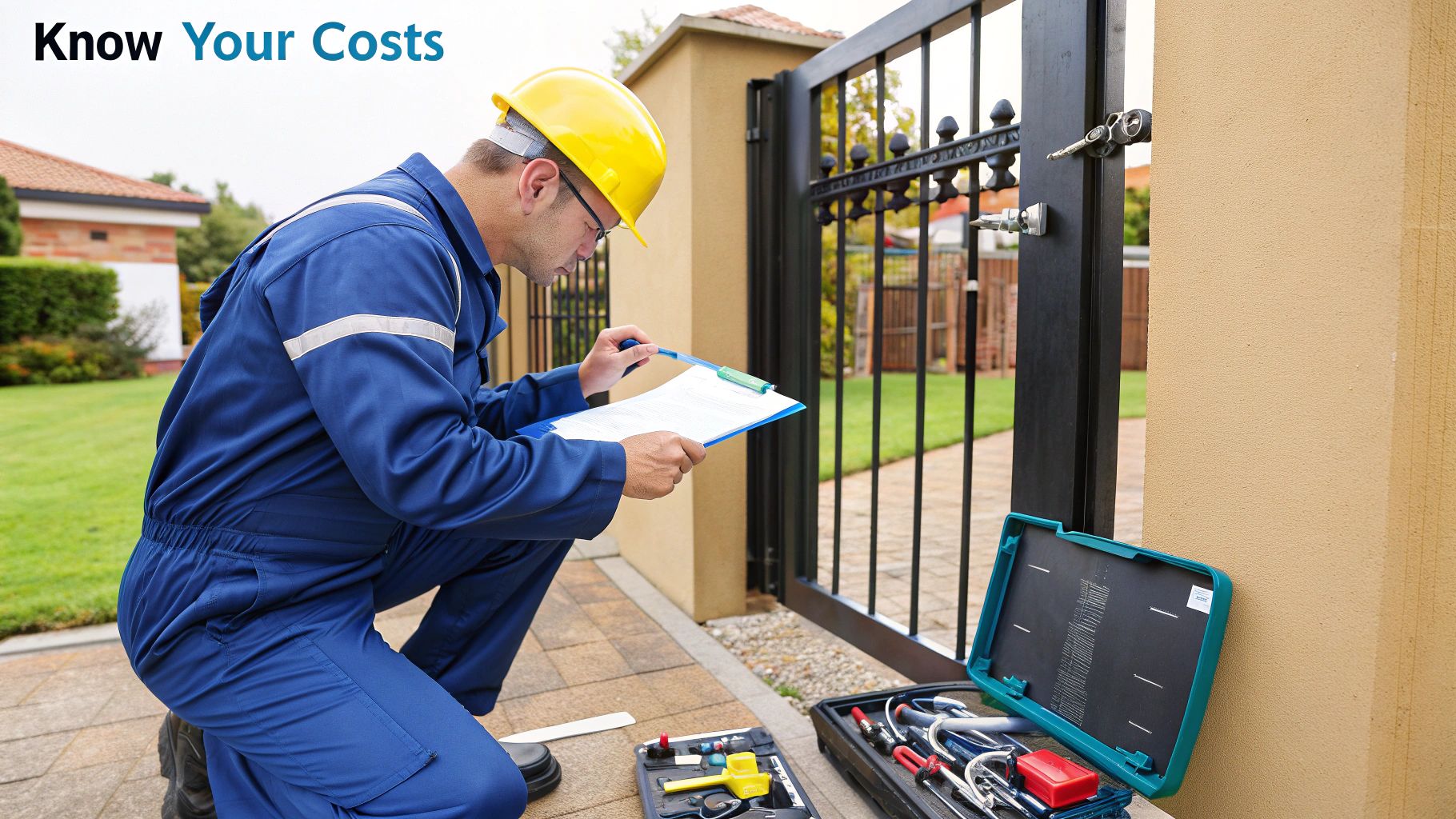
Alright, let's talk brass tacks. You’ve seen the benefits and picked your style, but what's it actually going to set you back? Think of an automatic gate as a proper investment in your property's security and value, so it’s worth getting a clear picture of the costs before jumping in.
There’s no single price tag here. The final bill is a mix of the gate's size, the material you pick (sleek aluminium is a different beast to heavy timber), the grunt of the motor, and any smart features you want to tack on. It's a bit like buying a car—the base model gets you on the road, but all the good stuff adds up.
A straightforward, professionally installed system might start around $3,500 to $5,000. If you're looking at something more bespoke, heavy-duty, or kitted out with all the bells and whistles, you could be looking at $7,000 to $12,000+. It really highlights how important it is to balance the upfront cost with the long-term value, something we dive into in our guide on what to expect from home security companies' costs.
Getting Your Property Ready
Before the installation crew even shows up, a little prep work is needed to ensure everything goes smoothly. A good installer will map this all out, but it pays to know what’s going on.
First, power. Your gate motor needs a dedicated, reliable electrical supply. This usually involves a licensed sparky running an underground conduit from your house to the gate area. Then there’s the groundwork. For a sliding gate, this means a dead-level concrete pad for the track to run on, ensuring it glides like a dream for years to come.
Think of the groundwork as the foundation of a house. If it’s not perfectly level and stable, you're just asking for trouble down the track. Getting it right from day one is non-negotiable for a reliable system.
Keeping Your Investment in Top Nick
Once your shiny new gate is up and running, a little bit of care will go a long way in protecting your investment. Just like you’d service your car, regular maintenance keeps everything ticking over and helps you spot little niggles before they become big, expensive headaches.
You can easily handle some of the basic checks yourself every month or so:
- Keep it Clean: For sliding gates, make sure the track is completely clear of leaves, dirt, and stones. Any little obstruction makes the motor work harder and can eventually cause it to burn out.
- Look and Listen: Give the gate a good once-over for any signs of rust or wear. Listen for any weird grinding or squeaking noises when it’s moving—these are often the first cries for help.
- Test the Safety Features: Carefully (and safely!) wave something like a broom in front of the safety sensors while the gate is closing. It should stop dead and reverse immediately.
While these DIY checks are great, it’s also a smart move to get a professional service every 12-18 months. A technician can give the motor a proper health check, lubricate all the moving parts, and fine-tune the alignment. This sort of preventative care is the secret to a long and happy life for your gate, giving you that seamless convenience day in and day out.
Got Questions About Automatic Gates? We've Got Answers.
Thinking about an automatic gate is a big step, and it’s only natural to have a few questions buzzing around. To help you out, we’ve tackled some of the most common queries we get from folks across Sydney, Newcastle, and the Central Coast.
How Much Power Do They Really Use?
This is a big one for a lot of people, but the answer is surprisingly little. Most of the day, your gate is just sitting there on standby, using about the same amount of power as a small bedside clock.
The motor only kicks into gear for the few seconds it takes to open or close, so you’re not going to see a scary spike in your electricity bill. They’re designed to be incredibly efficient.
What Happens If The Power Goes Out?
Don't worry, you won't be trapped in or out of your own driveway. Every single automatic gate comes with a manual override.
It’s usually a simple key that lets you disengage the motor. From there, you can just push the gate open and shut by hand like any regular gate until the power is back on. It’s a dead-simple, foolproof backup plan.
Peace of mind is knowing your gate will work for you, rain or shine, power on or off. The manual override is a standard feature that guarantees you're never stuck.
How Long Will My Gate System Last?
When you get it installed properly and show it a bit of love with regular maintenance, you're looking at a serious long-term investment. A quality motor should give you a solid 10 to 15 years of service, sometimes even more.
As for the gate itself? Materials like aluminium or properly treated steel are built tough for the Aussie climate and can easily last for decades.
Do I Need To Get Council Approval?
Ah, the classic red tape question. The short answer is: it really depends. The rules can vary quite a bit from one local council to the next, whether you're in the Northern Beaches, Lake Macquarie, or the Gosford area.
Things like the gate's height, how far it's set back from the road, and whether it swings out over a public footpath all come into play. The golden rule is to always check with your local council first. Better yet, chat with a professional installer who knows the local ins and outs. It'll save you a world of headaches down the track.
Ready to bring convenience and security to your driveway? The team at Advanced Comtech has the local expertise to design and install the perfect automatic gate system for your property. Get in touch with us today to arrange a consultation.