Let’s be real, the buffering wheel is the modern-day circle of hell. You’re trying to stream the Knights game, run your business from your Gosford home office, or just stop the kids from whinging about lag, and suddenly you’re frantically Googling ‘data cable installation near me’. Trust me, you’re not alone. A hardwired connection is often the silver bullet for all sorts of internet woes.
Is Your Wi-Fi Holding You Hostage?
That dreaded spinning circle isn’t just a minor annoyance; it’s a productivity killer and a genuine mood wrecker. For so many of us, from Newcastle down to Sydney, the NBN gives us a fantastic connection to our doorstep, but what happens inside the house is a totally different story.
Imagine this: you’ve finally got the NBN connected. The technician leaves, you run a speed test right next to the modem and it’s brilliant. But then you take your laptop to the home office at the other end of the house, and it’s slower than a snail in molasses. Your Wi-Fi signal is getting choked by brick walls, having to fight with your neighbour’s network for airtime, or just plain can’t reach. Sound familiar?
This is where a professional data cable installation becomes an absolute game-changer. It’s all about creating a direct, stable pipeline for your internet, completely bypassing the interference and obstacles that make Wi-Fi so unreliable.
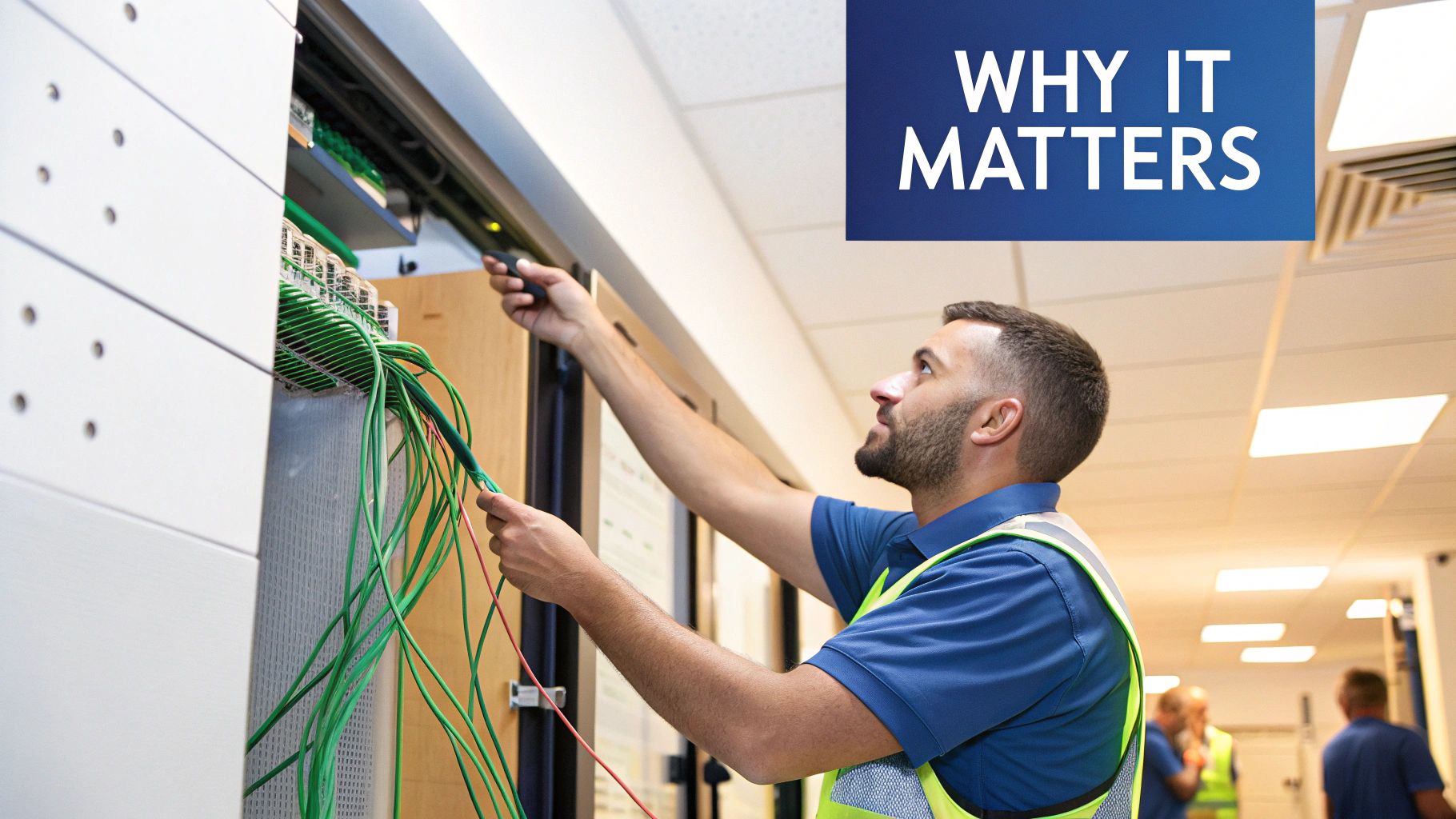
Why Hardwired Beats Wireless Every Time
While wireless is brilliant for casually scrolling on your phone, your most important devices deserve a rock-solid connection. A proper wired setup gives you some serious advantages:
- Unshakeable Stability: Forget about dropouts during that critical Zoom call or right when you’re about to clinch a win online.
- Blistering Speed: You can finally get the full internet speed you’re paying for, without the signal loss that’s so common with Wi-Fi.
- Lower Latency: This is a big one. It means less lag, which is absolutely crucial for online gaming, 4K streaming, and smooth video conferencing.
A professional installation ensures you get a dedicated, high-speed lane for your data, straight from your router to your device. It’s the difference between a winding country road and a direct motorway.
The Aussie government’s NBN rollout was a massive undertaking, and it’s fundamentally changed how we all get online. With around 12.53 million homes and businesses now connected, the core infrastructure is definitely in place. The network even boasts an availability rate of 99.95%, which just goes to show how reliable the system is. This means that more often than not, the weak link is lurking inside our own walls. If you’re curious about the full scope of the project, you can explore more NBN statistics and facts here.
Of course, improving your home network isn’t always about drilling holes and running cables. Before you commit to a full installation, it pays to understand all your options. For some people, a different kind of wireless solution might be a good first step. It’s worth taking a moment to check out our guide comparing Wi-Fi extenders and mesh systems. This will help you figure out if it’s truly time to call in the pros for a permanent, wired fix.
How to Spot a Great Tradie from a Dodgy One
Finding a reliable cabler can feel like a lottery, can’t it? You want someone who knows their Cat6 from their Cat6a, turns up on time, and doesn’t leave your place looking like a tip. This is your field guide to spotting the pros and dodging the cowboys when you’re searching for data cable installation near me.
First, let’s cover the absolute deal-breaker. In Australia, any tradie touching your data cabling must have an ACMA ‘Open Cabler Licence’. This isn’t just a nice-to-have; it’s the law.
Picture this: A bloke turns up in a beat-up ute, offers you a ‘cashy’ price that seems too good to be true, and gets a bit shifty when you ask about his licence. That’s your cue to politely tell him to sling his hook. If they can’t show you their licence, show them the door. It’s a massive red flag that they aren’t qualified, insured, or working to Australian standards. Simple as that.
Cutting Through the Online Chatter
Once you’ve confirmed they’re licensed, it’s time to play detective online. It’s easy for someone’s Uncle Barry to leave a glowing review, so you need to look for patterns and specifics to find the real story.
- Look for details. A review saying “Did a great job” is fine, but one that mentions “They ran the cable through the tricky wall cavity perfectly and tidied up afterwards” is absolute gold.
- Check the dates. A sudden burst of five-star reviews all posted in the same week can be a bit suss. Genuine feedback usually trickles in over time.
- How do they handle criticism? Even the best businesses get a bad review now and then. Pay attention to how they respond. A professional, helpful reply is a fantastic sign.
Think of it like this: you’re not just hiring someone to drill holes. You’re trusting them with the digital backbone of your home or business. A true professional understands that responsibility and has the qualifications and reputation to back it up.
Arming yourself with the right questions when you get a quote is your next best move. Asking about the types of cable they recommend, their insurance, and the warranty they offer on their work can tell you a lot about their professionalism.
Getting a clear picture of their expertise is vital. You can learn more about what a top-notch job looks like by exploring our detailed breakdown of professional home networking installation services. This will help you know exactly what to look for in a quality installation.
What to Expect on Installation Day
So, you’ve booked the job and the day has finally arrived. The van pulls up, and you’re probably wondering what’s about to unfold. Don’t stress, it’s not just a whirlwind of drilling and dust; a professional data cable installation is a surprisingly slick and organised process.
The first thing a good technician will do is have a proper yarn with you and walk through the property. They’re not just being friendly—they’re conducting a crucial on-site survey. This is where they map out the smartest, neatest cable routes to keep everything as hidden as possible, whether that’s through the ceiling, under the floor, or within wall cavities. They’re like a ninja, plotting the path of least resistance and least visibility.
The Art of the Install
Once the plan is locked in, the real work begins. This isn’t a rush job. It involves carefully running the cable and then performing the most critical step: terminating the ethernet jacks. This is where the magic happens, creating a solid, physical connection that guarantees performance. A sloppy termination is a recipe for dropouts and slow speeds.
This visual breaks down the key stages of a typical professional installation day.
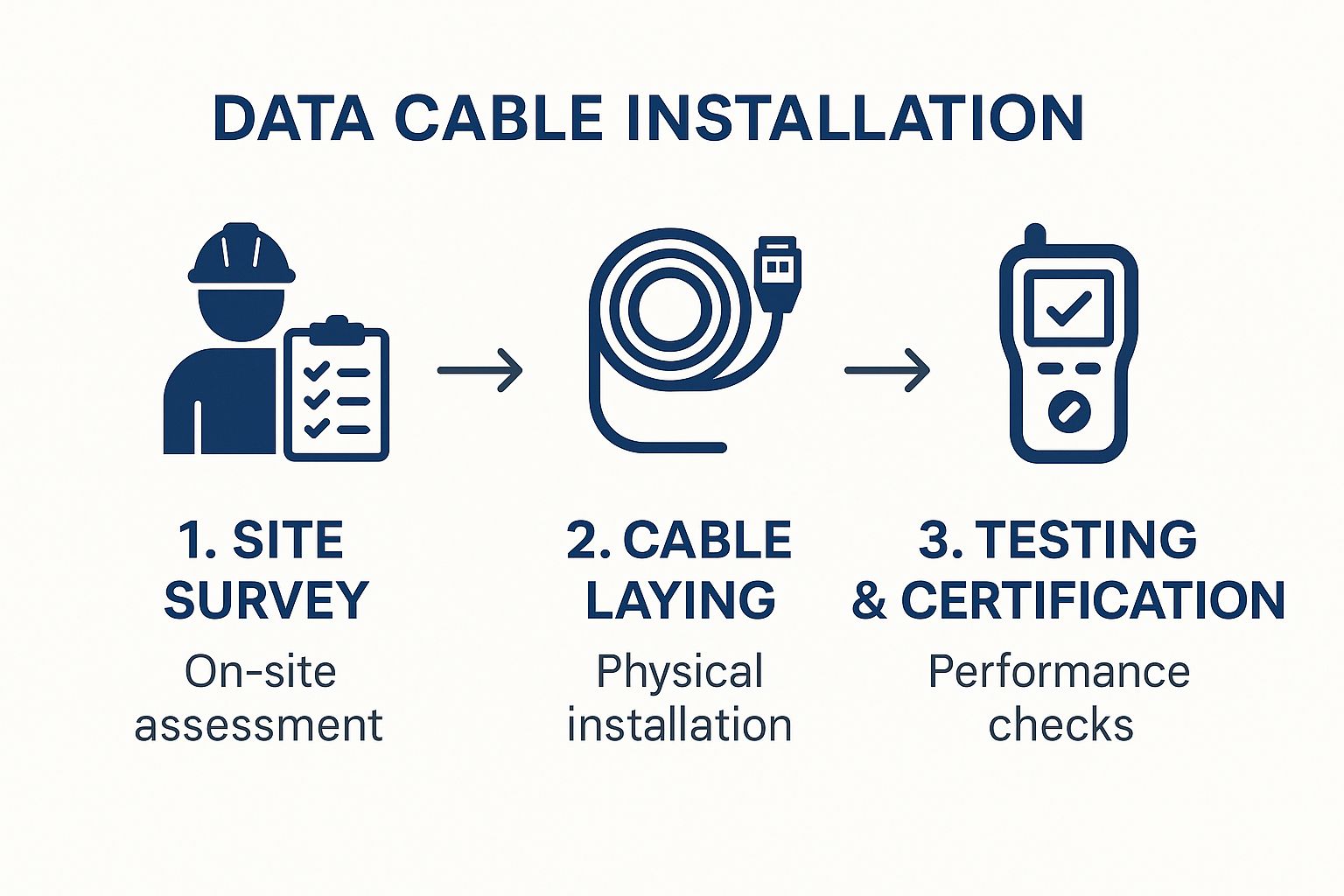
As you can see, the process is methodical, moving from a careful survey to the physical installation and finally to rigorous testing.
Good workmanship is easy to spot. It’s the neat, flush wall plate, the lack of mess left behind, and most importantly, the final test. A proper installer won’t just say, “She’s all good, mate.” They’ll use a specialised cable tester to certify the connection.
This final test is non-negotiable. It’s the proof in the pudding, confirming that every cable is performing at its peak and delivering the exact speeds you’re paying for.
Understanding this process from start to finish helps you know what to expect and what quality looks like. For a deeper dive into what a complete project entails, explore our full guide to a professional home network installation. You’ll be well-equipped to spot a job done right.
The Real Cost of Getting Hardwired
Alright, let’s talk dollars and sense. Asking “how much for data cabling?” is a bit like asking “how long is a piece of string?” The final figure on a quote for a professional data cable installation isn’t just pulled out of thin air; it’s a detailed calculation based on your specific job.
Think about it this way: running a single data cable in a new build in Warnervale with open walls and easy access is pretty straightforward. But trying to retrofit that same cable into a double-brick heritage terrace in The Rocks? That’s a whole different ball game. The complexity, time, and skill needed for that second job will naturally be higher, and the price will reflect that.
Breaking Down the Quote
So, what exactly goes into the price an expert cabler gives you? It usually boils down to three main things:
- Number of Points: This is the most direct factor. A single point for your new smart TV is going to be significantly less than wiring up an entire home office with multiple connections.
- Cable Type and Length: Are you sticking with the reliable standard Cat6, or are you looking to future-proof your home with Cat6a? The type of cable and the total length needed for each run directly impacts material costs.
- Job Complexity: This is the big variable. The construction of your walls (plasterboard is much easier than brick), the access we have to your ceiling space, and any tricky nooks and crannies we need to navigate all play a massive part in the labour required.
A professional quote isn’t just a number; it’s a reflection of the labour, materials, and expertise required to do the job right the first time, preventing costly headaches down the track.
The demand for this kind of work is huge. The Australian fibre optic installation industry is valued at a whopping $1.9 billion in 2024. While the initial NBN rollout might be behind us, the need for better, faster internal networks is exploding as our homes fill up with data-hungry devices. You can learn more about the trends in Australian fibre installation to see just how much is happening in this space.
Estimated Data Cabling Costs in AUD
To give you a clearer picture, here’s a rough guide to what you can expect to pay for professional data cabling services in areas like Sydney, Newcastle, and the Central Coast. Keep in mind these are estimates, and a final quote will always depend on the specifics of your home.
| Service Type | Typical Cost Range (Per Point) | Best For |
|---|---|---|
| Standard Cat6 Point | $200 – $280 | Everyday use, 4K streaming, gaming, home offices, and most smart homes. |
| Premium Cat6a Point | $250 – $350 | Future-proofing, high-demand networks, 10-Gigabit speeds, and data-heavy tasks. |
| Multi-Point Discount | $150 – $220 (after first) | Wiring multiple rooms at once, new builds, or extensive home renovations. |
Getting multiple points installed in one visit is definitely the way to go, as the cost per point usually drops significantly. It’s also smart to bundle jobs. For instance, the costs involved in wall-mounting a TV can often be combined with data cabling, giving you a super clean, wire-free setup and better value for money.
Why a Tidy Cable Job Actually Matters
Let’s be honest, a professional installation isn’t just about making things work. It’s about getting the job done cleanly, safely, and with an eye for the future. That ‘spaghetti junction’ of wires tangled up behind your desk or TV isn’t just an eyesore—it can genuinely slow down your network and even create a safety hazard.
Think of it like the plumbing in your house. When it’s laid out properly, everything flows without a hitch. A chaotic mess of pipes, on the other hand, is just begging for a blockage. It’s the exact same principle with your data cabling. Getting it organised from day one is the key to long-term reliability and makes any future troubleshooting so much easier.
The Tools for a Tidy Trade
A real pro won’t just shove cables into a wall cavity and call it a day. They come equipped with specific gear to build a system that’s both functional and neat.
- Cable Trays & Conduits: These act like dedicated highways for your wiring, protecting them from getting crushed or damaged and keeping everything in order.
- Proper Labelling: This is a non-negotiable. Every single cable should be clearly marked at both ends, so you (or another technician) know exactly what connects to what. It’s a lifesaver for future upgrades or fixes.
- Velcro Ties & Management Panels: Forget flimsy plastic ties. Good installers use velcro ties and dedicated panels to secure everything neatly, preventing tangles and taking the strain off the connection points.
This attention to detail is what separates a quick-fix from a rock-solid, long-term solution. It’s just as important for a business in Newcastle’s CBD as it is for a home media setup. Speaking of which, a tidy cable job is crucial when you’re getting your entertainment system sorted. You can see what we mean by checking out our guide on achieving a clean look with professional TV installation.
A well-managed installation isn’t an optional extra. It’s a core part of building a high-performance network that’s made to last.
The focus on proper cable management is growing right across the country. The Australian cable management market was valued at a massive $798 million in 2024 and is expected to more than double by 2033. This boom is all thanks to infrastructure upgrades and the ever-growing demand for high-speed connectivity. It’s a pretty big deal.
Got Questions About Data Cabling? We’ve Got Answers.
We get it. You probably still have a few things you’re wondering about. Here are some straight-up answers to the most common questions we hear from folks across the Central Coast, Sydney, and Newcastle. No fluff, just the info you need.
Do I Really Need a Pro to Install an Ethernet Cable?
Short answer: Yes, 100%.
In Australia, the law is crystal clear. Anyone running telecommunications cabling (which definitely includes your ethernet cables) has to hold an ACMA ‘Open Cabler Licence’. This isn’t just bureaucratic red tape; it’s a crucial measure for safety and quality.
An unlicensed job can lead to all sorts of headaches, from dodgy connections that constantly drop out to network interference. Worst-case scenario? It can even create a genuine fire hazard. A licensed pro ensures everything is done by the book, properly tested, and completely safe for your property.
What’s the Real Difference Between Cat6 and Cat6a Cable?
Think of it as the difference between a good highway and the German autobahn.
Cat6 is the go-to standard for most homes right now. It easily handles everything the NBN can throw at it, including smooth 4K streaming and everyday internet use. It’s a solid, reliable choice.
Cat6a (the ‘a’ stands for augmented) is the next step up. It’s built tougher with better shielding to fight off electrical interference and is designed to handle blistering 10 Gigabit speeds.
If you’re a serious gamer, running a data-heavy business from home, or just want to make sure your network is ready for whatever comes next, spending a little extra on Cat6a is a bloody smart move.
Is a Wired Connection Really Faster Than Wi-Fi?
In pretty much every situation, you bet it is.
Wi-Fi is fantastically convenient, but its signal is notoriously fickle. It can be weakened by thick brick walls, thrown off by your neighbour’s network, or even disrupted by your microwave.
A wired ethernet connection, on the other hand, is like a private, direct tunnel for your data. It delivers far more stable and consistent speeds with lower latency (or ‘ping’). For lag-free online gaming, stutter-free video calls, and streaming 4K movies without that dreaded buffering wheel, a hardwired connection is the undisputed champ.
How Many Data Points Should I Get Installed?
Here’s a piece of advice I always give my clients: install more than you think you need right now.
Have a proper think about where all your fixed devices will live. We’re talking about the TV, your home office computer, gaming consoles, and maybe a central spot for a dedicated Wi-Fi access point to blanket your home in a strong signal.
Getting them all done in a single visit is so much more cost-effective than calling us back a year later just to add one more point. A little bit of forward-thinking today will save you a decent chunk of money and hassle down the track.
Ready to stop fighting with your Wi-Fi and get a rock-solid connection you can actually rely on? For a professional, no-nonsense data cable installation on the Central Coast, Sydney, or Newcastle, get in touch with the team at Advanced Comtech. Let’s get you connected the right way.