Ever stumbled into a dark room with your arms full of groceries, doing that weird shuffle-kick thing to find the light switch? We’ve all been there. But what if your lights knew you were coming and turned on for you? That’s the magic of automated lighting control systems—they essentially give your lights a brain, making your life easier, safer, and a whole lot more efficient.
What Are Automated Lighting Control Systems Anyway?
Let’s picture a real-world scenario. Imagine the Jacksons, a busy Sydney family, navigating their morning chaos. Before, their hallway light would often get left on all day after the mad dash out the door. Now, as the last person leaves and locks up, the system senses it and automatically switches off all the lights. It’s not about flashy, complicated tech; it's about solving those small, everyday annoyances that add up.
At its heart, an automated lighting system is a network of smart switches, sensors, and a central controller that all talk to each other. This setup lets you manage your lighting automatically based on schedules you set, motion in a room, or even how much daylight is streaming through the windows. Think of it as upgrading from a basic light switch to an intelligent lighting assistant for your home.
Beyond the Light Switch
This isn't just a novelty for tech enthusiasts. For homeowners and businesses across the Central Coast and Newcastle, it’s a practical move towards creating a smarter, more responsive space. The numbers back this up, too; the Aussie market for these systems is booming. In fact, the local smart lighting control market was valued at around $1.25 billion AUD in 2025, showing just how many Aussies are embracing the change. You can find more global market insights on cognitivemarketresearch.com.
The real appeal of these systems is how versatile they are. The benefits go far beyond simple convenience.
- Enhanced Security: Automated lights can make it look like someone’s home when you're on holiday, which is a great deterrent for potential burglars. Even something as simple as a well-lit path from the car to the front door at night gives you extra peace of mind.
- Serious Energy Savings: No more lights left burning in empty rooms. Occupancy sensors and dimmers make sure you only use the power you absolutely need, which is fantastic news for your electricity bill.
- Unmatched Convenience: Picture your garden lights turning on by themselves at dusk, or setting the perfect "movie night" scene with a single voice command. That's the kind of effortless living we're talking about.
An automated lighting system adapts to your life, not the other way around. It’s about creating an environment that feels intuitive and just works for you, whether you're rushing out the door or settling in for the night.
These systems are just one piece of the smart home puzzle. If you're curious about how this all fits into the bigger picture, you can learn more from our comprehensive guide on home automation control systems and see how all your smart devices can work together seamlessly.
The Clever Components That Make It All Work
So, how does the magic of automated lighting actually happen? Let's pop the bonnet and have a look at the moving parts. An automated lighting control system isn't just one single gadget; it's more like a team of clever components all working in perfect sync.
Think of it like a well-rehearsed band creating the perfect atmosphere. Each part has a specific job to do.
Even if you think 'hard-wired' is just a type of coffee from a Newcastle cafe, we'll break it down in a way that makes perfect sense. Let's stick with that band analogy to see how each instrument plays its part.
The Brains of the Operation
Every great band needs a leader, right? In an automated lighting system, that's the central hub or controller. This is the command centre that tells everything else what to do and when to do it.
It’s where you’ll program your lighting schedules, set your 'scenes' (like 'movie night' or 'dinner party'), and connect all the other components. Think of it as the band's manager, making sure the drummer doesn’t launch into a solo during a quiet ballad. It keeps everything organised, whether it’s a simple setup in your Gosford apartment or a fully integrated system across a multi-storey Sydney office.
The Senses of the System
Next up, you’ve got the band's eyes and ears—the sensors. These are the devices dotted around your space that detect what’s happening in the environment. They then report that info back to the central hub, giving your system the awareness it needs to make smart decisions on its own.
Some of the key players here include:
- Occupancy or Motion Sensors: These are the quiet heroes of energy saving. They notice when someone enters or leaves a room and tell the lights to switch on or off accordingly. No more yelling at the kids for leaving the hallway light on!
- Daylight Sensors (Photocells): These clever devices measure how much natural light is coming through the windows. If it’s a bright, sunny day on the Central Coast, they'll tell the indoor lights to dim down or turn off completely, saving power without you lifting a finger.
Essentially, sensors provide the real-time information that transforms your lighting from a simple on/off switch into a responsive, intelligent system that works around you.
The Muscles That Do the Work
Finally, you have the "muscles" of the system—the parts that actually control the light itself. These are the devices that get the commands from the central hub and make things happen. This group includes your smart switches, dimmers, and globes.
When the hub says "go," they're the ones that dim the lights for dinner or brighten the office for the morning rush. These components are all connected through a network, which can be either wired or wireless.
Getting this network right is absolutely crucial, as it forms the communication backbone of the entire setup. You can learn more about the importance of proper network infrastructure in our guide to installing data points correctly the first time.
Together, these three groups—the brains, the senses, and the muscles—create a symphony of light that's perfectly tuned to your life.
How Automated Lighting Slashes Your Power Bill
Let's be honest, power bills across NSW are no joke. That familiar dread when the quarterly bill lands in your inbox is something we can all relate to. Investing in an automated lighting control system feels like a big step, but it’s really about getting a solid return on that investment.
Take Sarah, a small business owner in Newcastle. Her cafe’s electricity bill was getting out of control, mostly from lights being left on in storage rooms and the main dining area blazing away on sunny afternoons. After a particularly nasty bill, she took the plunge and had an automated system installed.
The change was immediate.
The Smartest Ways to Save
Sarah’s new system used a couple of key features that made a huge difference. These are the workhorses of energy efficiency in any automated setup.
- Occupancy Sensors: These were installed in the storeroom, bathroom, and office. Now, the lights only switch on when someone walks in and turn off automatically a few minutes after they leave. No more paying for lights in empty rooms.
- Daylight Harvesting: A clever sensor near the cafe’s big front window measures the amount of natural sunlight. On bright, sunny days, it automatically dims the indoor lights, saving power without anyone noticing the difference.
These features work quietly in the background, chipping away at your energy consumption without you lifting a finger. It's not just about being "green"; it's about being smart with your money.
The initial outlay for her system was around $4,000, but her next quarterly bill was almost $500 lower. At that rate, the system would pay for itself in just two years. For her, it was a no-brainer.
To put these savings into perspective, here’s a quick look at what a typical Aussie home or small business might save. The numbers below are estimates, but they paint a pretty clear picture.
Potential Annual Savings on Your Power Bill
An estimated look at how much you could save by switching to an automated lighting system in a typical Aussie home or small business.
| Lighting Feature | Traditional Cost (Est. per year) | Automated System Cost (Est. per year) | Potential Annual Savings (AUD) |
|---|---|---|---|
| General Room Lighting | $600 | $240 | $360 |
| Outdoor/Security Lights | $250 | $100 | $150 |
| Accent/Decorative Lighting | $180 | $90 | $90 |
| Task Lighting (Kitchen/Office) | $150 | $75 | $75 |
| Total Estimated Savings | $1,180 | $505 | $675 |
As you can see, the savings add up fast. It's not just one big thing; it's lots of small, consistent adjustments that make the real difference to your bottom line.
This shift towards energy efficiency isn't just a personal choice, either; it's being encouraged at a national level. Here in Australia, the market for these systems is growing fast, driven by initiatives to reduce energy use. Government policies, like the National Construction Code (NCC), now enforce stricter energy efficiency requirements that make automated controls almost essential for new builds.
Automated lighting is a key part of creating a truly intelligent and efficient home. To see how it fits into the bigger picture, check out our guide on how smart homes are designed for modern living. By combining smart lighting with other automated features, you can make your home work for you, saving both time and money.
Smarter Lighting for Businesses Across NSW
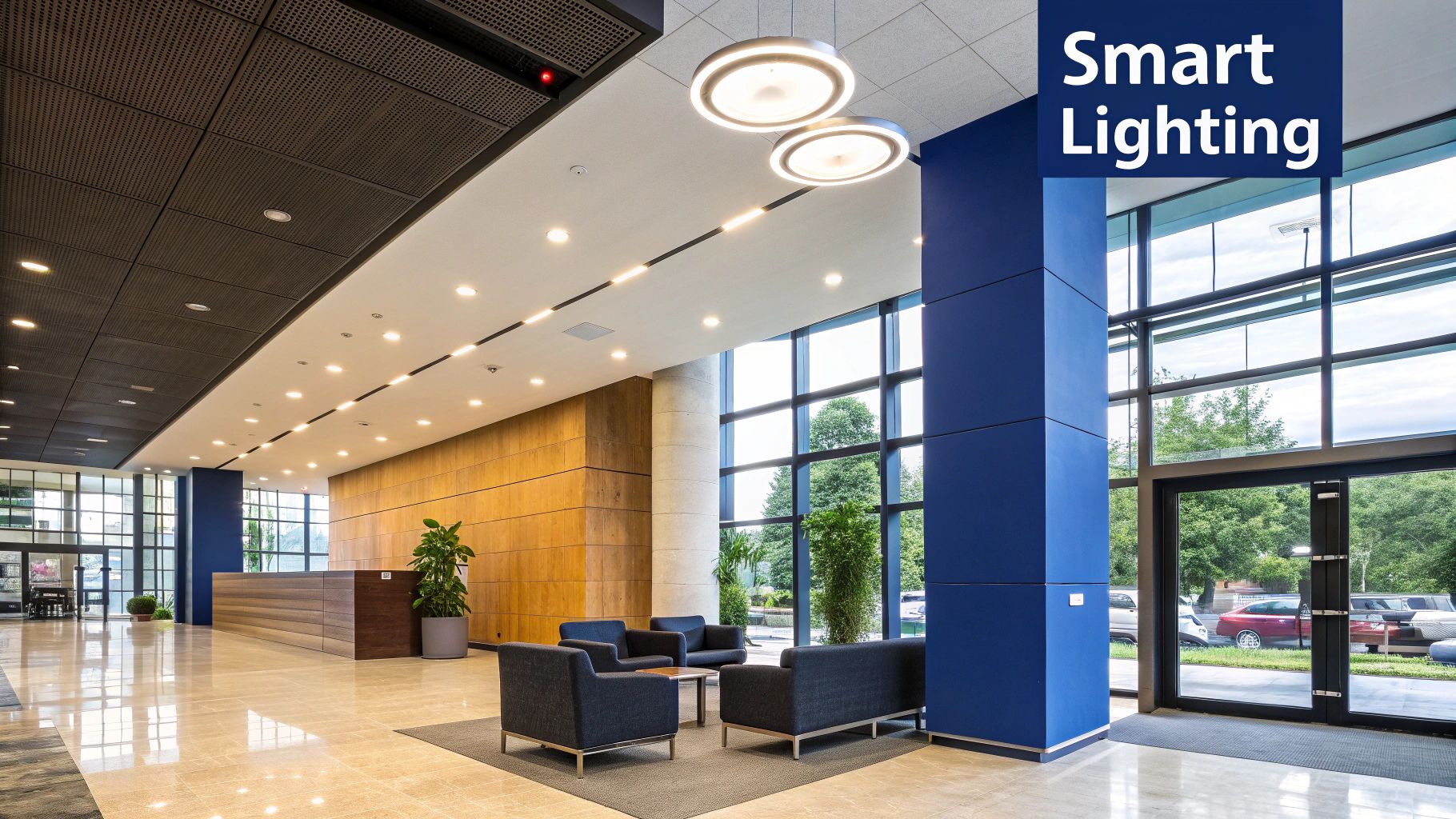
Automated lighting is so much more than a cool gadget for your living room. For businesses across Sydney, the Central Coast, and Newcastle, it's becoming a genuine competitive advantage. We're talking about creating commercial spaces that are smarter, far more efficient, and just plain more inviting for everyone.
Picture a busy Sydney office where the lights don't just switch on and off—they subtly adjust their brightness and even their colour temperature throughout the day. This is a brilliant technique known as human-centric lighting, and it works by mimicking the natural rhythm of daylight. It’s a simple tweak that can make a massive difference to your team’s focus, well-being, and overall productivity.
Beyond the Boardroom
The real magic happens when you see how versatile automated lighting control systems are in different business settings.
A retail shop in Newcastle, for example, could use dynamic lighting to spotlight a new product line, drawing customers' eyes exactly where they want them. A restaurant on the Central Coast could instantly switch its atmosphere with pre-programmed 'scenes'—shifting from a bright, energetic lunch service to a warm, intimate dinner setting with a single tap.
These systems deliver real-world benefits that you'll notice straight away, especially on your bottom line:
- Improved Safety and Security: In a large warehouse, motion sensors can light up specific aisles as workers move through them, ensuring clear visibility while saving a fortune in areas that are empty. When tied into your security setup, outdoor lights can instantly flood an area when motion is detected after hours—a powerful deterrent for would-be intruders. Our guide on commercial security camera systems dives deeper into how these technologies work hand-in-hand.
- Reduced Operational Costs: It's the same principle as at home, but on a much bigger scale. Occupancy sensors and clever scheduling ensure that lights are never accidentally left blazing in empty meeting rooms, bathrooms, or storage closets. These consistent energy savings really add up, leading to a significant drop in your quarterly power bills.
- Meeting Sustainability Goals: For any business serious about its environmental impact, automated lighting is a must-have. By slashing unnecessary electricity use, companies can shrink their carbon footprint and genuinely strengthen their green credentials.
For a business, smart lighting isn't just an expense; it's a strategic investment. It elevates the experience for both employees and customers, boosts safety, and delivers tangible financial returns through pure energy efficiency.
The commercial sector in Australia is really leaning into this technology. The market for commercial lighting—covering everything from office towers to shopping centres—is expected to jump from $19.6 billion AUD in 2025 to a whopping $34.6 billion AUD by 2031.
You can get more details on this trend in the full market report, but that incredible growth tells you everything you need to know. This isn't just a fleeting trend; it’s fast becoming the new standard for modern businesses that want to stay ahead of the curve.
Feeling a bit overwhelmed by all the options for automated lighting control systems? Don't stress. Picking the perfect setup is a lot like choosing a new car. You need to figure out what you’ll be using it for before you even think about visiting the dealership.
Are you after a reliable little hatchback just for zipping around town? Or do you need a powerful 4WD that can handle a massive family trip up the coast? Let’s use this idea to break down the main types of systems you'll come across, so you can have a confident chat with an installer or know exactly what to look for at the shops.
The Reliable Hatchback: Standalone Systems
Think of standalone systems as your trusty hatchback. These are your simple, plug-and-play solutions like smart globes or a single smart switch you can control from your phone. They're perfect for dipping your toes in the water or automating a single room, like your living room or outdoor entertaining area.
They’re super easy to install—often just a case of screwing in a new globe—and won't break the bank. However, like a small car, they have their limits. They usually work on their own and don't talk to each other, so you can't create complex, whole-home scenes. They’re great for a specific job but aren't built for a big adventure.
The Versatile SUV: Wireless Systems
Next up, we have wireless systems. This is your family SUV—more capable, more connected, and perfect for a growing setup. These systems use wireless signals like Wi-Fi, Zigbee, or Z-Wave to connect various switches, sensors, and a central hub.
This is where you start getting into true automation. You can create scenes, set schedules, and have different parts of your home work together. The installation is still relatively straightforward because you don't need to run new cables, making it a fantastic option for existing homes across Sydney and the Central Coast.
The real beauty of a wireless system is its flexibility. You can start with a few rooms and easily add more components later on, just like adding roof racks to your SUV when you decide to take up kayaking.
The main thing to keep in mind is that a strong and reliable network is absolutely essential. These systems live and die by their wireless connection. For a seamless experience, a professional home network installation can ensure you have solid coverage everywhere you need it, avoiding frustrating dropouts.
The Powerful 4WD: Hard-Wired Systems
Finally, we have hard-wired systems. This is the top-of-the-line 4WD, built for ultimate power, reliability, and big adventures. In these setups, all the components are physically connected by low-voltage wiring that runs back to a central control panel.
This is the most robust and reliable type of automated lighting control system available. Because everything is physically connected, you don't have to worry about wireless interference or signal dropouts. It's the gold standard for new builds or major renovations where you can run cables easily. While the upfront cost and installation are more involved, the payoff is a rock-solid, lightning-fast system that adds serious value to your property.
To help you visualise the differences, here’s a quick rundown of the pros and cons for each system type. Think of it as your cheat sheet before you head to the dealership.
Comparing Automated Lighting System Types
A quick look at the pros and cons of different system architectures to help you decide what's best for your home or business.
| System Type | Best For | Pros | Cons |
|---|---|---|---|
| Standalone | Single rooms, renters, or those just starting out with smart home tech. | Very affordable and easy to install yourself (DIY-friendly). | Limited to a single device or area; no whole-home coordination. |
| Wireless | Retrofitting into existing homes and those wanting flexibility to expand later. | Scalable and moderately priced. No need to run new wires. | Reliant on a strong wireless network; potential for signal issues. |
| Hard-Wired | New home builds, major renovations, or situations where reliability is paramount. | The most reliable and fastest system. Adds significant property value. | Highest upfront cost and requires professional installation. |
Ultimately, the right choice boils down to your budget, your property, and what you want to achieve. A hard-wired system is the dream for a new build, but a well-designed wireless setup can deliver an incredible experience in almost any home.
Got Questions About Automated Lighting? We've Got Answers
Still have a few questions rattling around in your head? You're not the only one. We've pulled together the most common queries we get from folks across Sydney, Newcastle, and the Central Coast who are thinking about making the switch to an automated lighting control system.
Think of this as your final checklist before diving in. We'll cover everything from costs and compatibility to what happens when the power inevitably goes out during a classic NSW storm.
How Much Does a System Cost?
This is the big one, and the honest answer is: it really depends. A simple setup with a few smart globes in one room could set you back less than $200. It’s a fantastic way to dip your toes in the water without a huge commitment.
On the other hand, a fully integrated, hard-wired system for a new build on the Central Coast could range from $5,000 to $20,000+, depending on the size of your home and the features you want. A professionally installed wireless system for an existing home often lands somewhere in the middle. The key is to see it as an investment that pays you back in energy savings and convenience over time.
Will It Work with My Existing Lights?
In most cases, absolutely! One of the best things about modern automated lighting is how flexible it is. You don't necessarily have to replace every single light fitting in your house.
Many systems work by simply replacing your existing wall switches with smart switches or dimmers. This means your current downlights, pendants, and even your favourite vintage lamp can all become part of your new smart setup. For specific lamps or tricky areas, smart globes are also a simple and really effective solution.
What Happens If the Power Goes Out?
Ah, the classic Aussie blackout concern. Don't worry, you won't be left permanently in the dark. When the power goes out, your automated lighting system will simply stop working—just like your regular lights would.
The good news is that once the power is restored, most quality systems reboot themselves and return to their last known state or a pre-programmed default setting. Better yet, your light switches will always function as normal manual switches, so you have a reliable backup. You won’t be fumbling for a phone app during a power cut, I promise.
The core function of a light switch remains. Automation adds a layer of intelligence on top, but the fundamental, reliable 'on/off' function is always there as a fail-safe.
Is an Automated Lighting System Really Worth It?
This is a personal question, but the numbers paint a pretty compelling picture. Beyond the cool factor of telling your lights what to do, these systems offer tangible benefits in efficiency, convenience, and energy reduction.
This infographic gives a quick visual comparison of how an automated system stacks up against old-school manual control.
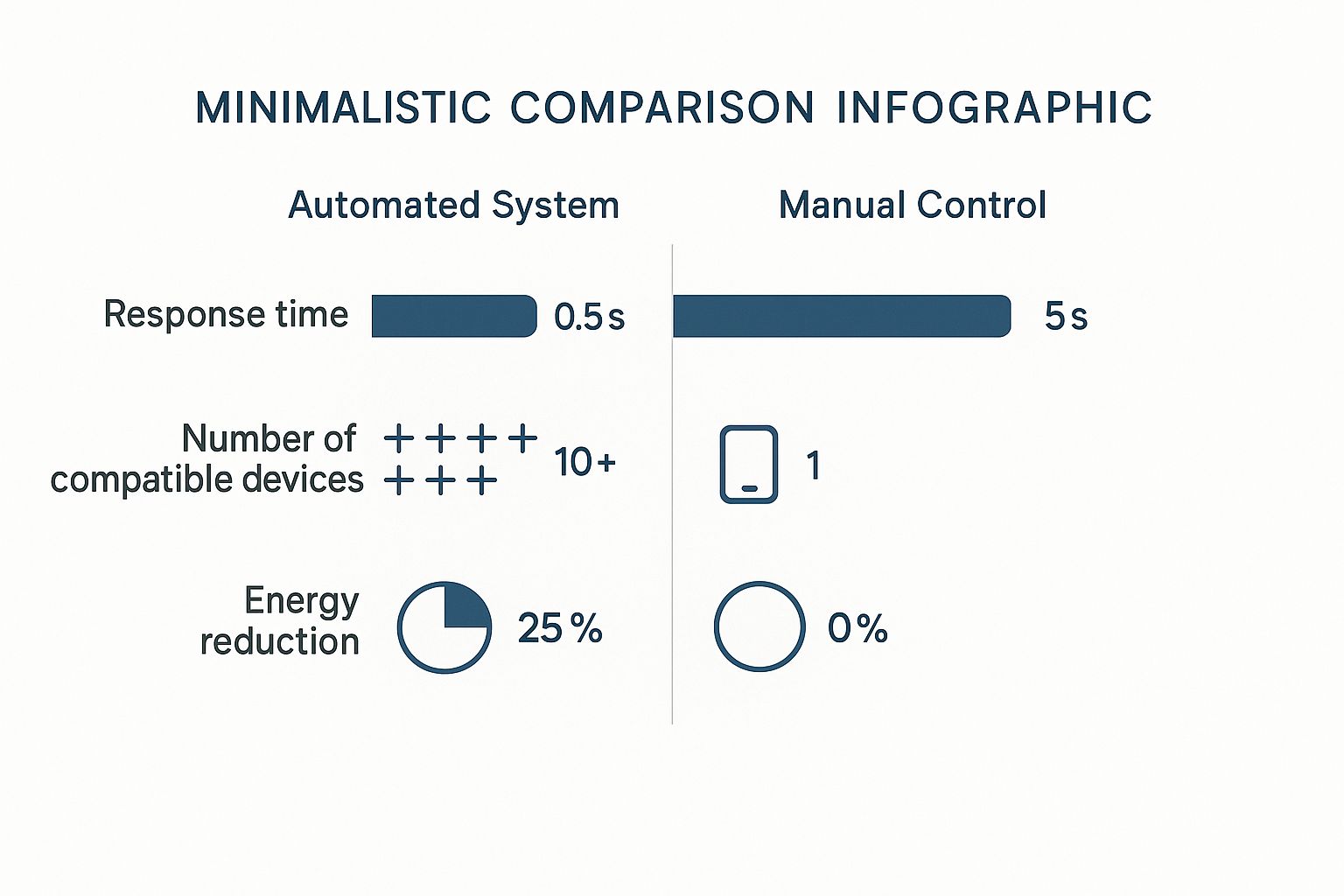
As you can see, the benefits are clear, from near-instant response times to significant energy savings that directly impact your power bill. An automated system isn’t just a single upgrade; it’s a whole network of smart devices working together to make your home run better.
Ready to bring intelligent, responsive lighting to your home or business? The team at Advanced Comtech has been designing and installing custom automated lighting control systems for decades. We handle everything from the initial design to the final installation, ensuring your system is reliable, easy to use, and perfectly suited to your space. Get in touch with our Central Coast experts today to start the conversation.