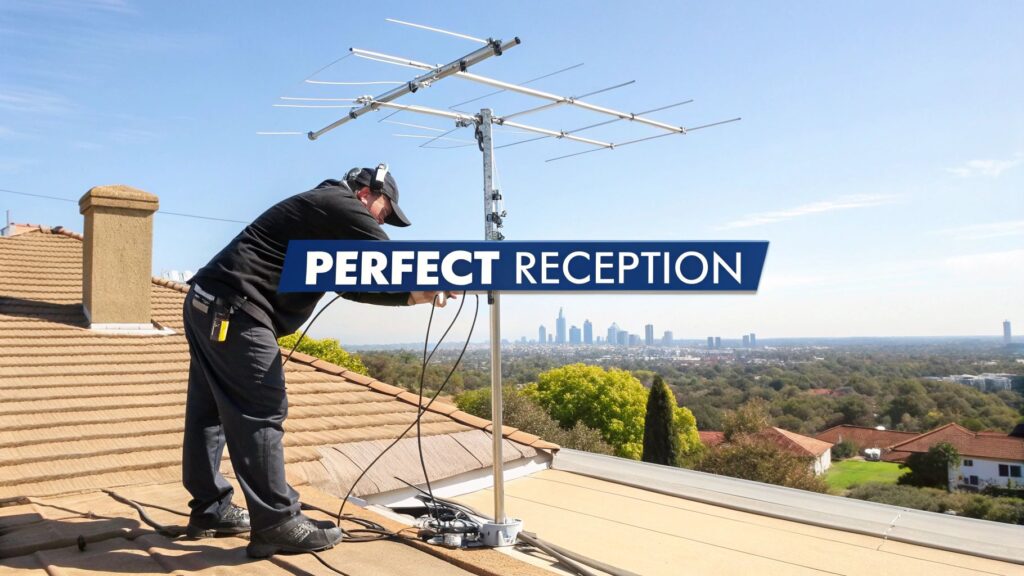
Television antenna services are basically your one-stop shop for getting brilliant, subscription-free TV. They handle everything from whacking a new antenna on your roof to fixing the annoying glitches that mess up your signal, so you can get a crystal-clear picture on all the free-to-air channels you love.
A pro can sort out all those classic reception headaches like pixelation or the signal dropping out right when the Bunnings sausage sizzle ad comes on. This is especially true for popular channels like Seven, Nine, and the ABC, making sure your telly time is actually relaxing.
Why a Good Antenna Still Beats Streaming
Remember fiddling with those old rabbit ears on top of the TV, trying to get a decent picture of Hey Hey It's Saturday? One person would hold the antenna in a strange pose while another yelled, "Stop, don't move!" from the couch. While our tellies have gotten flatter and smarter, the battle for a perfect signal is still very real, especially for households across the Central Coast, Sydney, and Newcastle.
The modern fix isn't another pricey streaming subscription; it's a professional antenna installation. This is the simple, one-off solution to finally end the frustration of a pixelated footy final or a glitchy evening news broadcast.
The Staying Power of Free-to-Air TV
You'd be forgiven for thinking that with all the streaming options out there, traditional TV is on its last legs. But the numbers tell a completely different story. Free-to-air television is still a huge part of daily life in Aussie homes. Despite all the noise around streaming giants, a massive number of us still rely on our antennas every day.
Recent data shows just how much we still love our broadcast channels. A 2025 Oztam report found that a whopping 61.5% of viewing minutes on connected TVs came from traditional broadcast channels. In stark contrast, services like ABC iView and 9Now only pulled in 8.4% of viewing. It just goes to show how important quality television antenna services still are. You can dive deeper into these viewing habits and see the full report on Australia's TV landscape.
The simple truth is that free, high-quality TV is hard to beat. A professionally installed antenna gives you access to dozens of channels in brilliant HD without ever needing to worry about monthly fees, buffering, or your NBN connection having a moment.
Your Secret Weapon for Perfect Reception
Think of a professional antenna service as your secret weapon against bad reception. It’s so much more than just sticking an aerial on the roof. It’s about an experienced technician finding the absolute perfect spot, choosing the right gear that can handle our coastal conditions, and making sure every single connection is rock solid.
That’s how you guarantee a flawless picture, letting you finally sit back and enjoy your favourite shows without any of the old-school reception drama.
Choosing the Right Antenna for Your NSW Home
Picking the right TV antenna isn't a one-size-fits-all job, especially when you’re dealing with the reception quirks across the Central Coast, Sydney, and Newcastle. Think of it like choosing tyres for your car. The slick racing tyres that are perfect for a smooth track would be a disaster on a muddy country road. It's the same deal with antennas.
That small indoor antenna that worked a treat in a Sydney CBD apartment will likely be useless if you're in a hilly part of the Central Coast. Why? Because everything from the distance to the broadcast tower, the local terrain, and even big buildings nearby can play havoc with your signal. It's a bit of a science, but definitely not rocket science.
What's With All the Antenna Jargon?
Once you start looking, you'll run into terms like 'Yagi', 'Log Periodic', 'UHF', and 'VHF'. It might sound a bit technical, but the ideas behind them are pretty straightforward.
- UHF (Ultra High Frequency) Antennas: These are the most common antennas you’ll see on Aussie roofs today. Think of a UHF antenna as a sniper rifle—it’s built to zero in on specific, distant signals with incredible accuracy. They’re perfect for locking onto digital TV channels from faraway broadcast towers.
- VHF (Very High Frequency) Antennas: While a lot of channels have moved off these frequencies, VHF antennas are still vital in some areas. These are more like a shotgun—great at capturing signals over a wider area, which can be a huge help depending on your location.
Getting the setup right is just as important as the antenna itself, which is why a professional installation makes all the difference.
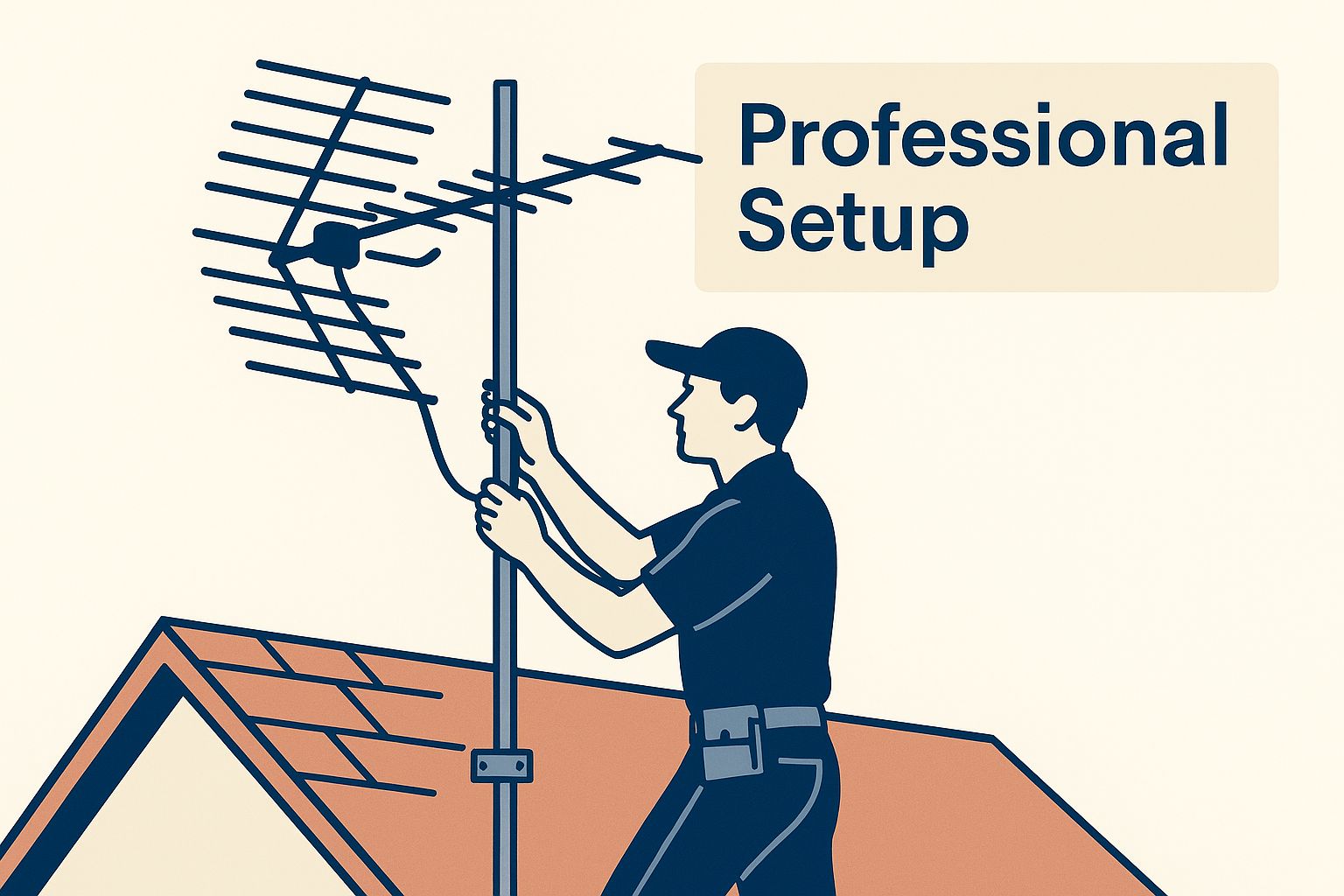
As you can see, expert alignment is non-negotiable. Even the fanciest antenna won't give you a clear picture if it isn't pointed in exactly the right direction.
Yagi vs. Log Periodic: What’s the Difference?
You’ll also hear about ‘Yagi’ or ‘Log Periodic’ designs. A Yagi antenna is that classic, fishbone-looking aerial you probably picture in your head. It’s highly directional, making it fantastic at grabbing a signal from a single transmitter while ignoring interference from other directions.
A Log Periodic antenna looks a bit more complex, often with its elements arranged in a V-shape. This one is more of a jack-of-all-trades, able to pick up a much wider range of frequencies. This makes it a great choice for homes located between two broadcast regions, like some parts of the Central Coast that could potentially receive signals from both Sydney and Newcastle.
The right antenna for your home depends entirely on your specific location. A technician offering professional television antenna services will use a signal meter to measure the strength and quality of available signals before recommending the perfect antenna for the job.
Choosing the Right Antenna for Your Location
To make it a little clearer, here’s a quick guide to which antenna types generally work best across our local regions.
| Antenna Type | Best For | Pros | Cons |
|---|---|---|---|
| Yagi (UHF) | Most metro and regional areas with clear line-of-sight to a single transmitter (e.g., Sydney, Newcastle). | High gain, excellent at rejecting interference. | Highly directional, not ideal for picking up signals from multiple directions. |
| Log Periodic | Areas between major transmitters (e.g., parts of the Central Coast) or where signals come from different directions. | Wide bandwidth, versatile for complex signal environments. | Lower gain than a Yagi for a specific channel. |
| Indoor Antenna | Apartments in the city centre with very strong signals and minimal obstructions. | Easy to install, cheap as chips. | Prone to interference, only works in high-signal areas. |
| High-Gain Antenna | Rural or fringe reception areas far from the transmitter. | Pulls in weak signals from a long distance. | Can be large and more susceptible to wind. |
Ultimately, this table is just a starting point. A proper signal test at your property is the only way to know for sure what you need.
Coastal Living and Your Antenna
If you live anywhere near the coast, from Bondi to Bar Beach, you’ve got another enemy to deal with: the salty air. That beautiful sea breeze is incredibly corrosive and can absolutely destroy a cheap, poorly made antenna in just a couple of years. The metal rusts, connections fail, and your picture quality will nose-dive.
For coastal homes, it’s crucial to choose an antenna built from high-quality, corrosion-resistant materials. Any good installer will use galvanised steel mounts and weatherproofed connections to make sure your setup can stand up to the harsh seaside environment. This is a vital part of a quality TV antenna installation, ensuring your investment lasts. It's about more than just getting a clear picture today; it's about having a reliable signal for the next 10 years.
What Happens During a Professional Antenna Installation?
So, you're thinking about a DIY antenna job to save a few quid. It's a tempting thought, but let's be honest—it often ends in a weekend-long headache, a dodgy signal, and a very real risk of taking a nasty tumble off the roof.
Let’s look at a classic example. We’ll call him 'Dave,' a homeowner in Gosford who was absolutely fed up with his glitchy TV. His experience is a perfect showcase of why calling in a professional is the smarter, safer, and ultimately more reliable choice.
Dave’s problem was a familiar one. His team was in the NRL finals, but his TV picture kept freezing at the most critical moments. After nearly launching the remote through the screen, he decided enough was enough and called in a pro. He quickly discovered that a proper installation is so much more than just whacking an antenna on a pole and hoping for the best.
It’s a methodical process, grounded in safety and geared towards one thing: getting you the best possible signal. It's a real blend of science, on-the-job experience, and having the right tools.
The Initial Site Assessment
The first thing the technician did wasn't to throw a ladder against the house. Instead, they pulled out a digital signal meter. This nifty gadget is an installer's secret weapon. Think of it like a doctor’s stethoscope for TV signals; it allows the tech to find the absolute sweet spot on Dave’s roof where the broadcast signal is strongest and clearest.
They took readings from various points around the property, identifying potential signal killers. For Dave, it turned out to be a double-whammy: a massive gum tree in the neighbour’s yard and a new apartment block that had recently shot up a few streets away. These obstacles were scattering the signal long before it reached his old, poorly placed antenna.
This diagnostic step is precisely what separates a professional job from a hopeful guess. A pro doesn't assume where the best signal is—they use precise instruments to find it, guaranteeing peak performance right from the start.
The Professional Installation Process
Once the perfect location was pinpointed, the real work began. And for Dave, this was the part that made him incredibly glad he didn't try to tackle it himself.
- Secure Mast Mounting: The technician didn't just screw the mast to the old timber fascia board. They used a heavy-duty, galvanised steel mount and bolted it directly into the roof rafters, ensuring it could handle the wild storms that roll into the Central Coast.
- High-Quality Cabling: They ripped out Dave's old, cracked coaxial cable and replaced it with brand-new, quad-shielded RG6 cable. This stuff is essential for protecting the signal from interference caused by mobile phone towers, electrical wiring, and other modern-day signal disruptors.
- Weatherproof Connections: Every single connection was sealed with weatherproof fittings. This is absolutely critical in our coastal climate, where moisture and salty air are the number one culprits for signal degradation over time.
- Cable Routing and Wall Plates: The new cable was run neatly through the wall cavity, not just tacked along the outside of the house. To finish it off, the technician installed a fresh, clean wall plate, giving the whole setup a polished, professional look.
After everything was connected, the job still wasn't finished. The final, crucial step was to fine-tune the entire system.
Final Tuning and Signal Testing
With the new antenna firmly in place, the technician went back inside and connected their signal meter directly to the new wall plate. Then, it was back up on the roof for some micro-adjustments. They carefully rotated the antenna, millimetre by millimetre, until the meter showed the strongest possible signal quality and strength.
This final calibration is what ensures every channel, from the ABC to SBS, comes through crystal clear without a hint of pixelation.
When the technician finally handed Dave the remote, the picture was flawless. The footy had never looked so good—glorious, uninterrupted HD. Dave’s story is a perfect example of the precision, safety, and expertise you get when you hire a pro. It’s not just about the antenna; it's about the entire system working in perfect harmony, from the rooftop right through to your TV screen.
To see how this level of detail applies elsewhere in your home entertainment setup, check out our advice on expert TV installation and mounting for a truly seamless finish.
Common Antenna Repairs and Services You Might Need
A top-notch antenna service is about much more than just sticking a new aerial on your roof. Picture this: it's the final, nail-biting minutes of the State of Origin decider, the Blues are on the attack, and suddenly your screen dissolves into a mess of pixels. Utter chaos. This is the moment you realise that ongoing television antenna services are just as crucial as the initial install.
Things go wrong. Antennas aren’t indestructible, especially with the wild weather we get along the coast from Sydney to Newcastle. From a simple realignment after a southerly buster to more complex fixes, a good technician has seen it all and has the tools to sort it out fast.
When Good Signals Go Bad
So, what are the usual suspects when your perfect picture suddenly disappears? It’s rarely just one thing, but there are a few common culprits that antenna pros deal with day in and day out.
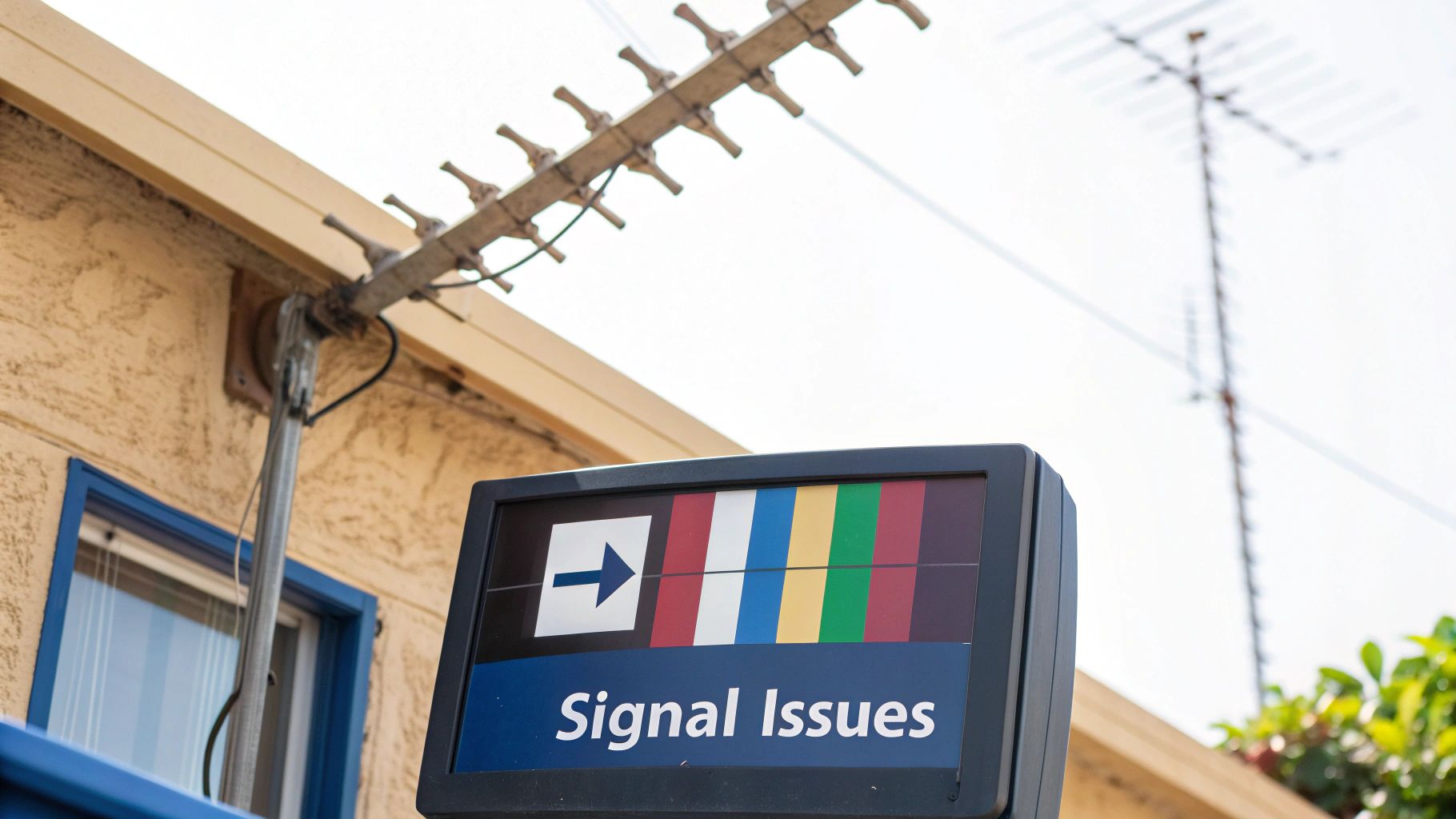
- Storm Damage and Misalignment: A heavy storm with high winds is the number one enemy of a perfectly tuned antenna. It doesn't take much to knock an aerial slightly off-kilter, and even a few millimetres of movement can be the difference between a crystal-clear picture and a screen full of static.
- Coastal Corrosion: That lovely salty sea breeze we enjoy on the Central Coast is brutal on metal. Over time, it causes connections to corrode and parts to rust, which slowly but surely degrades your signal quality.
- Water Damage and Cable Failure: Old coaxial cables can crack and perish, letting moisture creep in. Once water gets into the system, it's pretty much game over for your reception until the damaged cable and connections are replaced.
- Pesky Birds: You'd be surprised how much damage a flock of cockatoos can do. They seem to love chewing on cables and using antennas as their personal jungle gym, which can lead to breakages and misalignments.
More Than Just Repairs
Beyond just fixing what’s broken, a comprehensive antenna service can offer upgrades to make your viewing experience even better. It’s all about tailoring your setup to how your family actually lives.
For instance, maybe you’re tired of the kids hogging the main TV. An expert can easily install additional TV points in other rooms, like the kids’ bedrooms or the outdoor entertaining area. This is a straightforward job that involves running new, high-quality cabling to a new wall outlet, ensuring everyone gets a perfect picture wherever they are. You can learn more about the importance of professional wiring in our guide to data cabling installation, as many of the same principles of quality and care apply.
A professional service isn't just about fixing a problem; it's about providing solutions. From adding an extra TV outlet for the granny flat to installing a signal booster, it's all designed to make your free-to-air TV experience seamless.
Boosting Your Signal Strength
What if you live in a reception black spot? Some areas, particularly those tucked away in valleys or far from broadcast towers, naturally struggle to get a strong signal. This is where a masthead amplifier, often called a signal booster, comes into play.
This clever little device is installed right on the antenna mast. It grabs the weak signal from the antenna and gives it a power-up before sending it down the cable to your TV. It's an incredibly effective way to overcome reception challenges and turn a fuzzy, unwatchable picture into a stable, clear one. A good technician will use their signal meter to work out if a booster is necessary and install the right one for your specific needs. These kinds of services are a huge part of what keeps free-to-air TV reliable for countless Aussie homes.
What Will a TV Antenna Service Cost Me?
Alright, let's get down to brass tacks and talk about the cost. No one likes surprise bills, and when you’re just trying to get a clear picture for the nightly news, you want a straightforward price. Here's a realistic look at what you can expect to pay for professional antenna services across Sydney, the Central Coast, and Newcastle.
For a completely new, standard antenna installation, you're generally looking at a price tag somewhere between $300 and $600 AUD. This isn't just for the antenna itself; it typically covers the mast it sits on, all the necessary cabling, and the technician's time and expertise to get it perfectly positioned for the best signal. Think of it as a one-time investment for years of free-to-air telly.
What Makes the Price Fluctuate?
Of course, that price range isn't a one-size-fits-all number. Just like ordering a coffee, the base price is for a standard flat white—start adding extra shots or special milk, and the cost changes. A few key things can nudge the final quote up or down, and it's good to know what they are.
Here are the main factors a technician will look at when sizing up the job:
- Roof Height and Access: A single-storey home with a simple, walkable roof is a much easier (and cheaper) job than a towering three-storey house with a steep, slippery roof. The more complex or risky the access, the more it will cost.
- Antenna Type: We've already touched on this, but the right antenna for the job matters. If you're in a fringe reception area, you'll need a more powerful (and more expensive) high-gain antenna compared to someone living right near a broadcast tower.
- Cabling Needs: How much new cable do you need? Running a short line from the roof to the living room is one thing, but wiring up multiple rooms across a large house requires more materials and labour.
- Extra Gear: Sometimes, the signal just needs a bit of a push. If you need a signal booster (also called an amplifier) to get a reliable picture, that's an extra component that adds to the total cost.
Budgeting for Other Common Antenna Jobs
It's not always about a full replacement. You might just need a new TV point added to the kids' playroom or the outdoor entertaining area. A job like that will usually set you back around $150 to $250 AUD, mostly depending on how tricky it is to run the new cable through your walls and ceiling. While you're thinking about your setup, you might also find our guide on the cost to mount a TV on the wall useful for creating the perfect viewing space.
The real value isn't just in the parts, but in the peace of mind. Paying a professional means the job is done right the first time with quality gear that can handle our wild coastal weather. It saves you the headache and cost of repeat visits down the track.
Even with streaming services everywhere, free-to-air TV is still a massive part of Australian life, particularly in regional areas where internet signals can be unreliable. Interestingly, the industry itself is changing. New data suggests a 7% annual decrease in ad revenue for free-to-air broadcasters is expected between 2024 and 2028 as advertisers shift their budgets online. This really underlines how important that reliable antenna infrastructure is for delivering these essential services to millions of homes. You can read more about these media trends from the ACMA if you're curious.
How to Choose the Right Antenna Technician
Finding a reliable tradie can feel like a lottery, can't it? You get a few names, make some calls, and just hope for the best. But when it comes to getting your TV reception sorted, you really don't want to leave it to chance. Picking the right technician for your television antenna services is the difference between a job done right the first time and a job you'll be paying to fix again in a year.
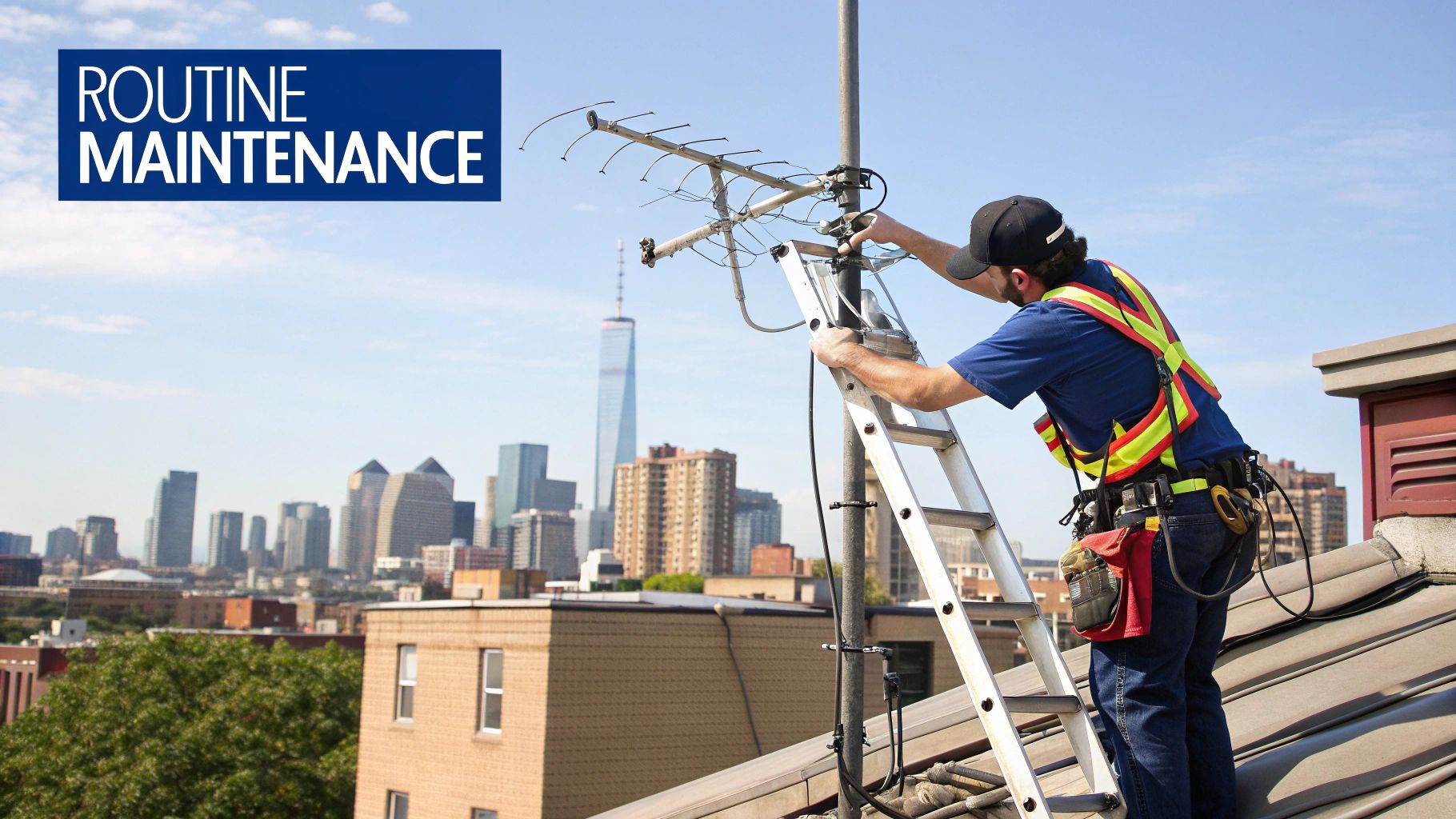
So, how do you sort the seasoned pros from the cowboys? It's easier than you might think. Here’s a practical checklist for finding a top-notch technician, whether you're in a Sydney suburb, up on the Central Coast, or kicking back in Newcastle.
Check for the Essentials First
Before you even start talking about price, there are a couple of non-negotiables you need to tick off. These are the absolute basics that any legitimate, professional business will have sorted.
-
Licensing and Insurance: In Australia, any tradie doing cabling work has to have the right qualifications and licenses. Don't be shy—ask if they're a registered cabler and if they hold public liability insurance. This protects both you and them if something unexpected happens on your property.
-
Local and Genuine Reviews: Don't just glance at the star rating. Actually dive into their Google reviews and see what locals in your area are saying. You’re looking for comments that mention things like punctuality, professionalism, and whether they cleaned up after themselves.
The Quote Says It All
Never, ever agree to a job without getting a clear, itemised quote first. A vague "it'll be a few hundred bucks" just isn't good enough. A proper, professional quote should break everything down so you don’t get any nasty surprises when the bill arrives.
A detailed quote is a sign of a transparent and honest business. It should clearly list the cost of the antenna, the mast, cabling, labour, and any other bits and pieces like splitters or amplifiers. If they can’t provide this, it’s a massive red flag.
This level of clarity is crucial. It proves they’ve actually assessed the job properly and aren't just plucking a number out of thin air.
Quality Parts and a Solid Warranty
You might save a few dollars upfront with a technician who uses cheap, generic parts, but it’ll almost certainly cost you more in the long run. The salty air along the NSW coast is brutal on cheap metal, and a poorly made antenna will start to rust and fail in just a couple of years.
Ask the technician what brands of antennas and cables they use. A good installer will happily stand by their work and the quality of their materials by offering a solid warranty on both parts and labour. That’s your peace of mind, knowing they’ve built a system that's designed to last.
It’s also worth making sure their work can integrate with your broader home tech. For example, if you're keen on better connectivity for streaming, you might want to learn more about a professional home network installation to ensure your whole setup works together perfectly.
By following this simple checklist, you can hire with confidence, knowing your new antenna will be installed safely and professionally—giving you years of crystal-clear, subscription-free TV.
Got Questions About Your TV Antenna? We've Got Answers
It's perfectly normal to have a few questions swirling around before you decide to get a new antenna installed. Getting someone up on your roof is a big step! So, let's tackle some of the most common queries we hear from our customers across Sydney, the Central Coast, and Newcastle.
Why Has My TV Reception Suddenly Tanked?
This is the big one. One minute you’re settled in for the footy, the next it’s a garbled, pixelated disaster. So what gives?
More often than not, it’s a few usual suspects. A wild storm, like one of those southerly busters that smashes the coast, can easily bump your antenna out of alignment. Even a slight shift can wreak havoc on your signal.
Another common culprit is new construction. That high-rise they just put up down the street might be sitting right in the path of your signal from the broadcast tower. Sometimes, it’s as simple as a cable that’s come loose or gotten waterlogged from all the rain. A pro technician can diagnose this stuff in minutes with a proper signal meter, playing detective to find the root cause and get it fixed.
Do I Really Need a Special Antenna for My 4K TV?
Great question, and the answer is a simple one: nah. Australian free-to-air channels broadcast in crystal-clear High Definition (HD), but not 4K. This means you don’t need to go searching for a fancy "4K antenna"—that’s really just marketing fluff.
What truly matters for getting the best possible picture is having a high-quality, modern digital antenna. It needs to be properly installed and aimed to lock onto the strongest, most stable signal for the frequencies used today. If you've got a rusty old analogue relic on your roof, upgrading to a new digital one will deliver a night-and-day improvement to your picture quality.
Forget the "4K antenna" hype. The secret to a perfect picture is a professionally installed, high-gain digital antenna that feeds your TV the cleanest, strongest HD signal possible.
How Long Can I Expect a New TV Antenna to Last?
A good quality antenna is a real investment in your home entertainment. When it's installed correctly by an experienced technician using top-notch gear, you can expect it to last a solid 10 to 15 years, and sometimes even longer. They’re built tough to handle the harsh Aussie sun and coastal storms.
But, there's a catch. If you live right on the coast—think Terrigal or Bar Beach—the salty sea air is brutal. It speeds up corrosion on metal parts and connections far quicker than it would just a few kilometres inland. This is exactly why a professional installation is worth its weight in gold. Good installers use quality, corrosion-resistant materials and weatherproof fittings designed to stand up to our unique coastal environment, ensuring you get years of flawless reception.
Ready to say goodbye to bad reception for good? The team at Advanced Comtech has been delivering expert television antenna services across the Central Coast, Sydney, and Newcastle for years. Get in touch today for a free quote and enjoy crystal-clear TV!